- Plants
- ›Vascular Plants
- ›flowering plants
- ›Dicots
- ›Legumes, Milkworts, and Allies
- ›Legumes
- ›Acacias, Mimosas, Mesquites, and Allies
- ›Mimoseae
- ›Prosopis
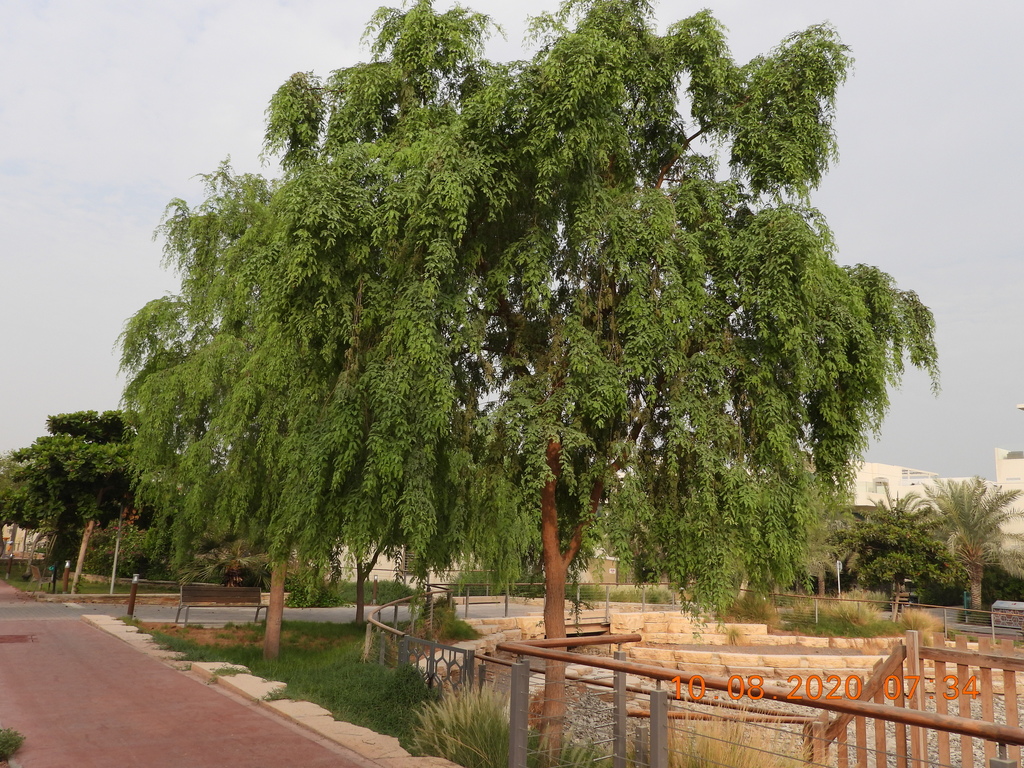
Indian mesquite
Prosopis cineraria
Prosopis cineraria, also known as Persian mesquite or ghaf, chaunkro (Braj Bhakha : चौंक्रो) , jand (Hindustani/Kauravi, Punjabi: जंड/ਜੰਡ) or khejri (Rajasthani: खेजड़ी), is a species of flowering tree in the pea family, Fabaceae. It is native to arid portions of Western Asia and the Indian subcontinent, including Afghanistan, Bahrain, Iran, India, Oman, Pakistan, Saudi Arabia, the United Arab Emirates, and Yemen. Its leaves are bipinnate. It can survive extreme drought. It is an established introduced species in parts of Southeast Asia, including Indonesia.
The ghaf is the national tree of the United Arab Emirates. Through the Give a Ghaf campaign its citizens are urged to plant it in their gardens to combat desertification and preserve their country's heritage. The desert village of Nazwa in the UAE is home to the Al Ghaf Conservation Reserve.
From the article Prosopis cineraria on Wikipedia (CC BY-SA), quoted section by section
Description
P. cineraria is a small tree, ranging in height from 3–5 m (9.8–16.4 ft). The leaves are bipinnate, with seven to fourteen leaflets on each of one to three pinnae. Branches are thorned along the internodes. Flowers are small and creamy-yellow and followed by seeds in pods. The tree is found in extremely arid conditions, with rainfall as low as 15 cm (5.9 in) annually; but is indicative of the presence of a deep water table. As with some other Prosopis spp., P. cineraria has demonstrated a tolerance of highly alkaline and saline environments. The tree should not be confused with the similar-looking Chinese lantern tree, Dichrostachys cinerea. They can be told apart by the flowers. While the Chinese lantern tree has bicolored pink-yellow flowers, the true Shami tree has yellow-colored bristled flowers only, like most other mesquites.
At the table
In Thar Desert the singhri or sangri pods growing on Prosopis cineraria are used in various types of bhaaji and kadhi. Singhri is one of the traditional cuisines of the Thar Desert.
Wikipedia: “Culinary uses”
In medicine
Extract from unripe fruit pods of the plant was shown to ameliorate artificially-induced damage to testes in an animal model. Leaves of this tree can ameliorate mouth ulcers. Chewing its leaves for a few minutes, so releasing the juice of the leaves in the mouth can relieve the ulcers. The swelling comes down significantly. The juice is then spat out, rather than swallowed.
Wikipedia: “Medical use”
Where it lives
Recorded sightings
—
geo-referenced records in GBIF, from museums, herbaria and field observers.
Drag the globe to turn it. Dots are where records exist, not a range map; darker means more records.
In the stacks
Searching the stacks…
Every page naming Prosopis cineraria in the Biodiversity Heritage Library →
This page is assembled live from iNaturalist, GBIF, Wikipedia, the Source Library and the Internet Archive. It is not yet part of the hand-edited codex. iNaturalist taxon 131133.