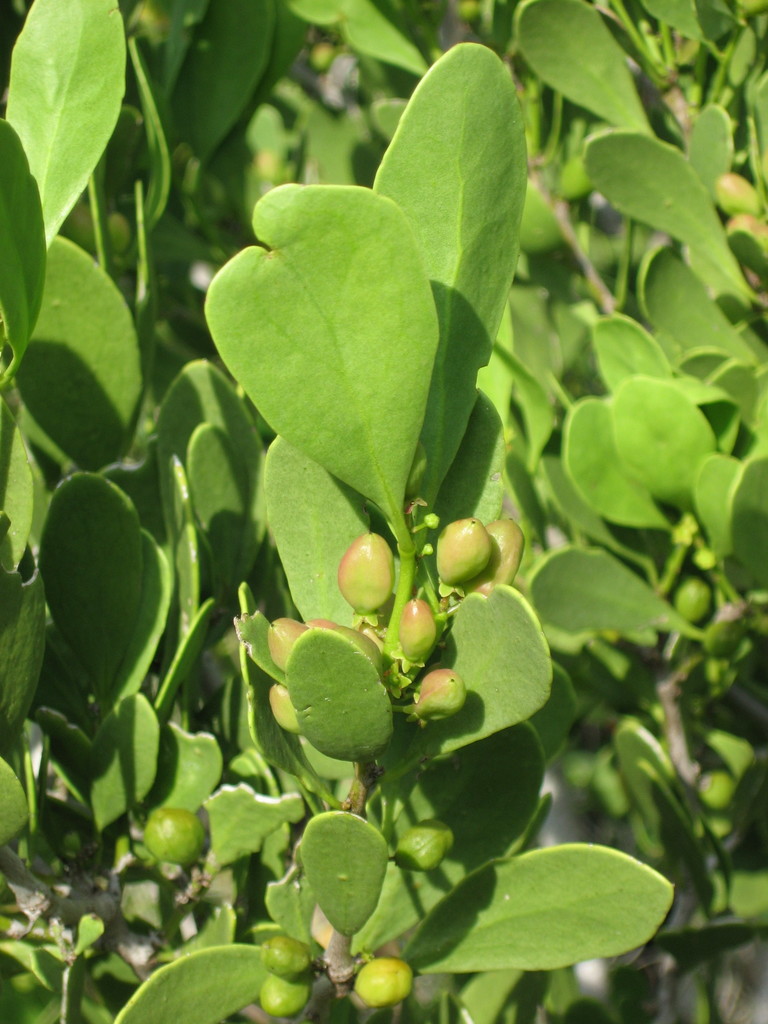
Florida Mayten
Maytenus phyllanthoides
Maytenus phyllanthoides, known variously as the Florida mayten, leather leaf, gutta-percha, maidenbush and mangle dulce, is a tree or shrub belonging to the family Celastraceae.
From the article Maytenus phyllanthoides on Wikipedia (CC BY-SA), quoted section by section
Description
Maytenus phyllanthoides grows up to 7m tall (23 feet), and its stems are covered with fine, soft hairs. Depending on the variety, it can stand erect, spread, lean on other plants, or lie on the ground. Its leaves are on petioles up to 6mm long (~1⁄4 inch), and more or less elliptic in shape but tending to be wider toward the leaf's tip, which is blunt to rounded, and sometimes bearing a tiny tooth or mucro. Typically, the blade base gradually diminishes to the petole, though blades of the variety along the Gulf Coast tend to be rounded. Blade margins can bear a few tiny teeth, though they are usually toothless and sometimes wavy. Flowers of Maytenus phyllanthoides arise along the stem either solitarily or a few in a cluster. Flowers display radial symmetry and bear 5 rounded petals up to 3mm long. They have a conspicuous, somewhat flat ring, the nectar-secreting "intrastaminal nectariferous disk", in the flower's center, surrounding the pistil; such disks occur in several plant families. Flowers may contain both male and female parts, being monoecious, or else bear sexual parts of only one sex, being dioecious. In male flowers, with 5 functional stamens, the stamens' filaments are inserted beneath the nectar-producing disk. …
Range & habitat
The iNaturalist map indicating observations of Maytenus phyllanthoides locates the species in Florida and southern Texas of the USA, much of Mexico, and Cuba. Other reports also place it in the Bahamas.
Wikipedia: “Distribution”
At the table
Medicinally, among the Mayo people of northwestern Mexico, the leaves of Maytenus phyllanthoides are mixed with petroleum jelly and applied to lingering sores. Also it's reported that some chew the leaves to alleviate stomach problems, as well as toothache and scurvy. Gum from the plant has been used to bind splints for broken limbs, and other uses. A 2014 study found that the species contains lyoniresinol, a compound recognized as an antitrichomonal agent that acts on Trichomonas parasites. In the countryside, branches of the plant break off easily and burn well as firewood. Goats also eat the leaves. Gardeners and landscapers may plant it because it's a mounding, evergreen shrub of a convenient size and deep green color. It produces relatively little litter, and makes good shelter for birds and butterflies. It's highly salt tolerant and thrives on little water. However, some gardeners don't like its slow growth rate.
Wikipedia: “Human uses”
In human culture
The genus name Maytenus is based on a vernacular name used in Chile, mayten, used for the type specimen upon which the genus was named. In the species name phyllanthoides, the suffix -oides is from the Ancient Greek oeidēs meaning "similar to". In this case, it means that Maytenus phyllanthoides is similar to the genus Phyllanthus.
Wikipedia: “Etymology”
Where it lives
Recorded sightings
—
geo-referenced records in GBIF, from museums, herbaria and field observers.
Drag the globe to turn it. Dots are where records exist, not a range map; darker means more records.
In the stacks
Searching the stacks…
Every page naming Maytenus phyllanthoides in the Biodiversity Heritage Library →
This page is assembled live from iNaturalist, GBIF, Wikipedia, the Source Library and the Internet Archive. It is not yet part of the hand-edited codex. iNaturalist taxon 131548.