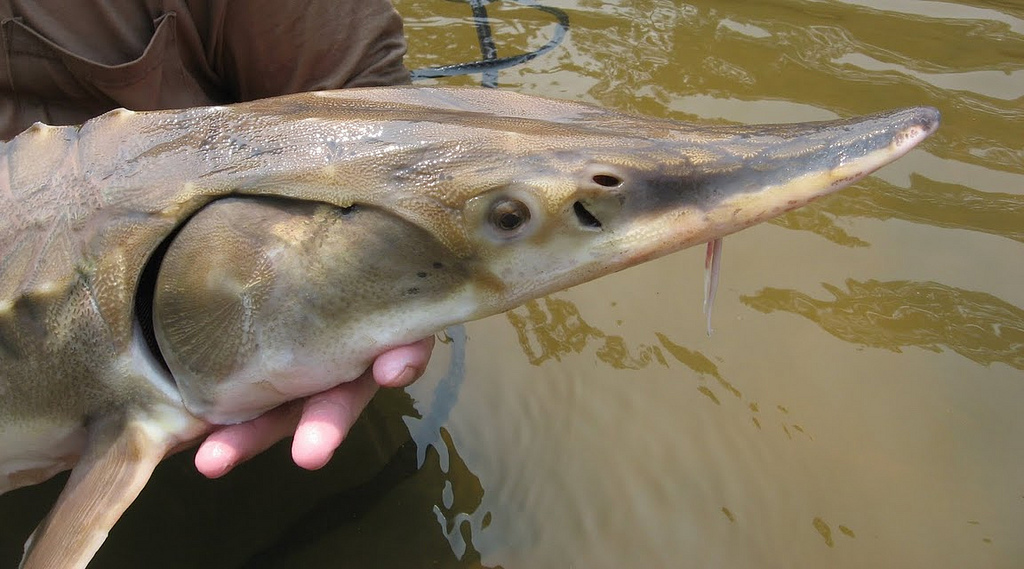
Gulf Sturgeon
Acipenser desotoi
The Gulf sturgeon (Acipenser desotoi) is a species of sturgeon endemic to the southeastern United States. An anadromous fish, it inhabits the Gulf of Mexico and spawns in a number of rivers that drain into it, from southern Florida west to eastern Louisiana. It has one of the southernmost distributions of all sturgeon, which otherwise tend to inhabit cooler habitats in more northern latitudes.
The Gulf sturgeon is listed as threatened under the United States Endangered Species Act, having been listed in 1991. Critical habitat, reflecting the range of the subspecies deemed essential for its continued survival, has been designated (see map). The historical range is thought to have been from the Suwannee River on the western coast of Florida to the Mississippi River, and marine waters of the central and eastern portions of the Gulf of Mexico. Three sturgeon species in genus Scaphirhynchus share river territory with the Gulf sturgeon; none of the other sturgeon species is anadromous.
From the article Gulf sturgeon on Wikipedia (CC BY-SA), quoted section by section
What it does
The primary foods of sturgeon while in freshwater areas include soft-bodied annelids, arthropods, aquatic insects, and globular mollusks. Adults that have emigrated from estuaries and into the sea will usually feed on epibenthic and hyperbenthic amphipods, grass shrimp, isopods, and worms. Most adult sturgeon will also feed on detritus and biofilm.
Wikipedia: “Diet”
Where it lives
Recorded sightings
—
geo-referenced records in GBIF, from museums, herbaria and field observers.
Drag the globe to turn it. Dots are where records exist, not a range map; darker means more records.
In the stacks
Searching the stacks…
Every page naming Acipenser desotoi in the Biodiversity Heritage Library →
This page is assembled live from iNaturalist, GBIF, Wikipedia, the Source Library and the Internet Archive. It is not yet part of the hand-edited codex. iNaturalist taxon 1316440.