- Plants
- ›Vascular Plants
- ›flowering plants
- ›Dicots
- ›saxifrages, stonecrops, and allies
- ›witch-hazel family
- ›Fothergilla
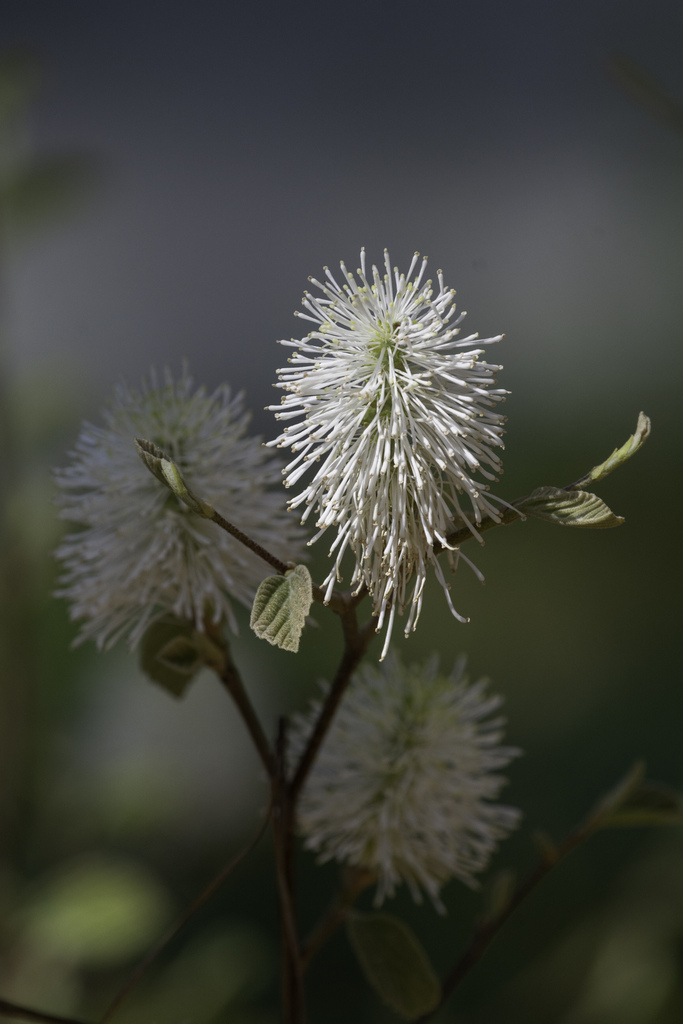
Coastal Witch-Alder
Fothergilla gardenii
Fothergilla gardenii, also known by the common names witch alder, dwarf fothergilla, American wych hazel, pocosin witchalder, and dwarf witchalder is a deciduous shrub in the Hamamelidaceae family. It is one of two species in the genus Fothergilla.
From the article Fothergilla gardenii on Wikipedia (CC BY-SA), quoted section by section
Description
Type: Slow-growing deciduous shrub. Height/spread: Max height and spread is 0.9 m (3 ft) to 1 m (3 ft). Leaves: Dark green, alternate leaves emerge in spring and range in shape from oval to obovate. Sizes up to 6 cm (2.5 in) in length, with irregularly toothed margins. Striking autumn colors, including bright red, crimson, orange, and yellow. Inflorescences: Terminal cylindrical spikes to 4 cm (1.5 in) are borne in spring, before the leaves emerge. Flowers: Small, white, petal-less, highly fragrant. Conspicuous filaments are 2.5 cm (1 in) long.
How it is grown
Hardiness: Fully hardy, to -29 °C (-20 °F). USDA zones 5-9. Cultivation: Prefers full sun or partial shade and humus-rich, well-drained soil which is kept moist. Full sun gives the best autumn color. Does well in woodland gardens or shrub borders. Propagation: Seed Sow seed outdoors in a cold frame or seedbed in autumn or winter. Seed typically germinates the second spring after sowing. Fresh seed works best. Cuttings Take softwood cuttings in summer and root them in a mist unit. Layering: Air Layering Air layering in summer. Simple Layering Can be propagated by layering. Pests and Diseases: Trouble free.
Wikipedia: “Cultivation”
In human culture
Fothergilla is named for Dr. John Fothergill (1712-1780) of Stratford, Essex, a physician and introducer of American plants. Gardenii is named for Dr. Alexander Garden (1730-1791), an Anglo-American botanist and correspondent with Carl Linnaeus.
Wikipedia: “Etymology”
Where it lives
Recorded sightings
—
geo-referenced records in GBIF, from museums, herbaria and field observers.
Drag the globe to turn it. Dots are where records exist, not a range map; darker means more records.
In the stacks
Searching the stacks…
Every page naming Fothergilla gardenii in the Biodiversity Heritage Library →
This page is assembled live from iNaturalist, GBIF, Wikipedia, the Source Library and the Internet Archive. It is not yet part of the hand-edited codex. iNaturalist taxon 131645.