- Plants
- ›Vascular Plants
- ›flowering plants
- ›monocots
- ›Agaves, Orchids, Irises, and Allies
- ›agave and allies
- ›Century plant subfamily
- ›Anthericum
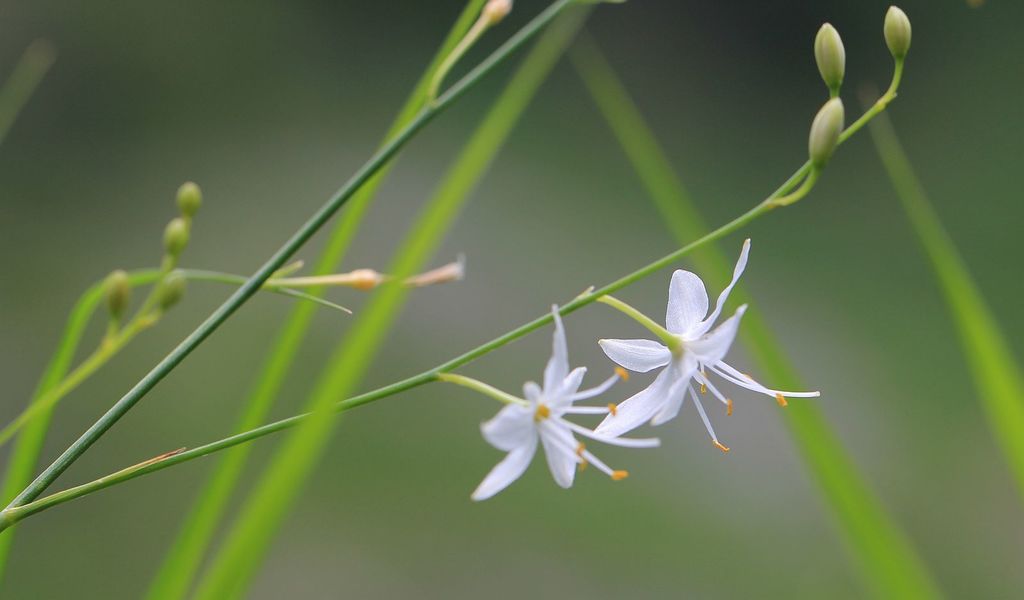
Branched St Bernard's Lily
Anthericum ramosum
Anthericum ramosum, known as branched St Bernard's-lily, is a herbaceous perennial plant with a rhizome. The genus Anthericum is currently placed in the family Asparagaceae, subfamily Agavoideae. It was formerly placed in its own family, Anthericaceae, and before that in the Liliaceae.
From the article Anthericum ramosum on Wikipedia (CC BY-SA), quoted section by section
Description
Anthericum ramosum reaches on average a height of 30–70 centimetres (12–28 in). The grass-like leaves are 50 centimetres (20 in) long and 2–6 millimetres (0.08–0.2 in) wide and are generally much shorter than the inflorescence. It has an erect, paniculate inflorescence. The flower spikes are branched (hence the Latin name ramosus), unlike Anthericum liliago. The six tepals are white, 10–13 millimetres (0.4–0.5 in) long, as are the six stamens. The flower is scentless and pure white, the anthers are bright yellow. The flowering period extends from June through August. The capsular fruit is spherical to three-faced. The flowers are pollinated by hymenopterans, while seed are distributed by the wind.
Range & habitat
This species is present in most of Europe, being more common in southern countries, and is widespread in Central Asia and Russia.
Wikipedia: “Distribution”
Where it lives
Recorded sightings
—
geo-referenced records in GBIF, from museums, herbaria and field observers.
Drag the globe to turn it. Dots are where records exist, not a range map; darker means more records.
In the stacks
Searching the stacks…
Every page naming Anthericum ramosum in the Biodiversity Heritage Library →
This page is assembled live from iNaturalist, GBIF, Wikipedia, the Source Library and the Internet Archive. It is not yet part of the hand-edited codex. iNaturalist taxon 131848.