- Plants
- ›Vascular Plants
- ›flowering plants
- ›Dicots
- ›Roses, Elms, Figs, and Allies
- ›mulberry and fig family
- ›Moreae
- ›Milicia
Iroko
Milicia excelsa
Milicia excelsa is a tree species from the genus Milicia of the family Moraceae. Distributed across tropical Central Africa, it is one of two species (the other being Milicia regia) yielding timber commonly known as ọjị, African teak, iroko, intule, kambala, moreira, mvule, odum and tule. The tree has several medicinal applications and is considered sacred in parts of West Africa. It is currently listed as "near-threatened" by the International Union for Conservation of Nature.
From the article Milicia excelsa on Wikipedia (CC BY-SA), quoted section by section
Description
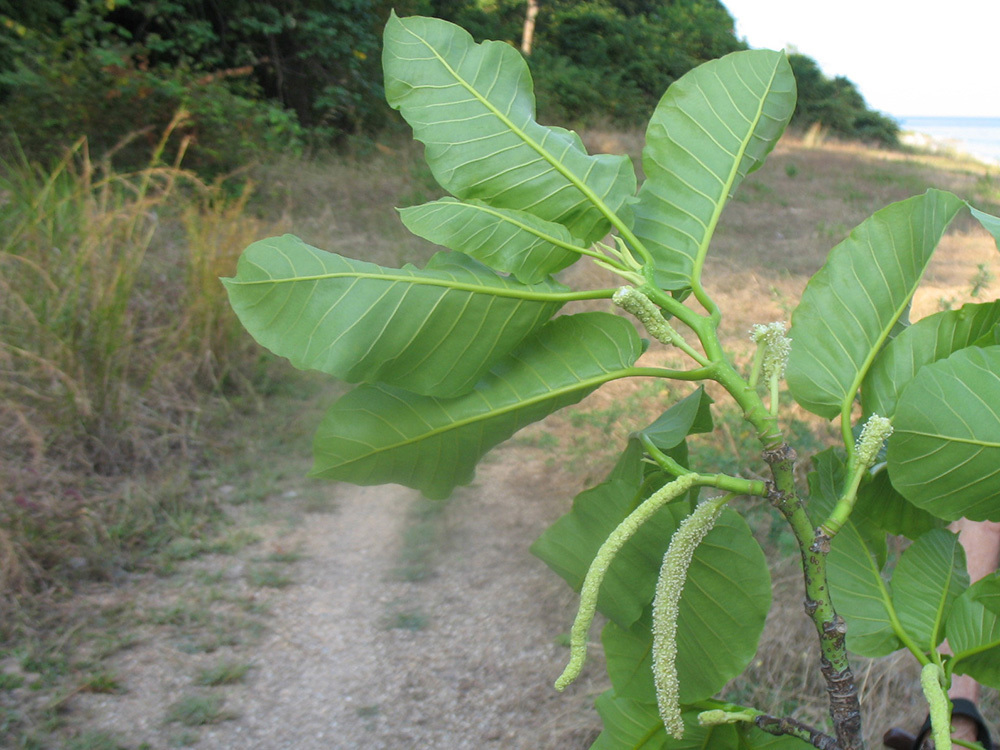
The species is a large deciduous tree growing up to 50 metres (160 feet) high. The trunk is bare lower down with the first branch usually at least 20 m (66 ft) above the ground. It often has several short buttress roots at the base. The bark is pale or dark gray, thick but little fissured, and if it gets damaged it oozes milky latex. There are a few thick branches in the crown all fairly horizontal giving an umbrella shape. The smaller branches hang down in female trees and curve up in male trees. The leaves are 5 to 10 centimetres (2 to 4 inches) long, ovate or elliptical with a finely toothed edge, green and smooth above and slightly downy beneath. Older leaves turn yellow, and all of the leaves have a prominent rectangular mesh of veins visible on the underside. The trees are dioecious. Male trees have white catkins that extend 15 to 20 cm (6 to 8 in) and dangle from twigs at the axils of the leaves. Female trees have flower spikes measuring 5 to 6 cm (2 to 2+1⁄4 in) long by 2 cm (3⁄4 in) wide, green with prominent styles. The fruit are long, wrinkled and fleshy with the small seeds embedded in the pulp. There is evidence that some of the variation that is described above amongst individuals is due to the variation in the environment. In a study done in 2010, it was found that environmental change from different regions in Benin caused much of the variation in M. excelsa. …
Range & habitat
African teak is distributed across tropical West, East, and Central Africa. Its range extends from Guinea-Bissau in the west to Ethiopia and Mozambique in the east. It is found in Angola, Benin, Burundi, Cameroon, Central African Republic, the Republic of the Congo, the Democratic Republic of the Congo, Equatorial Guinea, Ethiopia, Gabon, Ghana, Ivory Coast, Kenya, Malawi, Mozambique, Nigeria, Rwanda, São Tomé and Príncipe, Sierra Leone, Sudan, Tanzania, Togo, Uganda, Zambia and Zimbabwe. Its natural habitat is in wet savannah, rainforest, riverine and low-elevation evergreen forests. It can tolerate an annual rainfall of less than 70 cm (28 in) or six months of drought as long as there is a stream or a ground water source nearby. An introduced population of this species was discovered near Punalur in Kerala, India. In a study done on population distribution of M. excelsa in 2009, researchers found that most of the populations that were being studied were inbred. After some analysis the researchers found that the M. excelsa was inbreeding due to lack of proximity to other M. excelsa individuals. Inbreeding could contribute to why this species is moving closer to being on the Threatened conservation list. …
Wikipedia: “Distribution and habitat”
What it does
Flowering takes place at a range of different times, but often occurs in January and February soon after the time when most of the leaves fall or shortly before the new leaves appear. The fruits take about a month to ripen and are eaten by squirrels, bats, and birds, which then disperse the seeds in their droppings. Some populations, especially plantations, are attacked by a gall mite. A study in Ghana found that this tree relies heavily on the straw-coloured fruit bat (Eidolon helvum) for seed dispersal, over 98% of the seed falling to the ground having passed through its gut. This seed also germinated better than uneaten seed and resisted predation longer.
Importance to the environment. In a study done on the mineralization of M. excelsa, it was observed that in certain conditions Milicia acts as a carbon sink. These specific conditions are characterized by presence of oxalate, bacteria for oxalate oxidation and a dry season, which are common conditions in which Milicia tends to grow. This is important because the conversion of atmospheric carbon into land carbon decreases the amount of atmospheric carbon dioxide. Because of its importance to the environment there has been research done on how to conserve Iroko. A solution that has been proposed to help M. excelsa move further away from being threatened is agroforestry. …
Wikipedia: “Ecology”
At the table
Milicia excelsa is one of two tree species (the other being Milicia regia) that yield timber commonly known as African teak. M. excelsa yields a strong, dense and durable dark brown hardwood timber. It is resistant to termites and is used for construction, furniture, joinery, panelling, floors and boats. Iroko has been used in recent refit work performed on the Royal Navy's 104-gun first-rate ship of the line HMS Victory. The timber provides high chatoyance, with an average value above 21 PZC. The tree can be used in the control of erosion, and for providing shade as a roadside tree in urban areas. It grows rapidly, can be coppiced and is ready for cutting after about fifty years. The tree leaves are used for mulching. The tree is also used in herbal medicine. The powdered bark is used for coughs, heart problems and lassitude. The latex is used as an anti-tumour agent and to clear stomach and throat obstructions. The leaves and the ashes also have medicinal uses.
Wikipedia: “Uses”
In human culture
In West Africa, African teak is considered to be a sacred tree. It is often protected when the surrounding bush is cleared, ritual sacrifices take place underneath it and gifts are given to it. Fertility and birth are associated with it and its timber is used to make ceremonial drums and coffins.
Wikipedia: “In culture”
Where it lives
Recorded sightings
—
geo-referenced records in GBIF, from museums, herbaria and field observers.
Drag the globe to turn it. Dots are where records exist, not a range map; darker means more records.
In the stacks
Searching the stacks…
Every page naming Milicia excelsa in the Biodiversity Heritage Library →
This page is assembled live from iNaturalist, GBIF, Wikipedia, the Source Library and the Internet Archive. It is not yet part of the hand-edited codex. iNaturalist taxon 132509.