- Plants
- ›Vascular Plants
- ›flowering plants
- ›Dicots
- ›Mints, Plantains, Olives, and Allies
- ›Plantain Family
- ›Toadflaxes and Allies
- ›Linaria
- ›Supinae
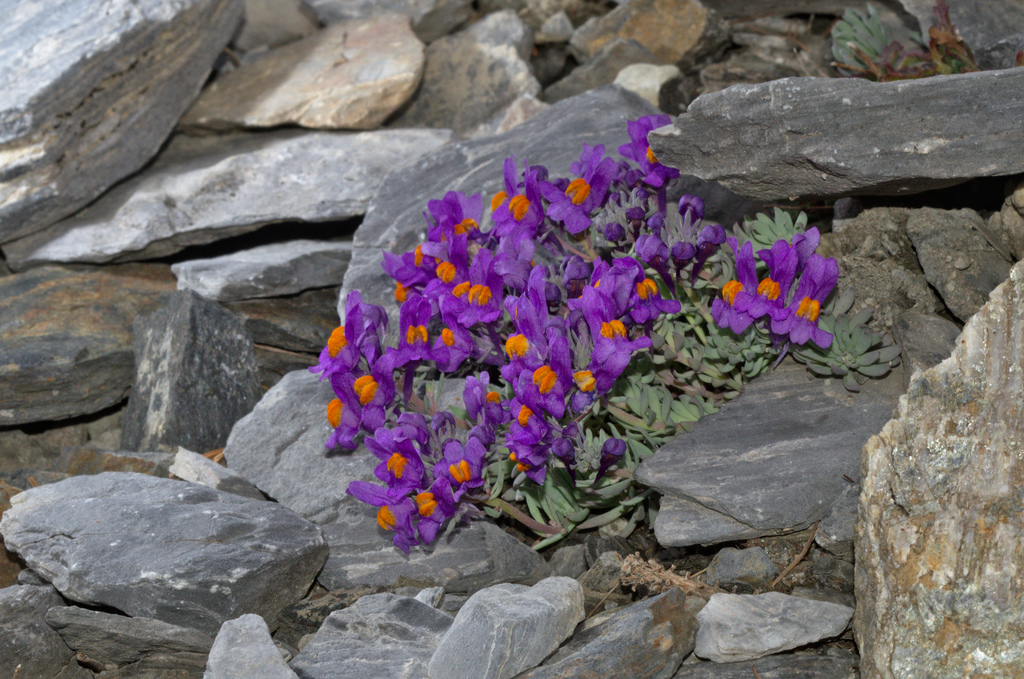
Alpine Toadflax
Linaria alpina
Linaria alpina, sometimes called alpine toadflax, is a purple-flowered member of the genus Linaria. It is found in many mountain ranges in southern and central Europe from the Sierra de Gredos and the Montes de León in Spain to the mountains of the Balkan Peninsula including the Jura mountains Alps, Pyrenees, and central Apennines.
From the article Linaria alpina on Wikipedia (CC BY-SA), quoted section by section
Description
Linaria alpina is a hairless herb that can behave as an annual, a biennial, or a perennial. It reaches heights of 5–15 centimetres (2–6 in), though some specimens can reach up to 20 cm (8 in). Its primary biological form is a scapose hemicryptophyte, with overwintering buds at ground level protected by snow or litter, but it can also be a scapose therophyte, surviving via seed, or a rhizomatous geophyte, relying on underground rhizomes. The plant is almost always prostrate, lying flat with only the tips ascending, and possesses a thread-like, often creeping rhizome. The entire plant is glabrous (hairless) and glaucous (waxy grey-blue). As with many other members of the genus, Linaria alpina flowers have a blue-violet or pinkish corolla, with short spurs 8–10 mm long. The upper lip is deeply two-lobed, purple with two yellow-orange spots, and an orange throat lobes in the centre, creating a striking colour contrast and making it easily identifiable when in flower. This is likely an optical signal for insects.
Vegetative organs. Roots: The root system tends to have a taproot. Stem: The aerial part of the stem is prostrate or ascending; its consistency is slender and fragile. An underground stem (rhizome type) may occasionally be present. Leaves: The fleshy leaves are linear to lanceolate, entire, and glaucous with a blue-green border. …
Range & habitat
It is found in many mountain ranges in southern and central Europe ranging from Spain to Romania between 1,500 and 3,800 metres, and in valleys with altitudes of up to 4,200 m. They inhabit the alpine and nival vegetation levels, and partially the subalpine, montane, and hilly levels. In Spain it is found in the Sierra de Gredos, the Montes de León and the Pyrenees. There is also a record in the Valencian Country at 1,200 m altitude in the highest part of the Alt Palància region. In France, it is found in the Jura, in several locations in Savoie and Haute-Savoie, in the Mercantour Park (up to over 2,800 m), in the Pyrenees, and in two locations in Burgundy. It is also found in other parts of the Alps (giving it its name), notably on the peaks of Champsaur (Hautes-Alpes). In Italy besides the Alps it is also found in the central Apennine Mountains. In Friuli, near Sagrado along the Isonzo river, these plants can grow down to the plains. It is a common species in Austria, Liechtenstein, Switzerland and northern Slovenia. In Germany, the species is primarily distributed throughout the Bavarian Alps. Scattered occurrences, known as "Alpenschwemmling" (alpine drifters), are found in the Alpine foothills along the Lech and Isar rivers, reaching as far as Landsberg am Lech and Munich. …
Wikipedia: “Distribution”
What it does
It is an early colonist of newly exposed, unconsolidated glacial moraine. The typical habitat for this plant includes scree slopes (ghiaioni), limestone debris, stony ground, and ruins. The preferred substrate is calcareous (limestone) but also siliceous, with a neutral-basic pH. The soil typically has low nutritional value and must remain moist. It is a calciphilous (lime-loving) plant, it inhabits the gravelly banks of mountain streams and is often washed down to lower elevations by water; for example, it reaches Lake Constance via the deposits of the Rhine, and there are older records of its occurrence on the deposits of the Danube. It tolerates constant burial by scree material well. A single underground rhizome can have up to 60 rootless shoots that penetrate coarse scree or lie on top of fine scree. Pollination of the flowers can only be performed by heavy insects with enough strength to open the flowers such as hymenopterans (bees and wasps), lepidopterans (butterflies and moths), or dipterans (flies). Alternatively, pollination can occur via the wind (anemophilous pollination). …
Wikipedia: “Habitat and ecology”
In human culture
The generic name Linaria is derived from the Latin name for "resembling flax (linen)". It refers to the similarity of the leaves of some species in this genus to those of the common flax species, Linum usitatissimum. The specific epithet alpina indicates that the plant is of alpine origin or inhabits mountainous regions with habitats similar to alpine altitudes.
Wikipedia: “Etymology”
Where it lives
Recorded sightings
—
geo-referenced records in GBIF, from museums, herbaria and field observers.
Drag the globe to turn it. Dots are where records exist, not a range map; darker means more records.
In the stacks
Searching the stacks…
Every page naming Linaria alpina in the Biodiversity Heritage Library →
This page is assembled live from iNaturalist, GBIF, Wikipedia, the Source Library and the Internet Archive. It is not yet part of the hand-edited codex. iNaturalist taxon 132608.