- Plants
- ›Vascular Plants
- ›flowering plants
- ›Dicots
- ›Legumes, Milkworts, and Allies
- ›Legumes
- ›Acacias, Mimosas, Mesquites, and Allies
- ›Ingeae
- ›Albizia
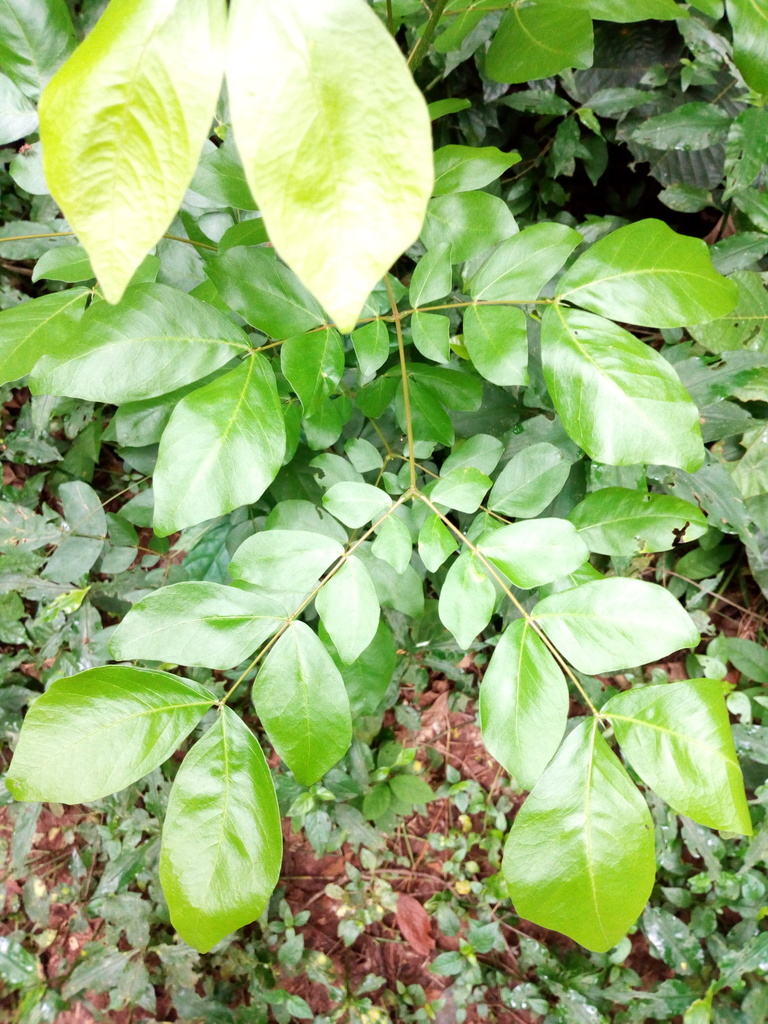
Albizia zygia
Albizia zygia is a fast growing medium-sized tree species within the Fabaceae family that is commonly found in West and Central Africa.
From the article Albizia zygia on Wikipedia (CC BY-SA), quoted section by section
Description
The species grows up to 30 meters tall. Its branches are ascending and wide spreading forming an open crown, the bark is greyish and fairly smooth. Leaves are pinnately compound, leaflets are obovate in shape, with the terminal pairs usually the largest. Flowers are often white to reddish and its fruits are papery and brownish black pods, up to 20 cm long and 3.5 cm wide, seeds are usually produced when plant reaches maturity, and are darkish brown.
Range & habitat
The species is commonly found largely in secondary high forest and semi-deciduous forest zones but it also occurs in primary forest and savannahs of West and Central Africa.
Wikipedia: “Distribution and habitat”
At the table
The plant is used as a shade tree by cocoa farmers. Leaves are boiled, dried and used to prepare vegetable soup. In Ghana its leaves are used in traditional medicine for their anti-inflammatory, antipyretic and analgesic effects.
== References ==
Wikipedia: “Uses”
Where it lives
Recorded sightings
—
geo-referenced records in GBIF, from museums, herbaria and field observers.
Drag the globe to turn it. Dots are where records exist, not a range map; darker means more records.
In the stacks
Searching the stacks…
Every page naming Albizia zygia in the Biodiversity Heritage Library →
This page is assembled live from iNaturalist, GBIF, Wikipedia, the Source Library and the Internet Archive. It is not yet part of the hand-edited codex. iNaturalist taxon 132900.