- Animals
- ›Arthropods
- ›Hexapods
- ›Insects
- ›Winged and Once-winged Insects
- ›Grasshoppers, Crickets, and Katydids
- ›Katydids, Crickets, and Allies
- ›Katydids, wētā, and allies
- ›Tettigonioidea
- ›Katydids
- ›Shieldback Katydids
- ›Tettigoniini
- ›Tettigonia
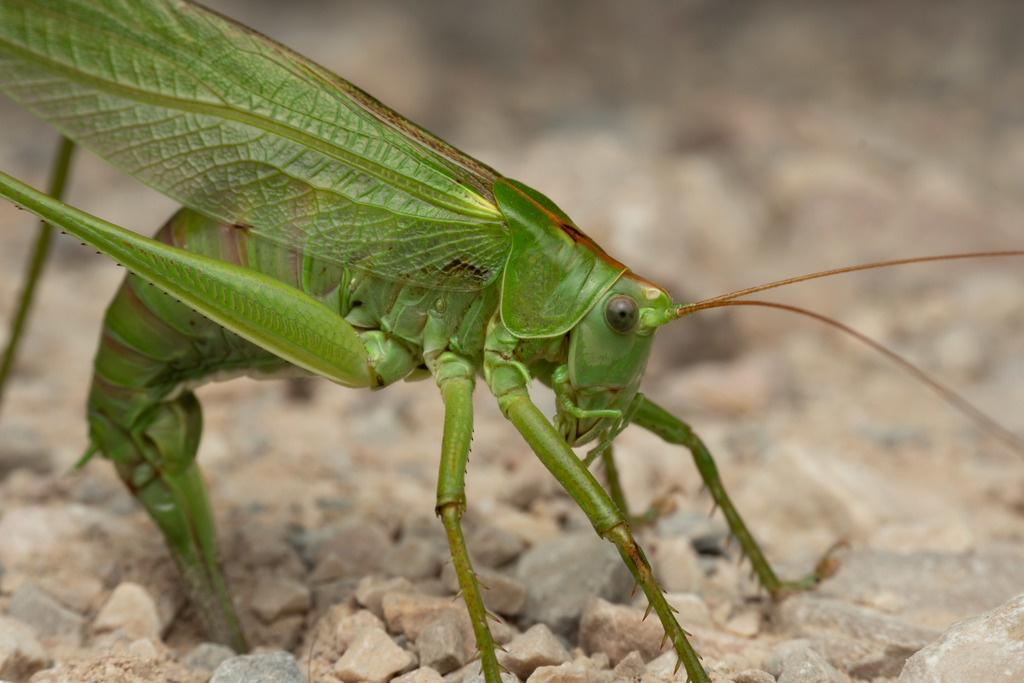
Great Green Bush-cricket
Tettigonia viridissima
Tettigonia viridissima, the great green bush-cricket, is a large species of katydid or bush-cricket belonging to the family Tettigoniidae, subfamily Tettigoniinae.
From the article Tettigonia viridissima on Wikipedia (CC BY-SA), quoted section by section
Description
The adult males grow up to 28–36 millimetres (1.1–1.4 in) long, while females reach 32–42 millimetres (1.3–1.7 in). This insect is most often completely green (but there are specimens completely yellowish or with yellow legs), excluding a rust-colored band on top of the body. The organ of the stridulation of the males is generally brown. Tettigonia viridissima is distinguished by its very long and thin antennae, which can sometimes reach up to three times the length of the body, thus differentiating them from grasshoppers, which always carry short antennae. It could be confused with Tettigonia cantans, whose wings are a centimeter shorter than the ovipositor, or Tettigonia caudata, whose hind femurs bear conspicuous black spines. The morphology of both sexes is very similar, but the female has an egg-laying organ (ovipositor) that can reach a length of 23–32 millimetres (0.91–1.26 in). It reaches the end of the elytra and is slightly curved downward. The larvae are green and the imago show a thin brown longitudinal stripe on their back. The ovipositor can be seen from the fifth stage; the wings appear in both genders from the sixth stage.
Range & habitat
This species can be encountered in most of Europe, in the eastern Palearctic realm, in the Near East, and in North Africa, especially in meadows, grasslands, prairies and occasionally in gardens at an elevation up to 1,800 metres (5,900 ft) above sea level.
Wikipedia: “Distribution and habitat”
Listen
Looking for field recordings…
Where it lives
Recorded sightings
—
geo-referenced records in GBIF, from museums, herbaria and field observers.
Drag the globe to turn it. Dots are where records exist, not a range map; darker means more records.
In the stacks
Searching the stacks…
Every page naming Tettigonia viridissima in the Biodiversity Heritage Library →
This page is assembled live from iNaturalist, GBIF, Wikipedia, the Source Library and the Internet Archive. It is not yet part of the hand-edited codex. iNaturalist taxon 133250.