- Plants
- ›Vascular Plants
- ›flowering plants
- ›Dicots
- ›Gentians, Dogbanes, Madders, and Allies
- ›madder family
- ›Rubioideae
- ›Spermacoceae
- ›Richardia
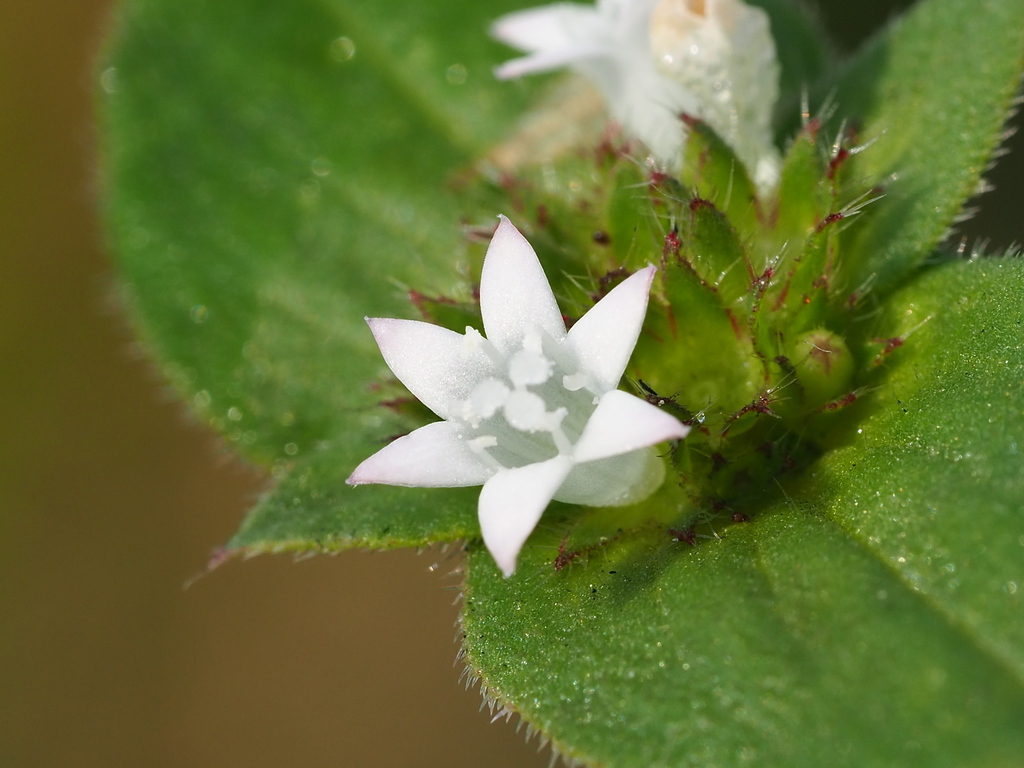
Florida Pusley
Richardia scabra
Richardia scabra, commonly called rough Mexican clover or Florida pusley, is a species of flowering plant in the coffee family. It is widespread, native to warm areas of both North America and South America. In the southeastern United States, it is often found in disturbed habitats.
From the article Richardia scabra on Wikipedia (CC BY-SA), quoted section by section
Description
The stems of R. scabra may reach a height between 1 and 7 decimeters (4 to 27.5 inches). The leaves are oppositely arranged, and lanceolate to elliptic in shape. They range in size from 2.5 to 7 centimeters (1 to 2.75 inches) in length. Individuals produce white flowers, inflorescence beginning as early as March and may last through December. The fruit produced by R. scabra is leathery in texture and is 3 to 4 millimeters in length.
Range & habitat
In the southeastern United States, this species is often found in disturbed habitats, with individuals observed in habitats such as along roadsides and within vacant lots. Within the United States' Coastal Plain region, R. scabra occurs within environments that possess fine sandy loams with slow permeability. Individuals have been documented in habitats such as upland pine communities and woodlands.
== References ==
Wikipedia: “Habitat”
Where it lives
Recorded sightings
—
geo-referenced records in GBIF, from museums, herbaria and field observers.
Drag the globe to turn it. Dots are where records exist, not a range map; darker means more records.
In the stacks
Searching the stacks…
Every page naming Richardia scabra in the Biodiversity Heritage Library →
This page is assembled live from iNaturalist, GBIF, Wikipedia, the Source Library and the Internet Archive. It is not yet part of the hand-edited codex. iNaturalist taxon 133311.