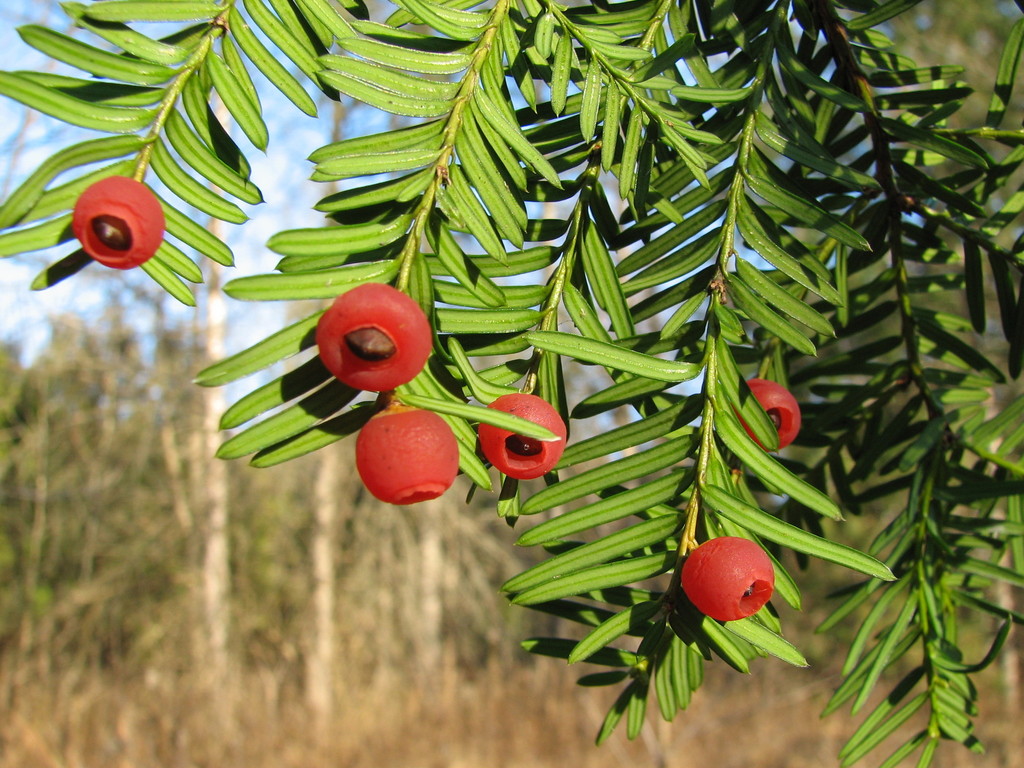
Japanese yew
Taxus cuspidata
Taxus cuspidata, the Japanese yew or spreading yew, is a conifer of the family Taxaceae, native to Japan, Korea, northeast China and the extreme southeast of Russia.
From the article Taxus cuspidata on Wikipedia (CC BY-SA), quoted section by section
Description
It is an evergreen tree or large shrub growing to 10–18 m tall, with a trunk up to 60 cm diameter. The leaves are lanceolate, flat, dark green, 1–3 cm long and 2–3 mm broad, arranged spirally on the stem, but with the leaf bases twisted to align the leaves in two flattish rows either side of the stem except on erect leading shoots where the spiral arrangement is more obvious. The seed cones are highly modified, each cone containing a single seed 4–8 mm long partly surrounded by a modified scale which develops into a soft, bright red berry-like structure called an aril, 8–12 mm long and wide and open at the end. The arils are mature 6–9 months after pollination. Taxus cuspidata is the fastest growing species of yew.
At the table
The tree is widely grown in eastern Asia and eastern North America as an ornamental plant.
Wikipedia: “Uses”
Toxicity
The entire yew bush, except the aril (the red flesh of the berry covering the seed), is toxic due to a group of chemicals called taxine alkaloids. Their cardiotoxicity is well known and act via calcium and sodium channel antagonism, causing an increase in cytoplasmic calcium currents of the myocardial cells. The seeds contains the highest concentrations of these alkaloids. If any leaves or seeds of the plant are ingested, urgent medical advice is recommended, as well as observation for at least 6 hours after the point of ingestion. The most cardiotoxic taxine is Taxine B followed by Taxine A; Taxine B also happens to be the most common alkaloid in the Taxus species.
Yew poisonings are relatively common in both domestic and wild animals who consume the plant accidentally. The taxine alkaloids are absorbed quickly from the intestine and in high enough quantities can cause death due to general cardiac failure, cardiac arrest, or respiratory failure. Taxines are also absorbed efficiently via the skin and Taxus species should thus be handled with care and preferably with gloves. Taxus baccata leaves contain approximately 5 mg of taxines per 1g of leaves. The estimated (i.e. …
Where it lives
Recorded sightings
—
geo-referenced records in GBIF, from museums, herbaria and field observers.
Drag the globe to turn it. Dots are where records exist, not a range map; darker means more records.
In the stacks
Searching the stacks…
Every page naming Taxus cuspidata in the Biodiversity Heritage Library →
This page is assembled live from iNaturalist, GBIF, Wikipedia, the Source Library and the Internet Archive. It is not yet part of the hand-edited codex. iNaturalist taxon 133386.