- Animals
- ›Arthropods
- ›Hexapods
- ›Insects
- ›Winged and Once-winged Insects
- ›Ants, Bees, Wasps, and Sawflies
- ›Narrow-waisted Wasps, Ants, and Bees
- ›Ants, Bees, and Stinging Wasps
- ›Bees and Apoid Wasps
- ›Bees
- ›Sweat Bees
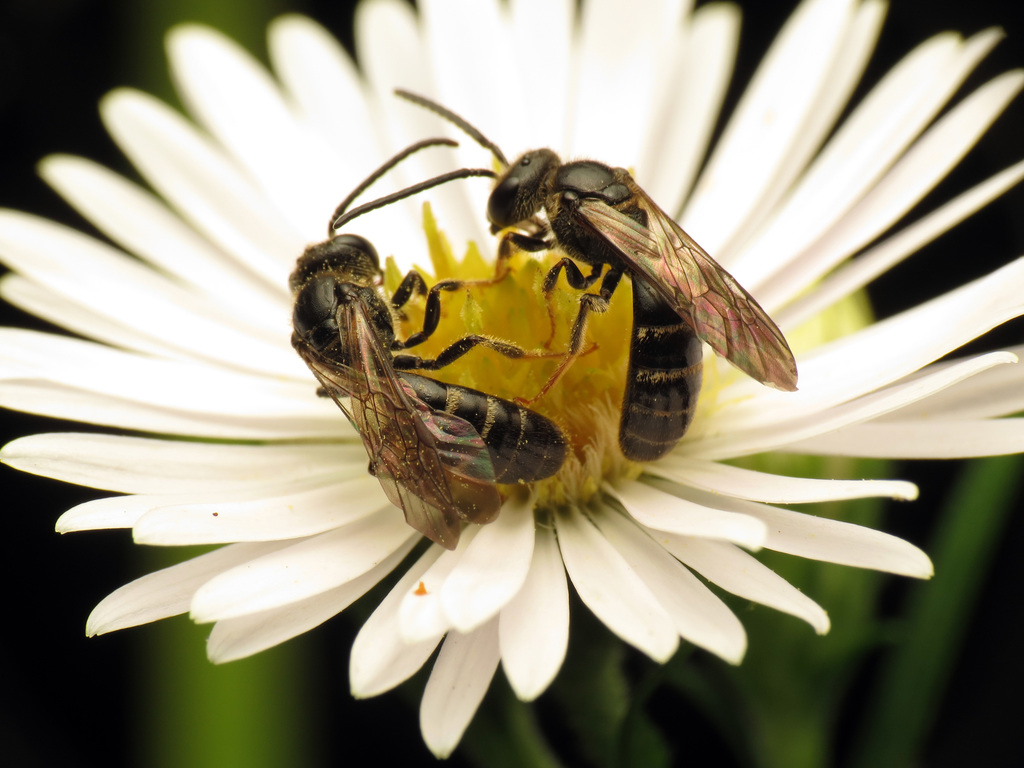
Sweat and Furrow bees
Halictinae
Within the insect order Hymenoptera, the Halictinae are the largest, most diverse, and most recently diverged of the four halictid subfamilies. They comprise over 2400 bee species belonging to the five taxonomic tribes Augochlorini, Thrinchostomini, Caenohalictini, Sphecodini, and Halictini, which some entomologists alternatively organize into the two tribes Augochlorini and Halictini.
The subfamily Halictinae also belongs to the hymenopteran monophyletic clade Aculeata, whose members are characterized by the possession of a modified ovipositor in the form of a venomous sting for predator and prey defense. Including all eusocial and cleptoparasitic Halictidae taxa, these small bees are pollen feeders who mass provision their young and exhibit a broad spectrum of behavioral social polymorphies, ranging from solitary nesting to obligate eusociality. Estimated from the fossil record, eusociality in this subfamily evolved about 20 to 22 million years ago, which is relatively recent in comparison with other inferred eusociality origins. Thus, the Halictinae are believed to model the primitive eusociality of advanced eusocial hymenopterans. Because of their polymorphic sociality and recently evolved eusociality, the Halictinae are valuable to the study of social evolution.
2 branches of this subfamily, most-observed first
See this branch on the Wheel of Life →

Where it lives
Recorded sightings
—
geo-referenced records in GBIF, from museums, herbaria and field observers.
Drag the globe to turn it. Dots are where records exist, not a range map; darker means more records.
In the stacks
Searching the stacks…
Every page naming Halictinae in the Biodiversity Heritage Library →
This page is assembled live from iNaturalist, GBIF, Wikipedia, the Source Library and the Internet Archive. It is not yet part of the hand-edited codex. iNaturalist taxon 134106.