- Animals
- ›Arthropods
- ›Hexapods
- ›Insects
- ›Winged and Once-winged Insects
- ›Flies
- ›Brachyceran Flies
- ›Orthorrhaphan Flies
- ›Asiloidea
- ›Robber Flies
- ›Dioctriinae
- ›Dioctriini
- ›Dioctria
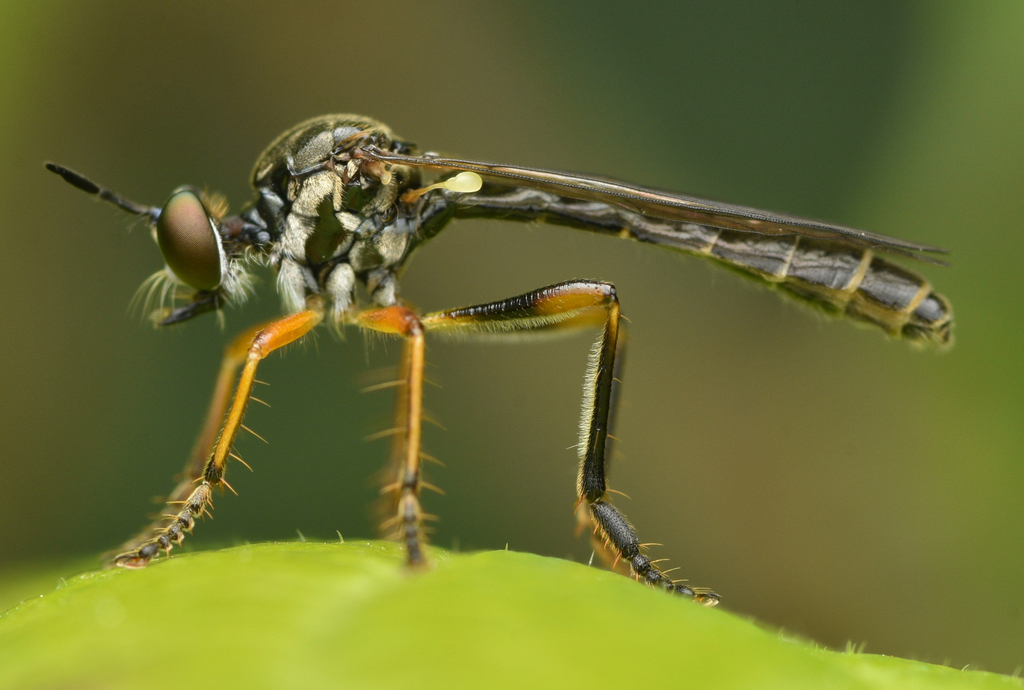
Stripe-legged Robber Fly
Dioctria hyalipennis
Dioctria hyalipennis is a Holarctic species of robber fly in the family Asilidae.
From the article Dioctria hyalipennis on Wikipedia (CC BY-SA), quoted section by section
Description
10 to 14 mm. The upper head and vertex are shiny black. The lower face has a silvery-white pile. The mystax is white and the short proboscis black. The antennae appears Y-shaped with the segments about equal in length. They are black with short black hair. The neck is obvious and the thorax is raised or humped. It is black with two long indented lines and a faint covering of light yellow pile. Segment 2 (scutellum) is small with a line of yellow pile at the base. The thorax sides have a wide stripe of whitish pollen extending along the thorax down to the front leg. The wings are hyaline, but appear darker when folded over the body. The veins are brown. Halteres light yellow. The front and middle legs are mostly yellow with black streaks on the top side and dark tips. The feet are black with grey piles and yellow spines and toes. The hind legs are black with a swollen 1st foot segment. The abdomen is shining black. The lower margin of segments has a thin whitish line. The first 4 male segments are very narrow and constricted (appear wavy); the last few segments gradually widen to the tip. Female abdomen flat on top side, rounded and orange on the underside; much wider and thicker than male, but shorter.
Listen
Looking for field recordings…
Where it lives
Recorded sightings
—
geo-referenced records in GBIF, from museums, herbaria and field observers.
Drag the globe to turn it. Dots are where records exist, not a range map; darker means more records.
In the stacks
Searching the stacks…
Every page naming Dioctria hyalipennis in the Biodiversity Heritage Library →
This page is assembled live from iNaturalist, GBIF, Wikipedia, the Source Library and the Internet Archive. It is not yet part of the hand-edited codex. iNaturalist taxon 135239.