- Animals
- ›Arthropods
- ›Hexapods
- ›Insects
- ›Winged and Once-winged Insects
- ›Ants, Bees, Wasps, and Sawflies
- ›Sawflies, Horntails, and Wood Wasps
- ›Typical Sawflies
- ›Conifer Sawflies
- ›Diprioninae
- ›Neodiprion
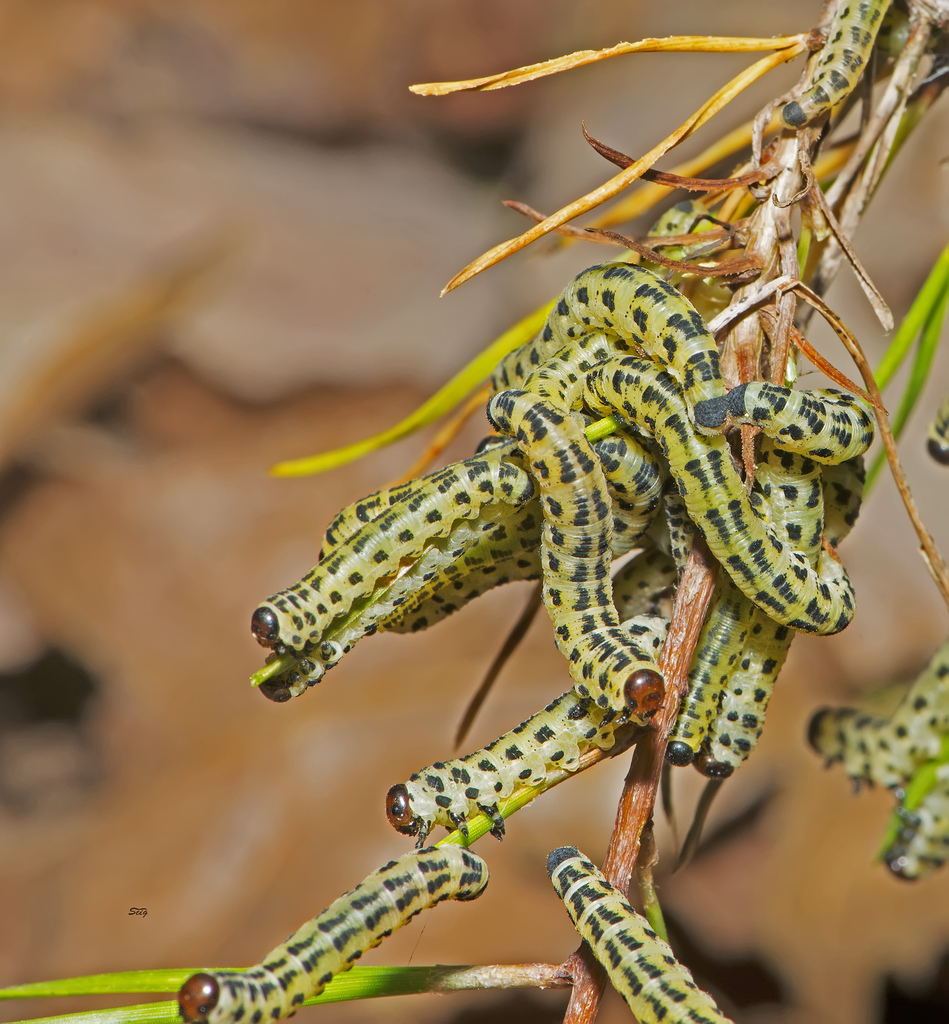
Red-headed Pine Sawfly
Neodiprion lecontei
Neodiprion lecontei is a species of sawfly in the family Diprionidae native to eastern North America, commonly known as the red-headed pine sawfly or Leconte's sawfly. The larvae feed on the foliage of many species of native and imported pines. This species was named after John Lawrence LeConte, an American entomologist of the 19th century.
From the article Neodiprion lecontei on Wikipedia (CC BY-SA), quoted section by section
Description
The adult N. lecontei has membranous wings and a broad waist and is between 5 and 8.5 mm (0.20 and 0.33 in) long, with the males being somewhat smaller than the females. Males have feathery antennae while females have serrated ones with nineteen segments. Males are entirely black and are more slender than the robust females, which have reddish-brown heads and thorax, and mainly black abdomens, sometimes with white on the sides. The larvae resemble the caterpillars of lepidopterans; young larvae are whitish with brown heads while older larvae are yellowish-green with up to eight longitudinal rows of black spots, and brown heads. They have three pairs of legs at the front and six to seven pairs of prolegs at the rear.
Range & habitat
Neodiprion lecontei is native to eastern North America. Its range extends from southeastern Canada westwards to the Great Plains and southwards to Texas and Florida.
Wikipedia: “Distribution”
What it does
The adult female sawfly cuts slits in pine needles with her ovipositor and deposits one egg in each slit. These appear pale and give the needle a banded appearance. The eggs hatch after about four weeks. The young larvae feed on the sides of the pine needle, leaving an uneaten central section which withers and dies, remaining on the tree giving a distinctive straw-like effect. Older larvae eat the whole needle before moving on to the next. The larvae are gregarious, and can strip whole branches and trees of needles. If the tree is completely defoliated, the larvae move as a group onto a neighboring tree, or may start chewing at the soft bark of twigs. When their development is finished, they drop to the ground and spin cocoons in the needle litter or underground. Here they overwinter as prepupae, pupating in the spring and biting their way out of one end of the cocoon to emerge as adults. Some individuals may not emerge as adults until the following year, or have an extended diapause. In the northern part of the range there is a single generation each year, but further south there may be two or three, sometimes overlapping, generations.
== References ==
Wikipedia: “Life cycle”
Listen
Looking for field recordings…
Where it lives
Recorded sightings
—
geo-referenced records in GBIF, from museums, herbaria and field observers.
Drag the globe to turn it. Dots are where records exist, not a range map; darker means more records.
In the stacks
Searching the stacks…
Every page naming Neodiprion lecontei in the Biodiversity Heritage Library →
This page is assembled live from iNaturalist, GBIF, Wikipedia, the Source Library and the Internet Archive. It is not yet part of the hand-edited codex. iNaturalist taxon 135292.