- Plants
- ›Vascular Plants
- ›flowering plants
- ›Dicots
- ›Mints, Plantains, Olives, and Allies
- ›Mint Family
- ›Nepetoideae
- ›Ocimeae
- ›Plectranthinae
- ›Thorncroftia
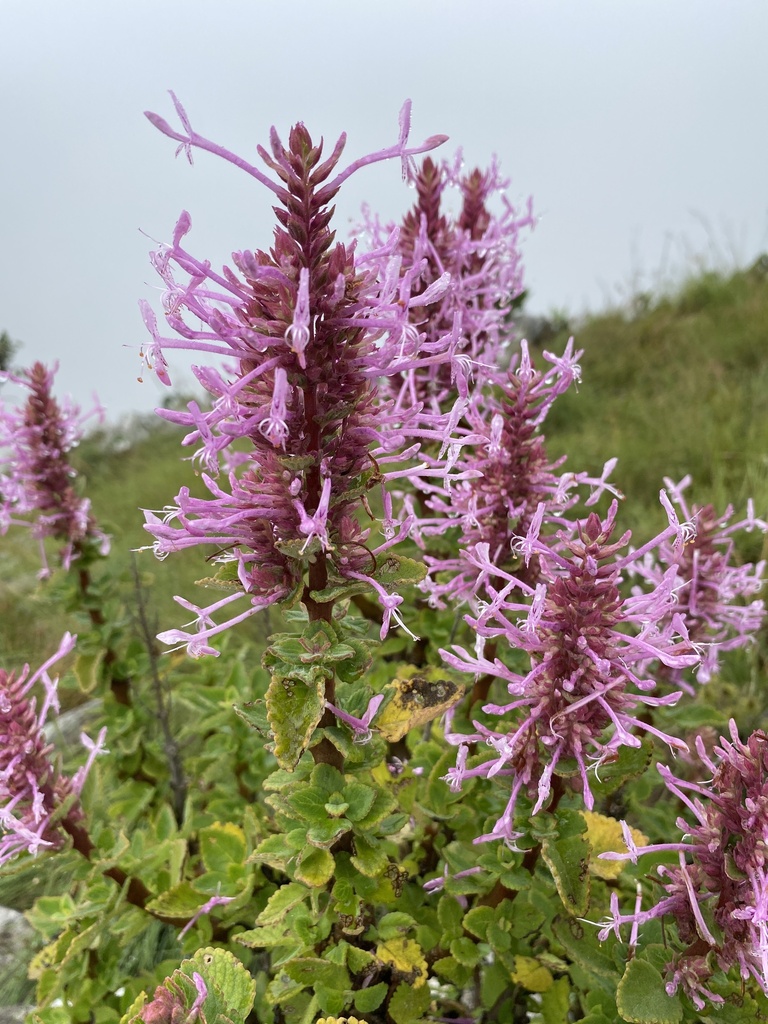
Ugutugulu Whistlesweet
Thorncroftia lotteri
Thorncroftia lotteri is a species of Thorncroftia commonly known as the Ugutugulu whistlesweet. It is endemic to South Africa′s Mpumalanga province, where it grows at 1,000–1,400 m (3,300–4,600 ft) above sea level on rocky mountain tops and quartzite ridges in the Barberton area.
Range-restricted and threatened by forestry operations and informal mining, it is listed as Vulnerable by SANBI.
From the article Thorncroftia lotteri on Wikipedia (CC BY-SA), quoted section by section
Description
Thorncroftia lotteri is a semi-succulent, erect herb or small shrub growing 30–100 cm (12–39 in) tall, usually with several main stems. The stems are grey near the base and purple to pale green above, sparingly branched, and densely covered in a felt-like layer of recurved hairs with scattered capitate glands. The leaves are opposite, ovate to elliptic-obovate, typically 3–4 cm (1.2–1.6 in) long and 2–3 cm (0.8–1.2 in) wide. The venation is sunken above and prominently raised below, forming a network of shallow recesses. Both leaf surfaces are hairy, especially the underside. The leaf margins are crenate in the upper three-quarters, with nine or more rounded scallops on each side. The leaf tip is rounded or acute, the base cuneate to obtuse, and the petiole is relatively long, usually 12–15 mm (0.47–0.59 in). The inflorescence is a compact, terminal panicle with a main axis up to 20 cm (8 in) long. The bracts are leaf-like near the base of the inflorescence and become progressively smaller towards the tip. The calyx is two-lipped and five-toothed, purple to maroon in colour, and 7–9 mm (0.28–0.35 in) long in fruit. The corolla is tubular, narrowly cylindrical, and laterally compressed, measuring about 20–23 mm (0.79–0.91 in) in length. It is light lilac, becoming paler towards the tip, and bears conspicuous glandular hairs. …
In human culture
The genus Thorncroftia is named for George Thorncroft (1857‒1934), an amateur botanist who collected extensively in the Barberton area. The species is named for Dr Mervyn Lötter (b. 1972), a biodiversity planner and GIS expert at the Mpumalanga Tourism and Parks Agency, who helped collect specimens of the plant.
Wikipedia: “Etymology”
Where it lives
Recorded sightings
—
geo-referenced records in GBIF, from museums, herbaria and field observers.
Drag the globe to turn it. Dots are where records exist, not a range map; darker means more records.
In the stacks
Searching the stacks…
Every page naming Thorncroftia lotteri in the Biodiversity Heritage Library →
This page is assembled live from iNaturalist, GBIF, Wikipedia, the Source Library and the Internet Archive. It is not yet part of the hand-edited codex. iNaturalist taxon 1353383.