- Plants
- ›Vascular Plants
- ›flowering plants
- ›Dicots
- ›Soapberries, Cashews, Mahoganies, and Allies
- ›soapberry family
- ›Harpullia
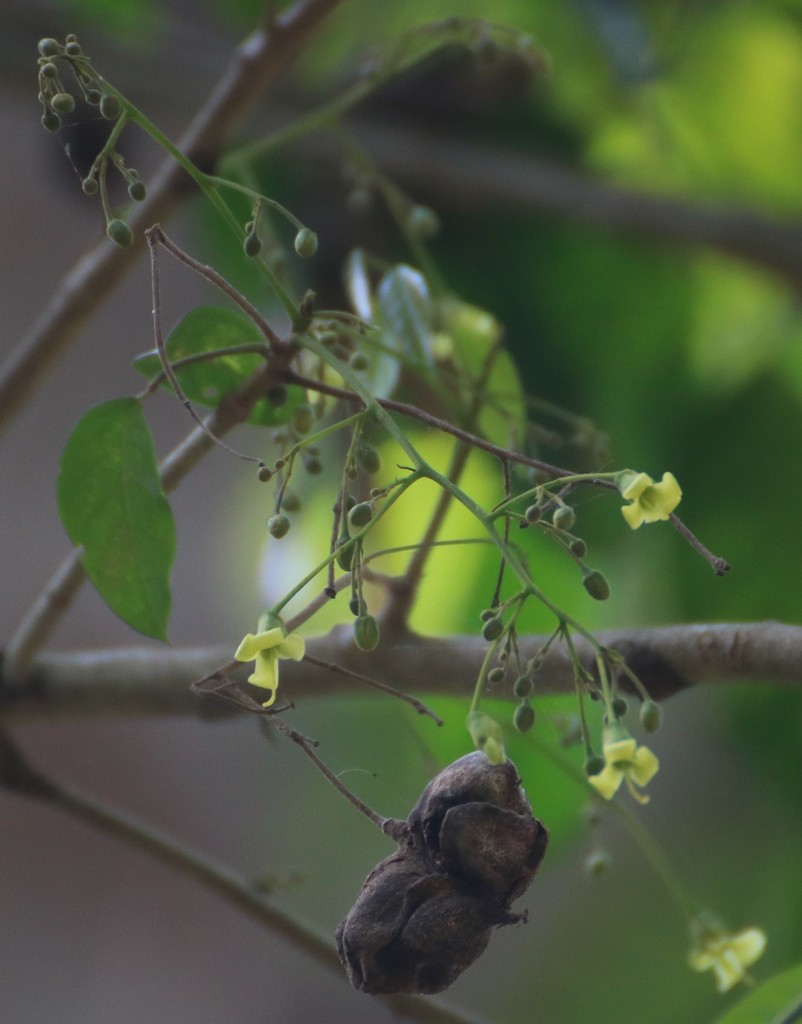
tulip-wood tree
Harpullia arborea
Harpullia arborea, commonly known as Cooktown tulipwood in Australia, is species of flowering plant in the family Sapindaceae is native to the Indian subcontinent, Sri Lanka throughout Mainland Southeast Asia and Malesia to Queensland in Australia and the Western Pacific. It is a tree with paripinnate leaves with 6 to 10 leaflets, small pink or pale green flowers arranged in leaf axils or on old woody stems, and orange-yellow to red capsules containing shiny black seeds.
From the article Harpullia arborea on Wikipedia (CC BY-SA), quoted section by section
Description
Harpullia arborea is a tree that typically grows to a height of up to 30 m (98 ft), sometimes to 40 m (130 ft), with a trunk dbh of 60–70 cm (24–28 in), its branchlets covered with woolly brown hairs. Its leaves are paripinnate, 40–220 mm (1.6–8.7 in) long with 6 to 10 elliptic to egg-shaped leaflets with the narrower end towards the base, mostly 100–190 mm (3.9–7.5 in) long and 40–75 mm (1.6–3.0 in) wide on a petiole 40–90 mm (1.6–3.5 in) long. Separate male and female flowers are borne on the same plant, usually in racemes in leaf axils, sometimes on old wood, and are 40–220 mm (1.6–8.7 in) long. Each flower is on a pedicel 10–50 mm (0.39–1.97 in) long. The sepals are 6–7 mm (0.24–0.28 in) long and covered with woolly hairs. The petals are pink or pale green and 12–14 mm (0.47–0.55 in) long, there are 5 stamens, and the ovary is covered with soft hairs. The fruit is a broadly heart-shaped, orange-yellow to red capsule 15–23 mm (0.59–0.91 in) long, containing shiny black seeds.
Range & habitat
Harpullia arborea usually grows in rainforest or monsoon forest in India, Bangladesh, Borneo, Cambodia, Fiji, Indonesia, Peninsular Malaysia, Nepal, New Guinea, the Philippines, Australia, Samoa, the Solomon Islands, Sri Lanka, Thailand, Tonga, Vanuatu and Vietnam. In New Guinea, it has been recorded in Madang, Morobe, the New Guinea Highlands, Milne Bay, New Britain and Bougainville. In Australia, it occurs from the Kutini-Payamu National Park on Cape York Peninsula to Cardwell in north-east Queensland.
== References ==
Wikipedia: “Distribution and habitat”
Where it lives
Recorded sightings
—
geo-referenced records in GBIF, from museums, herbaria and field observers.
Drag the globe to turn it. Dots are where records exist, not a range map; darker means more records.
In the stacks
Searching the stacks…
Every page naming Harpullia arborea in the Biodiversity Heritage Library →
This page is assembled live from iNaturalist, GBIF, Wikipedia, the Source Library and the Internet Archive. It is not yet part of the hand-edited codex. iNaturalist taxon 135402.