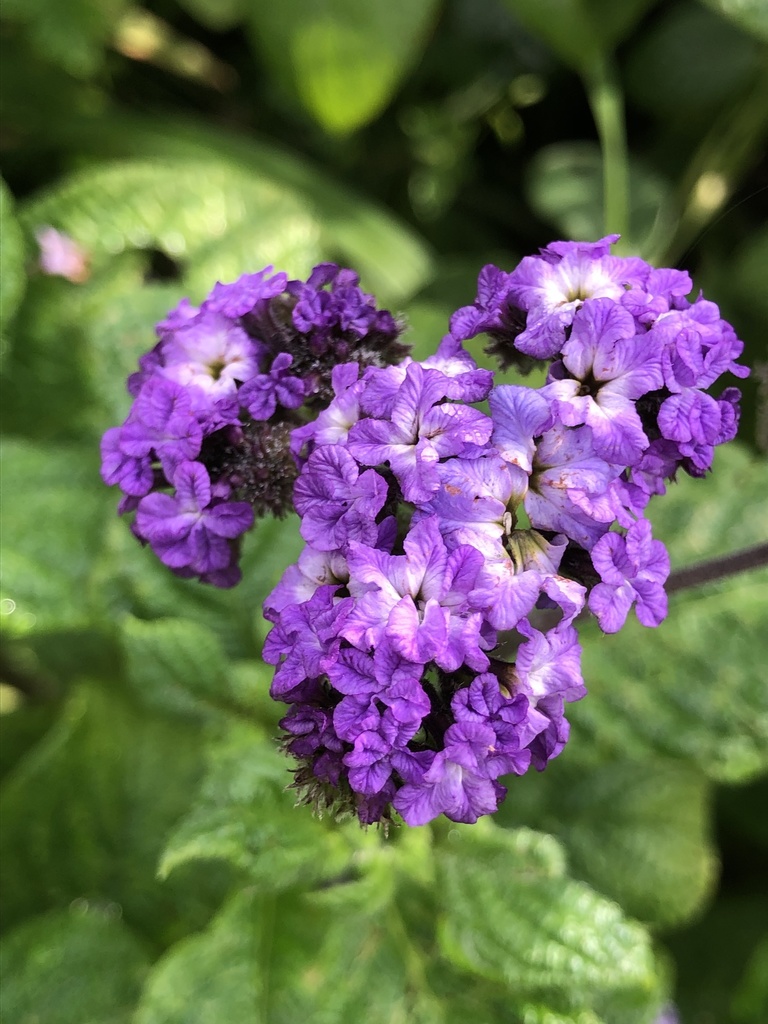
Cherry-pie
Heliotropium arborescens
Heliotropium arborescens, the garden heliotrope, is a highly fragrant perennial plant, originally from Peru. It is especially notable for its intense, rather vanilla-like fragrance. Common names include cherry pie and common heliotrope. Note that the common name "garden heliotrope" may also refer to Valerian (herb), which is not a heliotropium variety.
From the article Heliotropium arborescens on Wikipedia (CC BY-SA), quoted section by section
Description
Growing to 1.2 m (3.9 ft) tall and broad, it is a bushy, evergreen, short-lived shrub with dense clusters of bright purple flowers, notable for their intense, rather vanilla-like fragrance. Like many borage plants, the vanilla flower also contains poisonous pyrrolizidine alkaloids in addition to the fragrances.
Toxicity
The seeds are poisonous. The ASPCA's Animal Poison Control Center article on heliotropes lists them as a substance which is toxic to horses and can induce liver failure in equines. The plant is not very palatable, but will be eaten by animals with no other forage; poisonings typically occur from ingestion of green plant material or material in hay. The toxic components can cause liver failure, referred to as "walking disease" or "sleepy staggers". Signs include weight loss, weakness, sleepiness, yawning, incoordination, yellowish discoloration to mucous membranes (icterus), neurologic problems secondary to liver failure (aimless walking, chewing motions, head pressing). Animals may appear to be normal at first, then become suddenly affected; the syndrome progresses rapidly over a few days to a week. Pyrrolizidine alkaloids often cause upset stomachs and liver damage for humans who ingest any part of the plant. The purple coloration of the flower lent itself to the so-called "heliotrope cyanosis" that was characteristic of severely ill patients in the 1918 flu pandemic.
How it is grown
As a perennial, it is hardy in zones 10 to 11, and requires wintering indoors in zones 9 or colder. It is hardy down to about 5 °C (41 °F). It can also be grown as a half-hardy annual (grown from seed under glass and planted out after all danger of frost has passed) in those areas. Alternatively soft-wood cuttings may be taken in summer. During the Victorian era in England this plant gained great recognition, often appearing in gardens and the herbaceous borders of parks. They were also grown as standards. A vanilla-scented heliotrope was laid on the coffin of the American poet Emily Dickinson. Note that the common name "garden heliotrope" may also refer to valerian, which is not closely related.
Cultivars. Its popularity may have become less in more modern times, but hardy and colourful cultivars, such as 'Princess Marina', have ensured that this plant still regularly appears in seed catalogues and garden centres. …
Wikipedia: “Cultivation”
Where it lives
Recorded sightings
—
geo-referenced records in GBIF, from museums, herbaria and field observers.
Drag the globe to turn it. Dots are where records exist, not a range map; darker means more records.
In the stacks
Searching the stacks…
Every page naming Heliotropium arborescens in the Biodiversity Heritage Library →
This page is assembled live from iNaturalist, GBIF, Wikipedia, the Source Library and the Internet Archive. It is not yet part of the hand-edited codex. iNaturalist taxon 135430.