Cory's Jointfir
Ephedra coryi
Ephedra coryi, also known as Cory's joint-fir, is a rare, reed-like gymnosperm native to sandy, semi-arid areas of the North American South and Southwest.
From the article Ephedra coryi on Wikipedia (CC BY-SA), quoted section by section
Description
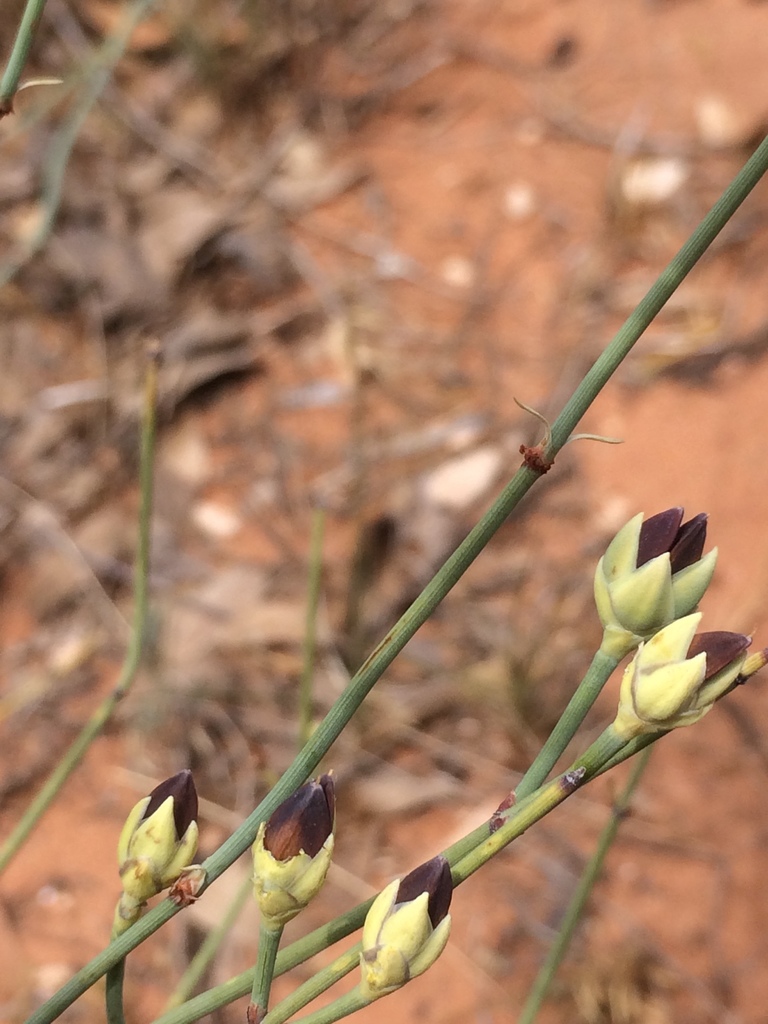
E. coryi is a Gymnosperm and a member of the Gnetophyta. E. coryi is a perennial shrub. Plant height ranges from 1–3 ft. The man photosynthetic structures of E. coryi are the stems, as is typical of the genus. The stems are thin and green with thicker, hardened bases covered in dark brown bark. Internodes are 1–5 mm in length. As a gymnosperm, E. coryi produces cones. The female cones are about 4–6 mm long and typically appear orange or yellow when mature. The cones grow on bare peduncles 7–15 mm in length and produce two smooth brown oval-shaped seeds. Cone maturation occurs from March to April. The plant forms conic terminal buds 1–3 mm in length. Mature female cones are sometimes mistaken for flowers at a distance, as they appear in groups of several cones at stem joints. E. coryi is similar to, and may be confused with the more common E. aspera, but E. coryi has two seeds in each cone while E. aspera only has one.[1]
Range & habitat
Ephedra coryi is found in the southern continental region of the United States. Native populations can be found growing in the county of Socorro, New Mexico, and several counties in Texas including; Andrews, Dawson, Ector, Gaines, Howard, Loving, Lubbock, Midland, Terry, Ward, and Winkler. This species is well-suited to arid environments and is capable of surviving in rocky, thin-soil areas including mesas.
Wikipedia: “Distribution”
What it does
This species is a rhizomatous shrub. It is found growing in nutrient scarce soils, such as sandy soils, rocky cliffs, dunes, semi-arid grassland prairies, and "shinneries" (dense thickets) of scrub oak.
Wikipedia: “Ecology”
Where it lives
Recorded sightings
—
geo-referenced records in GBIF, from museums, herbaria and field observers.
Drag the globe to turn it. Dots are where records exist, not a range map; darker means more records.
In the stacks
Searching the stacks…
Every page naming Ephedra coryi in the Biodiversity Heritage Library →
This page is assembled live from iNaturalist, GBIF, Wikipedia, the Source Library and the Internet Archive. It is not yet part of the hand-edited codex. iNaturalist taxon 135471.