Mataī
Prumnopitys taxifolia
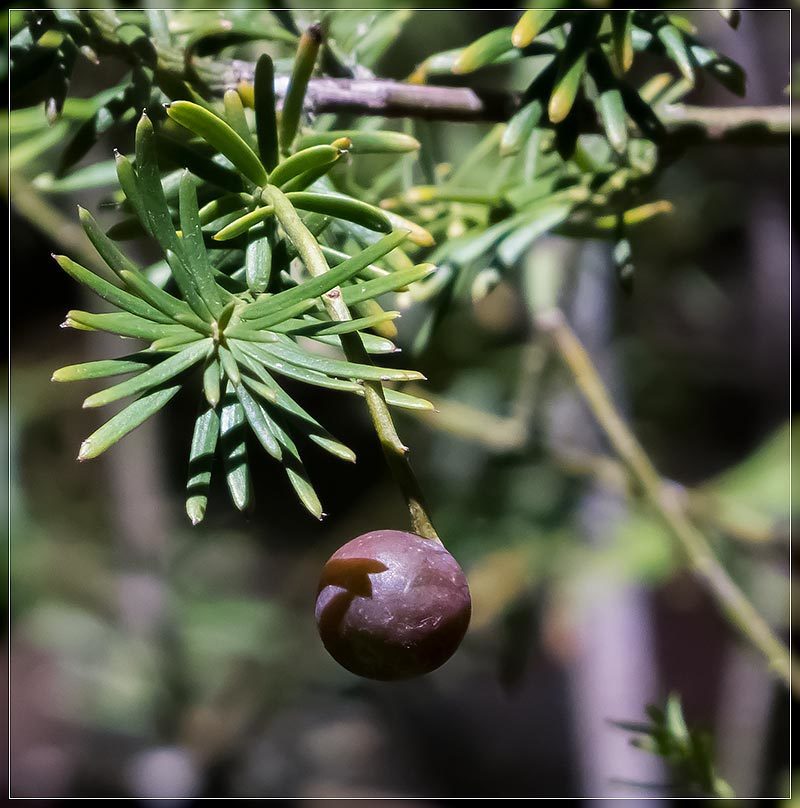
Prumnopitys taxifolia, commonly known as mataī and black pine, is a species of tree in the family Podocarpaceae. It is a dioecious evergreen conifer reaching 30 metres (100 feet) in height, with a stout trunk up to 2 m (6 ft 7 in) in diameter, typically inhabiting lowland to montane forests. It is endemic to New Zealand; its range mainly covers the North and South Islands, it is also found on Stewart Island, but is uncommon there. P. taxifolia is a slow-growing tree and is highly shade-tolerant. P. taxifolia is profoundly heteroblastic; its young form is distinct and resembles a divaricating-wiry shrub, which may last for up to 60 years. It is unknown why P. taxifolia developed this characteristic. P. taxifolia has an average lifespan of 600 years, although it sometimes may live longer than 1000 years.
Prumnopitys taxifolia was first described by the British botanist Aylmer Bourke Lambert in 1832. The fruits of P. taxifolia are dispersed by fruit-eating animals (frugivores), and the tree is pollinated by the wind. It is common on fertile and well-drained soils, although it can still grow well in drier climates. P. taxifolia's timber is noted for its strength and durability, and was historically used for building bridges and houses, railway sleepers, and furniture-making. The conservation status of P. taxifolia was assessed by the IUCN Red List in 2013 as "Least Concern".
From the article Prumnopitys taxifolia on Wikipedia (CC BY-SA), quoted section by section
Description
Prumnopitys taxifolia is a species of dioecious evergreen conifer in the family Podocarpaceae, reaching heights of 30 metres (100 feet), with a stout trunk of up to 1–2 metres (3 feet 3 inches – 6 feet 7 inches) in diameter. Branches are initially ascending and eventually become spreading, forming a domed or rounded crown. The bark is thin and smooth (particularly on younger trees); it has spots, similar to hammer marks, which are red or purplish-brown in colour when fresh, weathering into a dark brown to black colour, and peeling freely into thick flakes. The outer bark itself can vary in colour from a dark brown to an almost black colour. The wood is very dense, hard, and has a dark brown to a yellow-brown colour. P. taxifolia has an average lifespan of 600 years, although a specimen from Tongariro National Park is estimated to have lived for more than 1000 years. Prumnopitys taxifolia's young form is distinct and the species profoundly exhibits heteroblasty (a significant change in a plant's form). Its young form, resembles a tangled shrub, is so distinct that the first botanists in New Zealand initially thought they were separate species. Unlike the related miro (Pectinopitys ferruginea), P. taxifolia has a distinctive and long-lasting young stage, which is a tangle of slender, flexible, divaricating branchlets. …
Range & habitat
Prumnopitys taxifolia is endemic to New Zealand; its range primarily covers the North and South Islands. It also occurs on Stewart Island, but it is extremely uncommon there. In The Forest Flora of New Zealand, published in 1889, Thomas Kirk reported only one specimen growing on the southern side of Halfmoon Bay. Kirk also noted that the species was very common in the central areas of the North Island and in the western and south-western parts of the South Island. The conservation status of P. taxifolia was assessed by the IUCN Red List in 2013 as "Least Concern", and its population trend was evaluated as "Stable". Its assessment in the New Zealand Threat Classification System was evaluated in 2023 as "Not Threatened".
Habitat. Prumnopitys taxifolia is typically found in lowland and montane forests. It occurs from 20–1,000 m (70–3,000 ft) above sea level. It is commonly found on mountain slopes and grows in fertile, well-drained soils. In the eastern regions of both islands, where rainfall is relatively low, the tree can still grow well in the drier climates. The largest specimens of P. taxifolia have been found growing in deep pumiceous soils or in lime-rich soils beneath limestone escarpments. Similar to Pectinopitys ferruginea, the tree is commonly found on alluvial soils in the West Coast Region of the South Island. P. …
Wikipedia: “Distribution”
What it does
Prumnopitys taxifolia's fruits are dispersed by fruit-eating animals (frugivores), such as birds. The fruits of P. taxifolia reflect some ultraviolet radiation, which is visible to some species of birds and vertebrates, although they do not reflect as strongly as Dacrycarpus dacrydioides. A 1989 study, published in the New Zealand Journal of Ecology, recorded the kererū (Hemiphaga novaeseelandiae), kōkako (Callaeas wilsoni), tūī (Prosthemadera novaeseelandiae), and weka (Gallirallus australis) as dispersers of the fruits of P. taxifolia. The fruits are also eaten by introduced blackbirds (Turdus merula) and song thrushes (T. philomelos). The kākā (Nestor meridionalis) have been recorded destroying the fruits of P. taxifolia. The seeds of P. taxifolia are eaten by the larvae of Heterocrossa iophaea. P. taxifolia is a host to the native beetles, Ambeodontus tristis and Prionoplus reticularis. A 2012 study found that P. taxifolia fruits can still germinate after being excreted by feral pigs (Sus scrofa), with a success rate of 57 percent. A 2021 study hypothesised P. taxifolia's fruits were consumed by the extinct little bush moa (Anomalopteryx didiformis), although in low quantities when compared to other native species at the studied site at Borland Burn in Fiordland National Park. P. taxifolia can play host to epiphytes (plants that grow on other plants) of the genus Astelia. …
Wikipedia: “Ecology”
In human culture
Prumnopitys taxifolia was first described as Dacrydium taxifolium by the British botanist Aylmer Lambert in his work A Description of the Genus Pinus. It is the basionym (original scientific name) of the species. P. taxifolia was described as Dacrydium mai and Podocarpus spicatus in 1838. The species was attempted to be renamed to Stachycarpus spicatus in 1891 by the French botanist Philippe Édouard Léon Van Tieghem. American botanist David John de Laubenfels described it as Prumnopitys taxifolia in 1978, which is its currently recognised binomial name.
Wikipedia: “History”
Where it lives
Recorded sightings
—
geo-referenced records in GBIF, from museums, herbaria and field observers.
Drag the globe to turn it. Dots are where records exist, not a range map; darker means more records.
In the stacks
Searching the stacks…
Every page naming Prumnopitys taxifolia in the Biodiversity Heritage Library →
This page is assembled live from iNaturalist, GBIF, Wikipedia, the Source Library and the Internet Archive. It is not yet part of the hand-edited codex. iNaturalist taxon 135506.