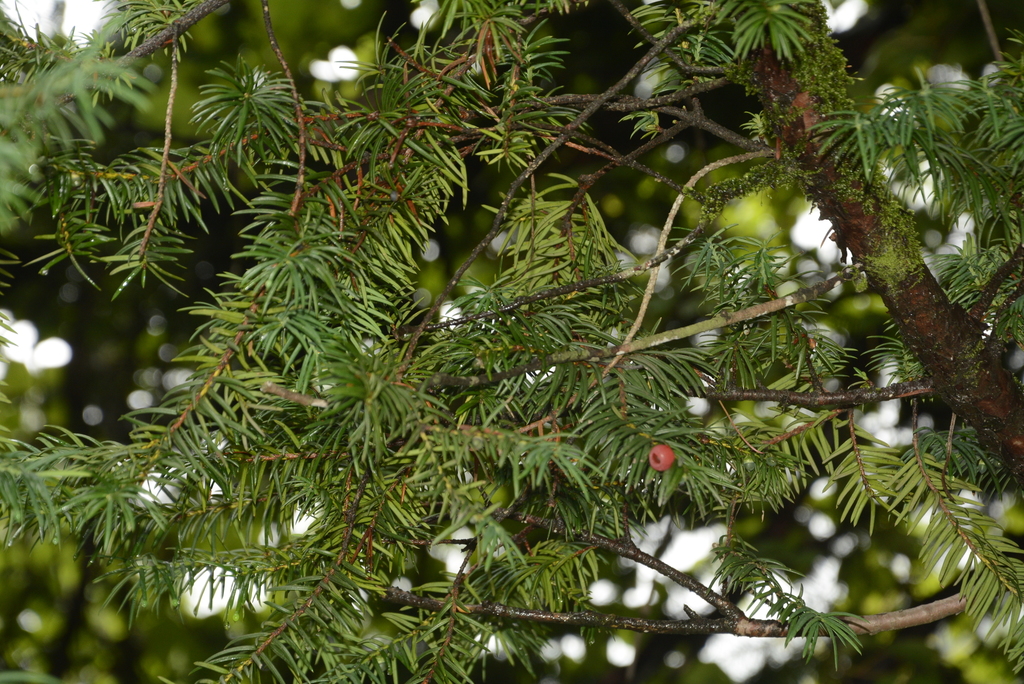
Himalayan Yew
Taxus wallichiana
Taxus wallichiana, the Himalayan yew, is a species of yew, native to the Himalaya and parts of south-east Asia. The species has a variety of uses in traditional medicine. It is currently classified as endangered by the IUCN.
From the article Taxus wallichiana on Wikipedia (CC BY-SA), quoted section by section
Range & habitat
The species favours a reasonably wide range of habitats, growing in montane, temperate, warm temperate, and tropical submontane to high montane forests which may be deciduous, evergreen, or of mixed character. In forests, it tends to present as a low canopy tree; in open situations it usually forms a large, broadly spreading shrub. Elevation ranges from 900 to 3,700 m (3,000 to 12,100 ft).
Wikipedia: “Distribution and habitat”
At the table
The tree has medicinal use in Ayurveda and Tibetan medicine. Taxus wallichiana is also a source of the chemical precursors to the anticancer drug paclitaxel (taxol). Taxus wallichiana is used for making tea by the Bhotiya tribal community in the Garhwal Himalaya. The stem bark of this species, which is locally known as thuner, is collected for this purpose. This species is also used as fuelwood by the local communities. In Himachal it is known to be medicine for some types of cancer. A high-quality phased genome of T. wallichiana has been sequenced, and collinearity analysis between it and other closely related species to gymnosperms has helped provide evidence explaining why Taxus species are the only plants providing a large-scale source of paclitaxel. Helping identify and annotate several CYP450 genes involved in the paclitaxel biosynthetic pathway.
Wikipedia: “Medicinal uses”
Where it lives
Recorded sightings
—
geo-referenced records in GBIF, from museums, herbaria and field observers.
Drag the globe to turn it. Dots are where records exist, not a range map; darker means more records.
In the stacks
Searching the stacks…
Every page naming Taxus wallichiana in the Biodiversity Heritage Library →
This page is assembled live from iNaturalist, GBIF, Wikipedia, the Source Library and the Internet Archive. It is not yet part of the hand-edited codex. iNaturalist taxon 135517.