- Plants
- ›Vascular Plants
- ›conifers
- ›conifers
- ›cypress family
- ›cypress-pines, incense-cedars, and allies
- ›Widdringtonia
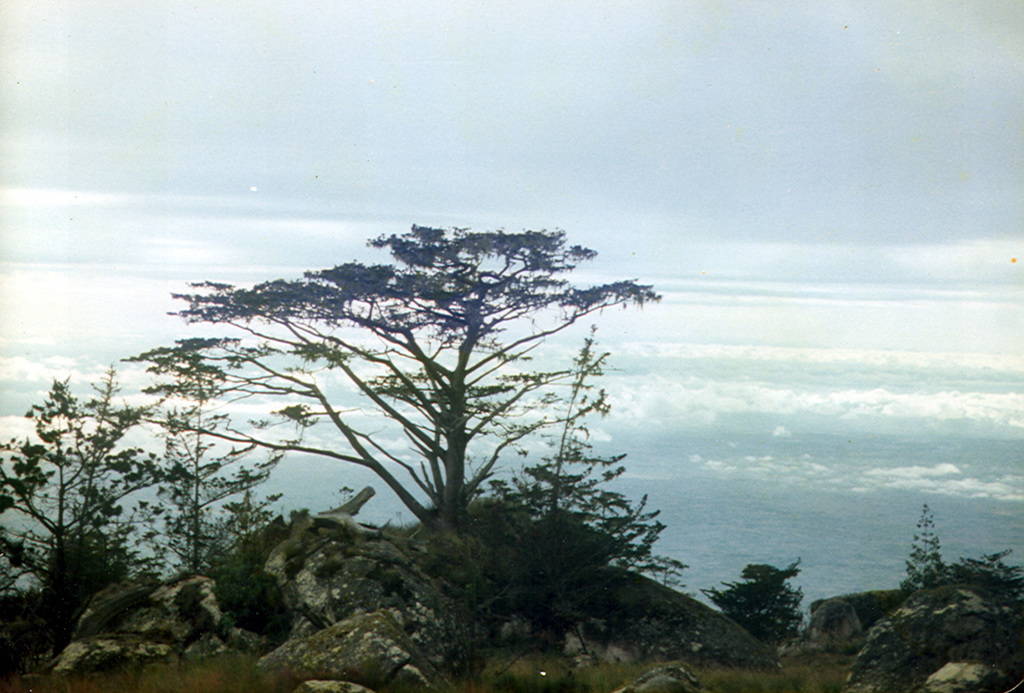
Mulanje cypress
Widdringtonia whytei
Widdringtonia whytei, the Mulanje cedar or Mulanje cypress, is a species of conifer in the cypress family, Cupressaceae, endemic to Malawi, where it is endemic to the Mulanje Massif at altitudes of 1,830–2,550 m (6,000–8,370 ft). It has become endangered as a result of over-harvesting for its wood, and an increase in the frequency of wildfires due to human activity.
From the article Widdringtonia whytei on Wikipedia (CC BY-SA), quoted section by section
Description
It is a large coniferous tree growing to 40–50 m (130–160 ft) tall. The leaves are scale-like, 1.5–3.5 mm long and 1–1.5 mm broad on small shoots, up to 10 mm long on strong-growing shoots, and arranged in opposite decussate pairs. The cones are globose, 1.5–2.2 cm (0.59–0.87 in) long, with four scales.
Range & habitat
The species Widdringtonia nodiflora is common in South Africa and Zimbabwe in its dwarf form which has little more stature that a scrubby bush. It is only on Mulanje and Mchese Mountain that a closely related tree form is found, Widdringtonia whytei, commonly known as Mulanje cedarwood, but renamed "Mulanje cypress" by the University of the Witwatersrand, to better reflect its botanical relationships. On these mountains the tree is limited to altitudes between 1,830 and 2,550 m (6,000 and 8,370 ft), and it is normally confined to hollows and valleys where the topography provides some protection from fire. Most commonly it occurs as small woodlands amongst rolling tussocky grassland slopes, between craggy, granite, rock faces. The timber is pale red, straight grained and pleasantly fragrant. Its major qualities are that it works well and is extremely durable, being resistant to attacks from termites, wood boring insects and fungi. For these reasons the timber achieved major economic significance during the first three decades of the 20th century, when it was high in demand for developing work. Currently the timber is most used in the making of local arts and crafts, fishing boats for Lake Malawi, as well as in the construction and decoration of many prestigious buildings.
Wikipedia: “Distribution”
Where it lives
Recorded sightings
—
geo-referenced records in GBIF, from museums, herbaria and field observers.
Drag the globe to turn it. Dots are where records exist, not a range map; darker means more records.
In the stacks
Searching the stacks…
Every page naming Widdringtonia whytei in the Biodiversity Heritage Library →
This page is assembled live from iNaturalist, GBIF, Wikipedia, the Source Library and the Internet Archive. It is not yet part of the hand-edited codex. iNaturalist taxon 135523.