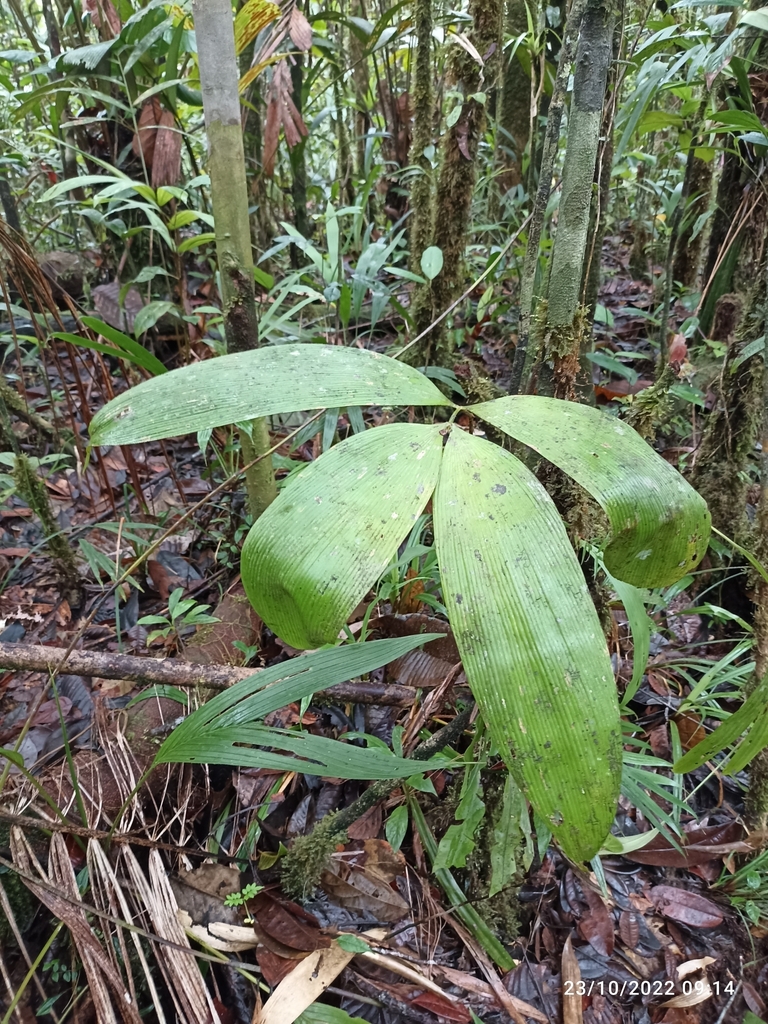
Zamia amplifolia
Zamia amplifolia is a species of plant in the Zamiaceae family. It is endemic to the Calima River watershed of Valle del Cauca Department, Colombia. It is threatened by habitat loss.
From the article Zamia amplifolia on Wikipedia (CC BY-SA), quoted section by section
Description
Zamia amplifolia is a bush or small tree, with a stem up to 2.5 metres (8 ft 2 in) tall. There are three to six leaves on a plant, 1 to 2 metres (3 ft 3 in to 6 ft 7 in) long, with a 0.5 to 1 metre (1 ft 8 in to 3 ft 3 in) long petiole (stalk). The stalk is covered with prickles, which may extend into the lower third of the leaf axis. There are six to ten leaflets, which are elliptical, pointed at the ends and with smooth edges. Leaflets in the middle of the leaf are 30 to 50 centimetres (12 to 20 in) long and 12 to 15 centimetres (4.7 to 5.9 in) wide. The specific name amplifolia technically refers to the size of the leaves, but was intended to refer to the very large leaflets. Like all Zamias, Z. amplifolia is dioecious, with each plant being either male or female. Male strobili (cones) are cylindrical to elongate-cylindrical, 8 to 12 centimetres (3.1 to 4.7 in) long and 1 to 2 centimetres (0.39 to 0.79 in) in diameter, and cream to tan in color. Female cones are ovoid to ovoid-cylindrical, 20 to 40 centimetres (7.9 to 15.7 in) long and 8 to 12 centimetres (3.1 to 4.7 in) in diameter, brown in color, and stand on shortpeduncles (stalks). Seeds are ovoid, 1.5 to 2.5 centimetres (0.59 to 0.98 in) in diameter, and have a red sarcotesta (outer fleshy coat).
Range & habitat
Zamia amplifolia appears to be very rare, with a very limited distribution. It has been found at only three locations very near the neotype location, and, as of 2004, had been found only four times since it was first described in 1878. Z. amplifolia is close in appearance to Z. skinneri, found in Panama, with the primary difference being that Z. amplifolia has smooth leaflet edges while those of Z. skinneri are toothed.
Wikipedia: “Distribution”
Where it lives
Recorded sightings
—
geo-referenced records in GBIF, from museums, herbaria and field observers.
Drag the globe to turn it. Dots are where records exist, not a range map; darker means more records.
In the stacks
Searching the stacks…
Every page naming Zamia amplifolia in the Biodiversity Heritage Library →
This page is assembled live from iNaturalist, GBIF, Wikipedia, the Source Library and the Internet Archive. It is not yet part of the hand-edited codex. iNaturalist taxon 135527.