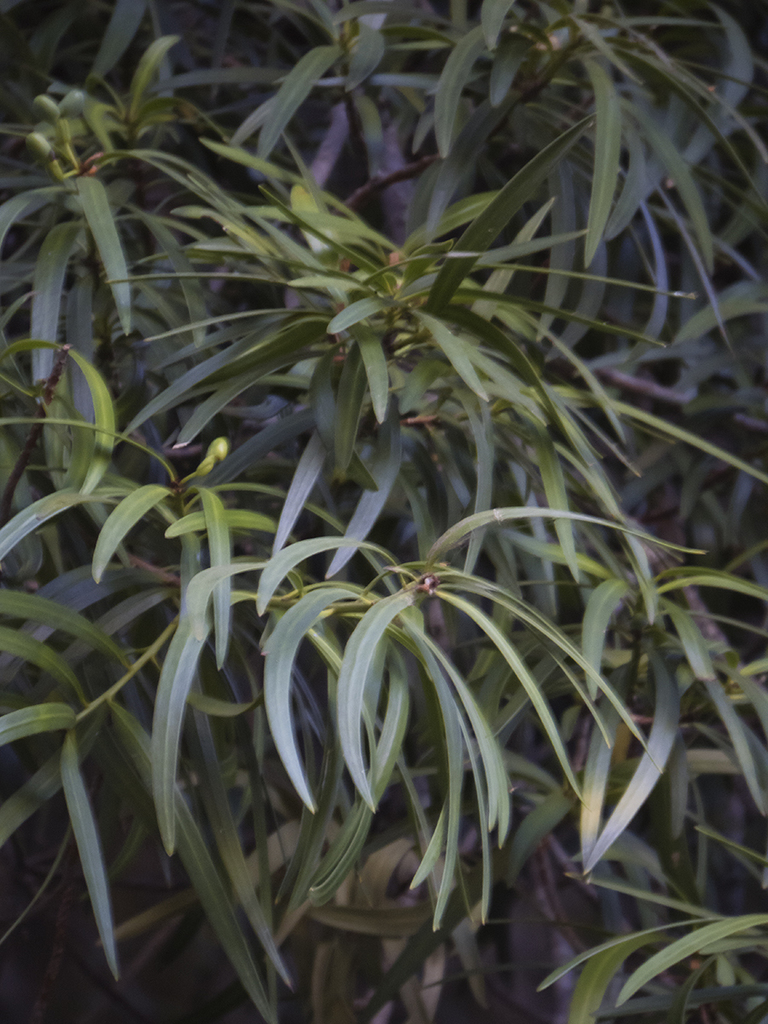
willow podocarp
Podocarpus salignus
Podocarpus salignus is a species of coniferous evergreen tree in the Podocarpaceae family. It is found only in Chile, from 35 to 42° south latitude, where it is threatened by habitat loss. Growing up to 20 m (66 ft) in height and 1 m (3 ft) in diameter, the trunk is straight and cylindrical, with reddish-gray bark. In Chile it is known as Mañío de hojas largas (long-leaved).
From the article Podocarpus salignus on Wikipedia (CC BY-SA), quoted section by section
Description
Podocarpus salignus is a species of coniferous tree that reaches up to 20 m (66 ft) in height and 1 m (3 ft) in diameter, the trunk is straight and cylindrical, with reddish-gray bark. The arching branches bear long, narrow, willow-like leaves, and red fleshy oval fruits where male and female plants are grown together.
At the table
This tree is grown in gardens and parks of Chile, and has been introduced to the British Isles. It requires heavy rainfalls or high humidity, but withstands temperatures down to −25 °C (−13 °F). It has gained the Royal Horticultural Society's Award of Garden Merit. The wood is of good quality, yellowish colored, straight grained, and highly moisture resistant. It is used in furniture and construction.
Wikipedia: “Cultivation and uses”
Where it lives
Recorded sightings
—
geo-referenced records in GBIF, from museums, herbaria and field observers.
Drag the globe to turn it. Dots are where records exist, not a range map; darker means more records.
In the stacks
Searching the stacks…
Every page naming Podocarpus salignus in the Biodiversity Heritage Library →
This page is assembled live from iNaturalist, GBIF, Wikipedia, the Source Library and the Internet Archive. It is not yet part of the hand-edited codex. iNaturalist taxon 135647.