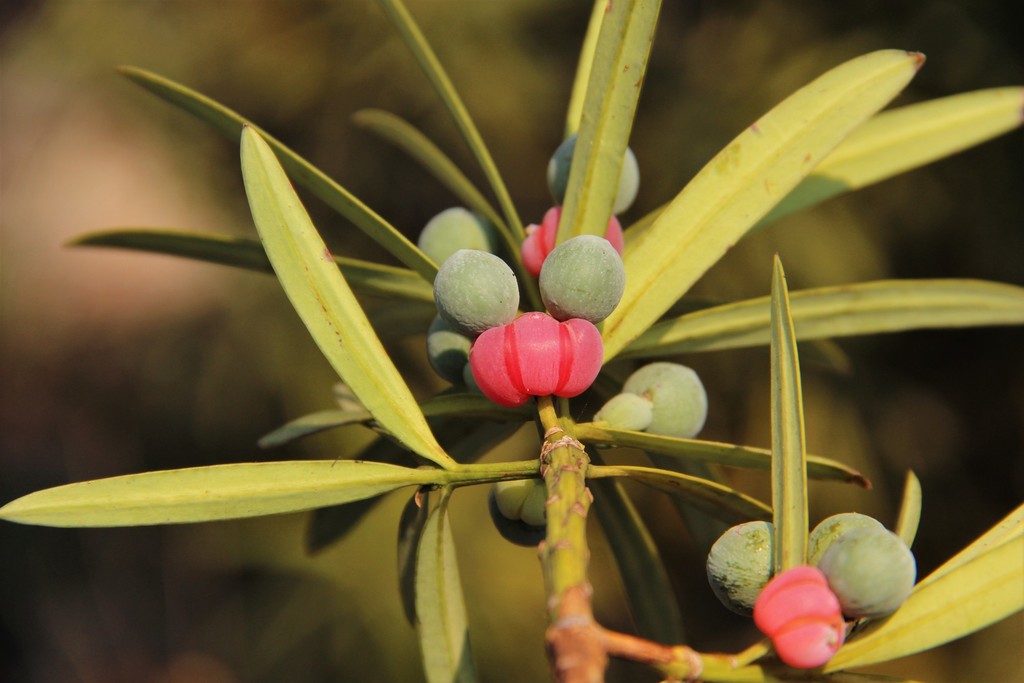
East African Yellowwood
Podocarpus milanjianus
Podocarpus milanjianus is a species of conifer in the Podocarpaceae family. It is found in Angola, Burundi, Cameroon, Republic of the Congo, Democratic Republic of the Congo, Kenya, Malawi, Mozambique, Nigeria, Rwanda, Sudan, Tanzania, Uganda, Zambia, and Zimbabwe.
From the article Podocarpus milanjianus on Wikipedia (CC BY-SA), quoted section by section
Description
Podocarpus milanjianus is a medium-sized coniferous tree which can grow slowly up to 35 meters in height, and up to 40 meters in favorable conditions. It is generally conical in form, with a straight cylindrical trunk. The trunk of mature trees can range from 150 to 300 cm in diameter, and unbranched for the first 10 to 20 meters from the ground. Some trees have a buttressed base. The leaves are narrow, glossy, and bright green. The trees are dioecious, meaning male and female trees are required to produce cones and seeds.
Range & habitat
Podocarpus milanjianus is the most widespread African podocarp. It is found in Angola, Burundi, Cameroon, Republic of the Congo, Democratic Republic of the Congo, Kenya, Malawi, Mozambique, Nigeria, Rwanda, Sudan, Tanzania, Uganda, Zambia, and Zimbabwe. It grows in tropical montane (Afromontane) evergreen rainforests, cloud forests, and high-elevation dwarf forests, between 900 and 3,250 meters elevation. The tree is widespread and locally plentiful, and is rated "least concern" in the IUCN Red List of Threatened Species.
Relationship to Podocarpus latifolius. Podocarpus milanjianus is closely related to Podocarpus latifolius. Whether they are a single or two separate species is not settled. Some authorities, including Plants of the World Online, treat the South African populations as Podocarpus latifolius, and those elsewhere in Africa as Podocarpus milanjianus. Others treat them as a single species, Podocarpus latifolius. A 2020 study sampled DNA from Podocarpus latifolius and Podocarpus milanjianus trees, gathered from 88 sites across Africa. They concluded that all populations sampled constituted a single species: "As South African samples (P. latifolius) did not form a clade separated from the other clades (P. milanjianus), we confirm that the two taxa can be considered as synonyms." The authors concluded that the species originated in East Africa. …
Wikipedia: “Habitat and range”
At the table
Podocarpus milanjianus is valued as a timber tree, both commercially and artisanally. It produces straight pale yellow timber, which is fine-grained and easily sawn and worked. The tree is used to provide shade in tea, coffee, cocoa, and banana plantations, in reforestation projects, and as a roadside or ornamental tree. Parts of the tree have minor local uses as food (the fleshy receptacles at the seed base) or medicine (bark or leaves).
== References ==
Wikipedia: “Uses”
Where it lives
Recorded sightings
—
geo-referenced records in GBIF, from museums, herbaria and field observers.
Drag the globe to turn it. Dots are where records exist, not a range map; darker means more records.
In the stacks
Searching the stacks…
Every page naming Podocarpus milanjianus in the Biodiversity Heritage Library →
This page is assembled live from iNaturalist, GBIF, Wikipedia, the Source Library and the Internet Archive. It is not yet part of the hand-edited codex. iNaturalist taxon 135701.