- Plants
- ›Vascular Plants
- ›conifers
- ›conifers
- ›pine family
- ›pines, spruces, larches, and allies
- ›Pinus
- ›Strobus
- ›Parrya
- ›Rzedowskiae
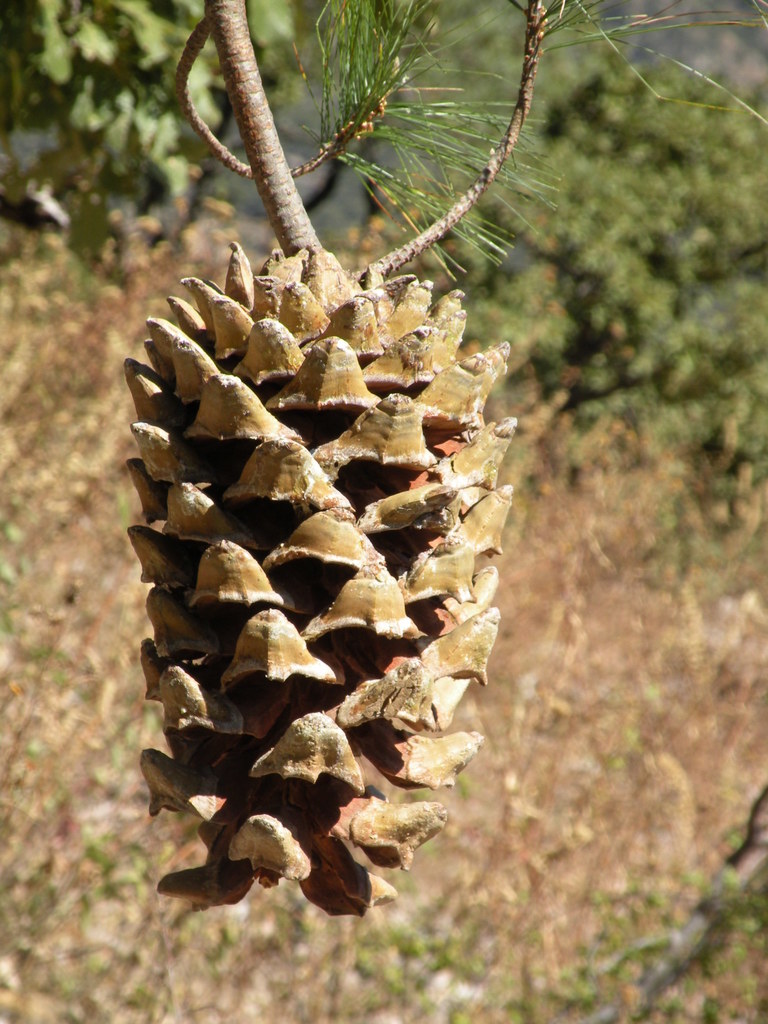
big-cone pinyon
Pinus maximartinezii
Pinus maximartinezii, called Martinez pinyon, big-cone pinyon or maxipiñon, is a pine in the pinyon pine group, native to central Mexico. The range is highly localised, confined to a small area of the southern Sierra Madre Occidental in southern Zacatecas. It occurs at moderate altitudes, from 1800–2400 m and 21° North latitude, in warm and temperate, dry climate conditions.
From the article Pinus maximartinezii on Wikipedia (CC BY-SA), quoted section by section
Description
It is a small tree, reaching 5–15 m (16–49 ft) tall and with a trunk diameter of up to 50 cm (20 in). The bark is brown, thick and fissured at the base of the trunk. The leaves ('needles') are in fascicles of five, slender, 7–13 cm (2+3⁄4–5 in) long, and deep green to blue-green, with stomata confined to a bright white band on the inner surfaces. The cones are ovoid, massive, 15–27 cm (6–10+3⁄4 in) long and 8–14 cm (3+1⁄4–5+1⁄2 in) broad and up to 2 kg (4.4 lb) weight when closed, green at first, ripening yellow-brown when 26–28 months old, with very thick, woody scales, typically 30–60 fertile scales. The scales are unusual for a pine in the soft pine group (Pinus subgenus Strobus); most pines in that group have flexible scales. The cones open to 10–15 cm (4–6 in) broad when mature. The seeds are 2–3 cm (3⁄4–1+1⁄4 in) long, with a thick shell, with a vestigial 1–2 mm (0.04–0.08 in) wing; the seedlings have 18–24 cotyledons, the highest number reported for any plant. It differs from all other pinyon species in that it has very massive cones and large seeds. Like other pinyons, the seeds are edible; this represents a threat to the species' survival, as the majority of the seeds produced are harvested, limiting natural regeneration of the pines.
Range & habitat
The range is highly localised, confined to two small areas of the southern Sierra Madre Occidental – the Sierra de Morones in southern Zacatecas, and La Muralla in Durango. It occurs at moderate altitudes, from 1800–2400 m and 21° North latitude, in warm and temperate, dry climate conditions. The Mexican government has declared this species endangered.
Wikipedia: “Range and habitat”
Where it lives
Recorded sightings
—
geo-referenced records in GBIF, from museums, herbaria and field observers.
Drag the globe to turn it. Dots are where records exist, not a range map; darker means more records.
In the stacks
Searching the stacks…
Every page naming Pinus maximartinezii in the Biodiversity Heritage Library →
This page is assembled live from iNaturalist, GBIF, Wikipedia, the Source Library and the Internet Archive. It is not yet part of the hand-edited codex. iNaturalist taxon 135787.