- Plants
- ›Vascular Plants
- ›conifers
- ›conifers
- ›cypress family
- ›Cypresses, Cedars, Junipers, and Allies
- ›Juniperus
- ›Caryocedrus
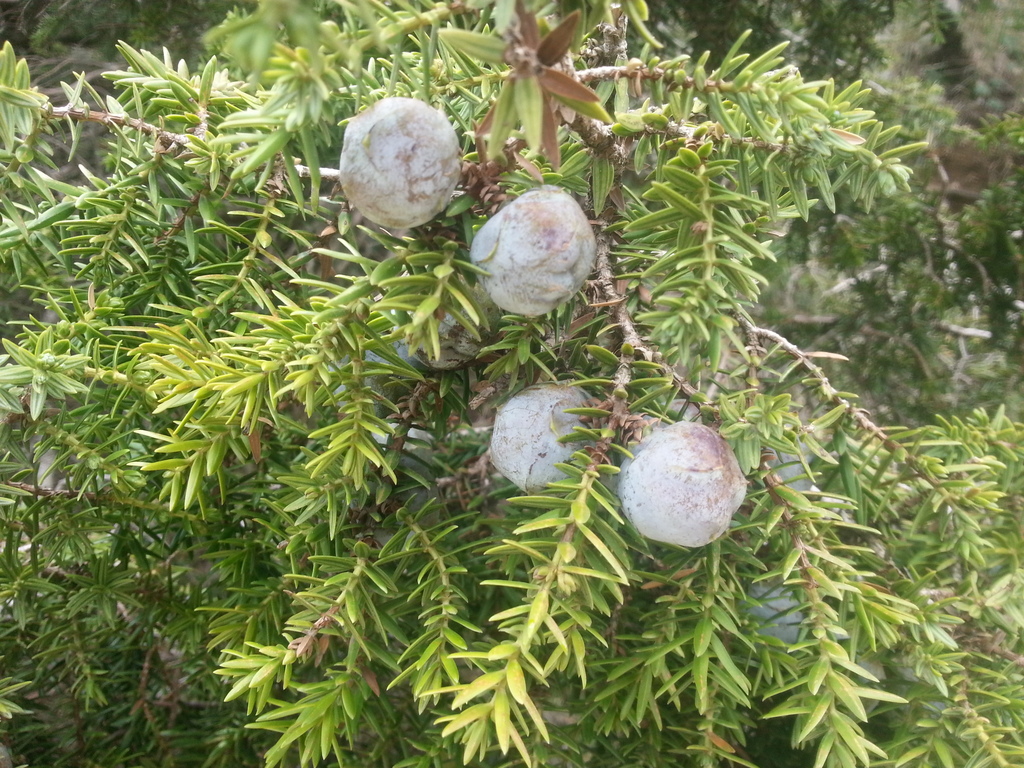
Syrian juniper
Juniperus drupacea
Juniperus drupacea, the Syrian juniper, is a species of juniper native to the eastern Mediterranean region from southern Greece (mount Parnon in the Peloponnese), southern Turkey, western Syria, Lebanon, and northern Israel, growing on rocky sites from 800–1,700 metres (2,600–5,600 feet) in altitude. The species is the sole member of Juniperus sect. Caryocedrus., which is sometimes recognised as genus Arceuthos.
From the article Juniperus drupacea on Wikipedia (CC BY-SA), quoted section by section
Description
Juniperus drupacea is the tallest species of juniper, forming a conical tree 10–25 metres (33–82 feet) tall, exceptionally up to 40 m (130 ft), and with a trunk up to 1–2 m (3+1⁄2–6+1⁄2 ft) thick. It has needle-like leaves in whorls of three; the leaves are green, 5–25 millimetres (1⁄4–1 in) long and 2–3 mm broad, with a double white stomatal band (split by a green midrib) on the inner surface. It is usually dioecious, with separate male and female plants. The seed cones are the largest of any juniper, berry-like but hard and dry, green ripening in about 25 months to dark purple-brown with a pale blue waxy coating; they are ovoid to spherical, 20–27 mm (3⁄4–1 in) long and 20–25 mm diameter, and have six or nine fused scales in 2–3 whorls, each scale with a slightly raised apex. The three apical scales each bear a single seed, but with the three seeds fused together into a single nut-like shell. The male cones are produced in clusters (unlike any other juniper) of 5–20 cones together, yellow, 3–4 mm long, and fall soon after shedding their pollen in early spring.
At the table
In Southeastern Turkey, on mountainsides of Enekli Tepe, the fruit is boiled into an edible concentrate, to be preserved, and then consumed. This solution is called pekmez, and in addition to being nutritious, and promoting energy, is seen as an aphrodisiac. It is also used to treat asthma. Additional time-honoured medicinal uses for the tree in Turkey include treatment of haemorrhoids, stomach ailments, urinary infections, gout, wounds, diarrhoea, cough, and ordinary cold symptoms.
Wikipedia: “Culinary and Medicinal Uses”
Where it lives
Recorded sightings
—
geo-referenced records in GBIF, from museums, herbaria and field observers.
Drag the globe to turn it. Dots are where records exist, not a range map; darker means more records.
In the stacks
Searching the stacks…
Every page naming Juniperus drupacea in the Biodiversity Heritage Library →
This page is assembled live from iNaturalist, GBIF, Wikipedia, the Source Library and the Internet Archive. It is not yet part of the hand-edited codex. iNaturalist taxon 135935.