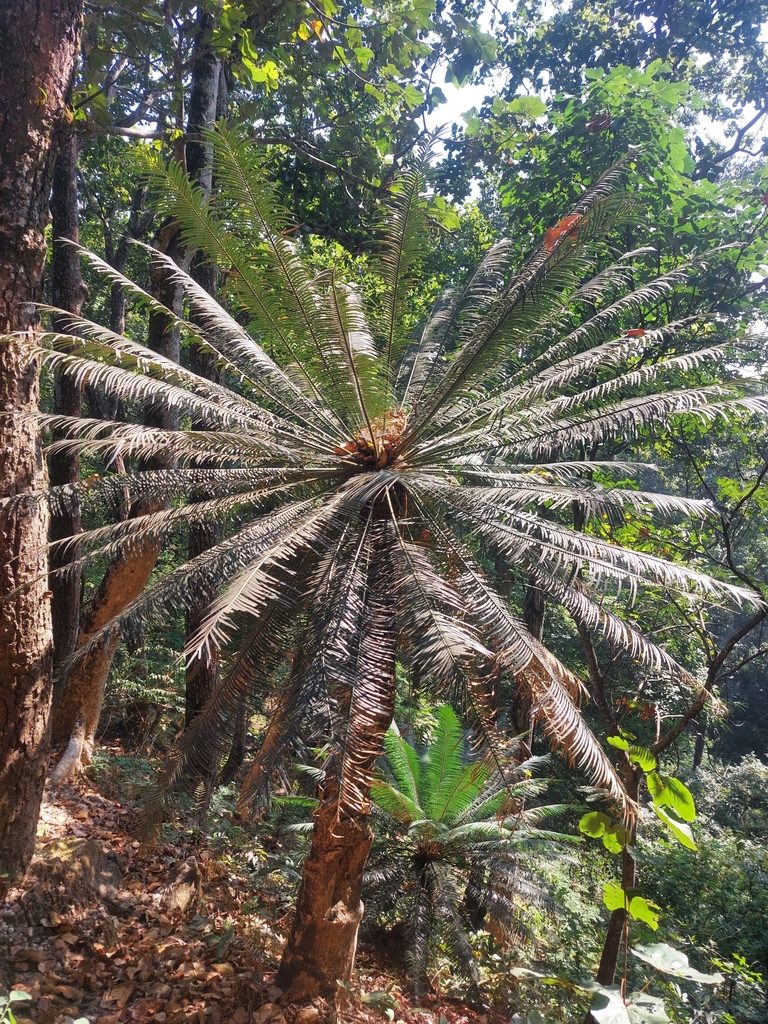
Cycas pectinata
Cycas pectinata is a species of Cycas, the fourth to be named; it was described in 1826 by Scottish surgeon and botanist Francis Buchanan-Hamilton from Kamrup, Assam in northeast India. The species is one of the most widespread cycads. It is found in the northeastern part of India (Assam, Manipur, Meghalaya, Sikkim, Darjeeling), Nepal, Bhutan, Myanmar, southern China (Yunnan), Bangladesh, Malaysia, Cambodia, northern Thailand, Laos, and Vietnam. Cycas pectinata usually grows at elevations from 300 m to 1200 m and in difficult terrains. In China, it grows in dry, open thickets in limestone mountains and red soil in sparse monsoon forests. Cycas pectinata grows up to 40 feet (12 m) tall and has very large, ovoid male cones. The tallest Cycas pectinata is a female plant in North Kamrup, Assam which measures 52.8 feet (16.1 m). The tree is the world's tallest Cycas plant. In Northeast India, the species is under severe threat due to clearing of forest and overcollection of male cones for preparation of traditional medicines. The species is listed in CITES Appendix II and IUCN Red List.
From the article Cycas pectinata on Wikipedia (CC BY-SA), quoted section by section
Description
Tall evergreen trees with crown of leaves at the apex of trunk. Stems robust, glabrous at base and usually branched when mature. Leaves 1 to 2 m long, dark green. Male cones usually large, cylindrically ovoid and yellowish or orange in maturity. Megasporophylls deeply pectinate and densely covered with hairs. Seeds ovoid, glabrous and orange to red-yellow on maturity.
Wikipedia: “Morphology”
In medicine
Young fronds are eaten as vegetables in Manipur and Sikkim. Seeds of Cycas pectinata are traditionally utilized as a source of starch by indigenous tribes and are eaten raw or roasted in Assam and the bordering region of Meghalaya. Microsporophylls are chewed raw to cure stomach-aches and ulcers. The young microsporophylls are eaten by young men in Meghalaya and Assam to enhance male sexual potency.
Wikipedia: “Traditional”
Where it lives
Recorded sightings
—
geo-referenced records in GBIF, from museums, herbaria and field observers.
Drag the globe to turn it. Dots are where records exist, not a range map; darker means more records.
In the stacks
Searching the stacks…
Every page naming Cycas pectinata in the Biodiversity Heritage Library →
This page is assembled live from iNaturalist, GBIF, Wikipedia, the Source Library and the Internet Archive. It is not yet part of the hand-edited codex. iNaturalist taxon 136016.