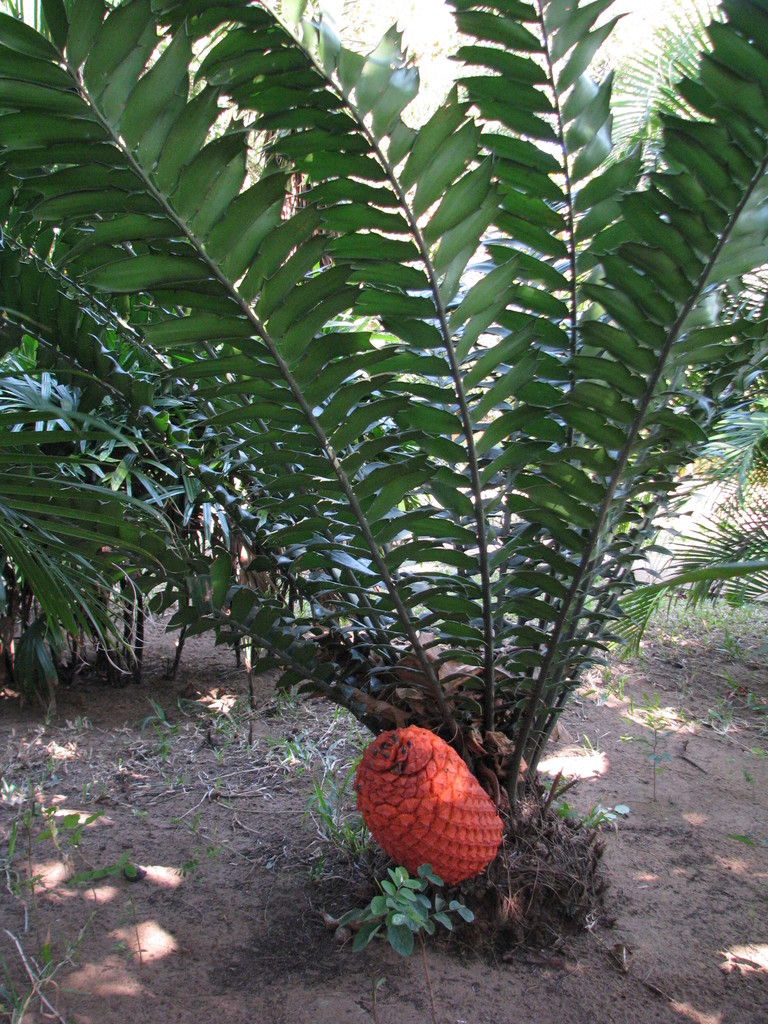
Maputaland Cycad
Encephalartos ferox
Encephalartos ferox, a member of the family Zamiaceae, is a small cycad with 35 cm wide subterranean trunk. It gets its name from the Latin word ferocious, likely from the spine-tipped lobes on the leaves of the plant. It is found naturally on the south-eastern coast of Africa where it has been used by local people for its starch content. It is considered to be one of the most popular cultivated cycads.
From the article Encephalartos ferox on Wikipedia (CC BY-SA), quoted section by section
Range & habitat
E. ferox is found along the southern coast of Mozambique and in northern Natal and can be found very close to the ocean on white beach sand, often growing near other vegetation on the sand dunes. It is also found in evergreen forests. Its preferred habitat is very humid in the summer and rainfall amounts can range from 1,000 mm to 1,250 mm per year. The climate is more mild in the winter, and it is uncertain whether the species is ever exposed to frost.
Wikipedia: “Habitat”
What it does
E. ferox is reported to grow relatively fast compared to members of other cycad genera, but are considered slow-growing when compared to other orders and classes. E. ferox reproduces using cones that are of a dark salmon color, as opposed to the greenish coloration typical of other cycads. It shares this coloration with E. gratus, although the two species likely evolved this condition independently. The cones are sexually dimorphic: the male cone is a 40 to 50 cm long cylinder that is 7 to 10 cm wide with a peduncle that is up to 2 to 3 cm long; the female cone is 25 to 50 cm long, 20 to 25 cm wide, and sessile. Males can have up to ten cones at one time and females can have up to five cones at one time. The cones also emerge in succession, rather than emerging simultaneously. The shields of the megasporophylls are pyramidal shaped, with flattened facets. The seeds, which are about 4.5 to 5 cm long and 1.5 to 2 cm wide, are red, narrow, oblong and glossy.
Wikipedia: “Reproduction and growth”
How it is grown
Cultivation is very popular among E. ferox since it can be grown fairly easily as long as there is plenty of water, well-drained soil, and moderate temperatures. It is not very tolerant to frost, and it is best suited in warmer regions. They can be propagated from both the seed and from the removal of suckers. Humans have been known to obtain and consume starch that is found in the stem of E. ferox. It can be used by local people for starch content
Wikipedia: “Human use and cultivation”
In human culture
E. ferox is not able to hybridize with other species of the genus Encephalartos very successfully. The chromosome number in E. ferox, as well as other species of the genus Encephalartos for which chromosome number has been found, is 2n = 18. It is possible that E. ferox is most closely related to E. arenarius due to a similar ecology and similar leaf and cone morphologies. One study used E. ferox as an out group in a comparison of eight Eastern Cape species because it was considered distantly related to those species.
Wikipedia: “Genetics and evolutionary history”
Where it lives
Recorded sightings
—
geo-referenced records in GBIF, from museums, herbaria and field observers.
Drag the globe to turn it. Dots are where records exist, not a range map; darker means more records.
In the stacks
Searching the stacks…
Every page naming Encephalartos ferox in the Biodiversity Heritage Library →
This page is assembled live from iNaturalist, GBIF, Wikipedia, the Source Library and the Internet Archive. It is not yet part of the hand-edited codex. iNaturalist taxon 136025.