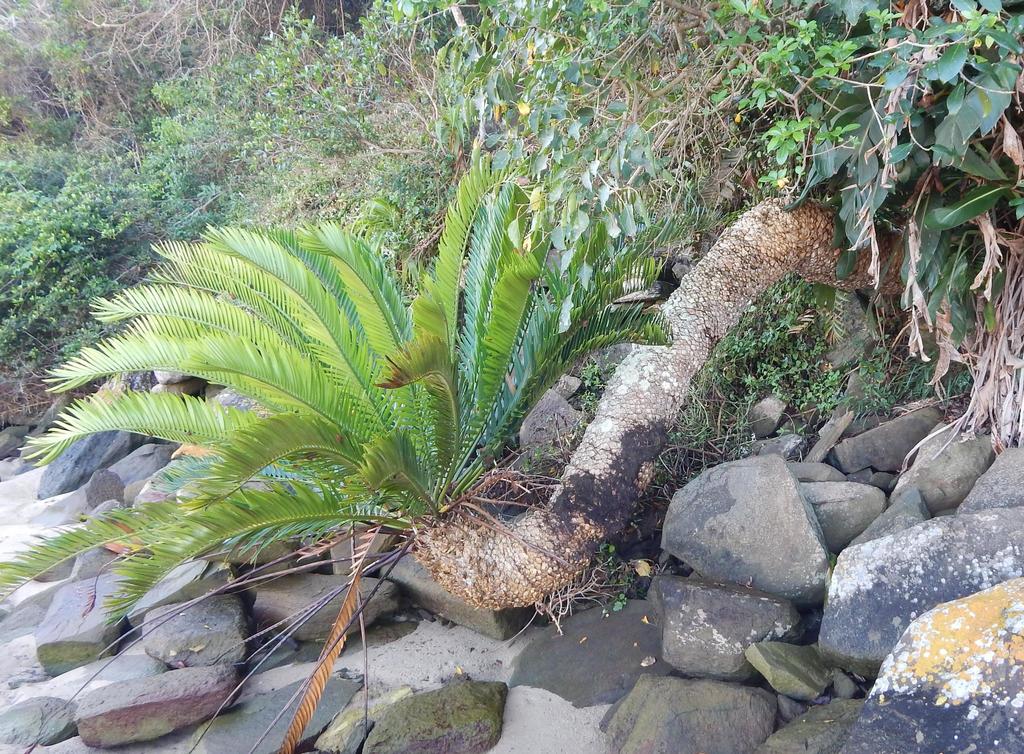
Eastern Cape giant cycad
Encephalartos altensteinii
Encephalartos altensteinii is a species of palm-like cycad in the family Zamiaceae. It is endemic to South Africa. The species name altensteinii commemorates Altenstein, a 19th-century German chancellor and patron of science. It is commonly known as the breadtree, broodboom, Eastern Cape giant cycad or uJobane (Zulu). It is listed as vulnerable due to habitat destruction, use for traditional medicine and removal by collectors.
From the article Encephalartos altensteinii on Wikipedia (CC BY-SA), quoted section by section
Description
This cycad grows up to seven metres (23 ft) tall and may be branched or unbranched. The leaves are straight or curved backwards and up to three metres (9.8 ft) in length. The leaflets are rigid and fairly broad with one or both margins toothed. There are no prickles at the base of the leaf which distinguishes it from E. natalensis. There are usually two to five greenish-yellow cones up to 50 centimetres (20 in) long, the female scales covered with protuberances. The cones are poisonous to humans. The seeds are scarlet and up to four centimetres (1.6 in) long.
Range & habitat
This species is widespread in the Eastern Cape and south-western KwaZulu-Natal provinces of South Africa. It favours sites near the coast including open scrub, steep rocky slopes, evergreen forests in valleys and river banks. It also occurs inland at a higher altitude in isolated sites in the Amatola Mountains. The individual growing in the Palm House at Royal Botanic Gardens, Kew, UK is considered to be the oldest potted plant in the world, having arrived there in 1775. Other individuals have also reached a great age, with the one in Lednice Greenhouse, Czech Republic estimated to be 300 to 600 years old.
Wikipedia: “Distribution and habitat”
Where it lives
Recorded sightings
—
geo-referenced records in GBIF, from museums, herbaria and field observers.
Drag the globe to turn it. Dots are where records exist, not a range map; darker means more records.
In the stacks
Searching the stacks…
Every page naming Encephalartos altensteinii in the Biodiversity Heritage Library →
This page is assembled live from iNaturalist, GBIF, Wikipedia, the Source Library and the Internet Archive. It is not yet part of the hand-edited codex. iNaturalist taxon 136096.