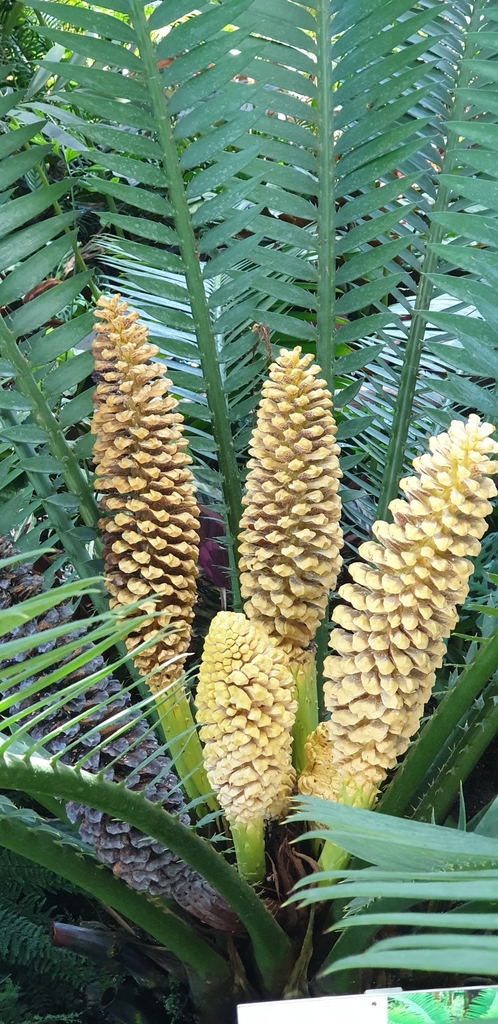
Encephalartos kisambo
Encephalartos kisambo is a species of cycad in the family Zamiaceae native to Kenya and Tanzania. It is known as the Voi cycad. The species grows on steep, forested hills and rocky slopes, including cloud forest habitat. It is threatened by habitat loss and over-collection for the horticultural trade.
From the article Encephalartos kisambo on Wikipedia (CC BY-SA), quoted section by section
Description
Encephalartos kisambo is an arborescent, dioecious cycad with a stout, barrel-shaped trunk 1.2–2 m tall and 45–52 cm in diameter, erect or sometimes decumbent. The crown bears dark green pinnate leaves 240–360 cm long with a short petiole. Young leaves are initially covered in tan hairs and later become smooth. The median leaflets are leathery, falcate to oblanceolate, slightly overlapping along the rachis, and armed with several spines near the base of the distal margin. Male plants bear several cylindrical cones, creamy yellow at maturity, while female plants bear 1–5 ovoid to cylindrical cones that mature from pale yellow to orange or tan. The seeds are ovoid to ellipsoid and covered with an orange to orange-red fleshy outer layer.
Range & habitat
The species is native to Kenya and Tanzania. When it was formally described, it was known with certainty only from a very small area in the Maungu Hills of Kenya. There it was reported from evergreen mist forest and, more occasionally, from exposed slopes in dry bushland at elevations of 800–1,050 m. Most populations occur on steep mountain hills near the Kenya–Tanzania border, where the plants grow in misty forest and cloud forest, with some individuals on drier rocky slopes and cliffsides. A more southerly population occurs on Mount Kanga, a hill in the Nguru Mountains of Mvomero District, Morogoro Region, Tanzania. There the plants grow on the southern ridge and south-eastern slopes at elevations of 1,000–1,300 m, among forest and rocky heath vegetation.
Wikipedia: “Distribution and habitat”
Where it lives
Recorded sightings
—
geo-referenced records in GBIF, from museums, herbaria and field observers.
Drag the globe to turn it. Dots are where records exist, not a range map; darker means more records.
In the stacks
Searching the stacks…
Every page naming Encephalartos kisambo in the Biodiversity Heritage Library →
This page is assembled live from iNaturalist, GBIF, Wikipedia, the Source Library and the Internet Archive. It is not yet part of the hand-edited codex. iNaturalist taxon 136110.