- Animals
- ›Arthropods
- ›Crustaceans
- ›Typical Crustaceans
- ›Malacostracans
- ›Decapods, Isopods, and allies
- ›Amphipods, Isopods, and Allies
- ›Amphipods
- ›Senticaudata
- ›Gammarida
- ›Gammaridira
- ›Gammaroidea
- ›Macrohectopidae
- ›Macrohectopus
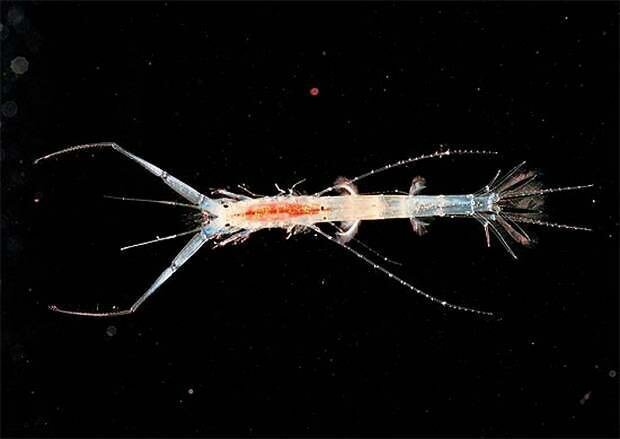
Macrohectopus branickii
Macrohectopus branickii is a species of amphipod (a group containing the scuds) living in the pelagic zone of Lake Baikal, believed to be the only species of amphipod in this niche within freshwater (many more amphipods are pelagic/planktonic in the sea, such as the Hyperiids). It is the only known species within the genus Macrohectopus and the only member of the family Macrohectopidae.
The sheer scale of Lake Baikal allows many species, including M. branickii, to occupy niches which do not exist in other freshwater ecosystems. These pelagic amphipods are prey to many animals within its ecosystem, including the top aquatic predator of the lake, the Baikal seal.
From the article Macrohectopus on Wikipedia (CC BY-SA), quoted section by section
Description
Macrohectopus branickii was described by Benedykt Dybowski, who diagnosed it as possessing two pairs of antennae covered in setae, with the upper pair more robust and elongate, kidney-shaped eyes that each occupy half of the head, smooth body segments, along with keeled and spined tail segments. The laminae of the gills and brood plates are not covered, and are visible from the side. The chitinous segments are near-transparent, making the animal "clear as water"; which makes the muscle fibers visible without dissection. This is likely to be a means of camouflage; Cystisoma, a marine amphipod, is similarly transparent to avoid predation. Indeed, Takhteev noted that M. branickii exhibits some ecological parallels with other marine amphipods, those being the Vitjazianidae and Hyperiopsidae families. Male M. branickii are up to 6 mm (0.24 in) long, immature females are 7–14 mm (0.28–0.55 in), and mature females reach up to 37 mm (1.5 in); they exhibit significant sexual size dimorphism, with some considering the males to be "dwarfed". The mitochondrial genome of M. branickii was analyzed in 2021; containing 42,256 base pairs, it is the longest sequence known for amphipods and one of the largest genomes within the animal kingdom.
What it does
Macrohectopus branickii is endemic to Lake Baikal, with the "center" of its range being the deepest, central part of the lake. It prefers waters colder than 4 °C (39 °F). Lake Baikal contains a great diversity of amphipod species; 40% of all known species of gammaroid amphipods live within this lake, and they have undergone significant adaptive radiation into a plethora of morphological forms. Out of all these species, M. branickii is the only pelagic member of the group; molecular and morphological analysis, however, indicates that the genus originates within Micruropodidae, a family of burrowers, though Micruropus wahli is a capable swimmer and may be caught at the surface through light-fishing; this attraction to light is also observed for the pelagic amphipod. Phototaxis may make them vulnerable to light pollution in littoral zones close to settlements.
The pelagic amphipod migrates throughout the lake all year round, continuing to do so in their peak breeding season. This species also undergoes diel vertical migration, moving to the surface at night from their daytime depth range of 200–700 m (660–2,300 ft). The larger mature females inhabit the deeper range of this depth compared to smaller individuals. During nighttime, they may be especially abundant in the water column above underwater slopes. …
Wikipedia: “Ecology”
Where it lives
Recorded sightings
—
geo-referenced records in GBIF, from museums, herbaria and field observers.
Drag the globe to turn it. Dots are where records exist, not a range map; darker means more records.
In the stacks
Searching the stacks…
Every page naming Macrohectopus branickii in the Biodiversity Heritage Library →
This page is assembled live from iNaturalist, GBIF, Wikipedia, the Source Library and the Internet Archive. It is not yet part of the hand-edited codex. iNaturalist taxon 1361328.