- Fungi Including Lichens
- ›Basidiomycete Fungi
- ›Higher Basidiomycetes
- ›Mushrooms, Bracket Fungi, Puffballs, and Allies
- ›Agaricomycetidae
- ›Common Gilled Mushrooms and Allies
- ›Agaricineae
- ›Webcaps
- ›Cortinarius
- ›Iodolentes
- ›Obtusi
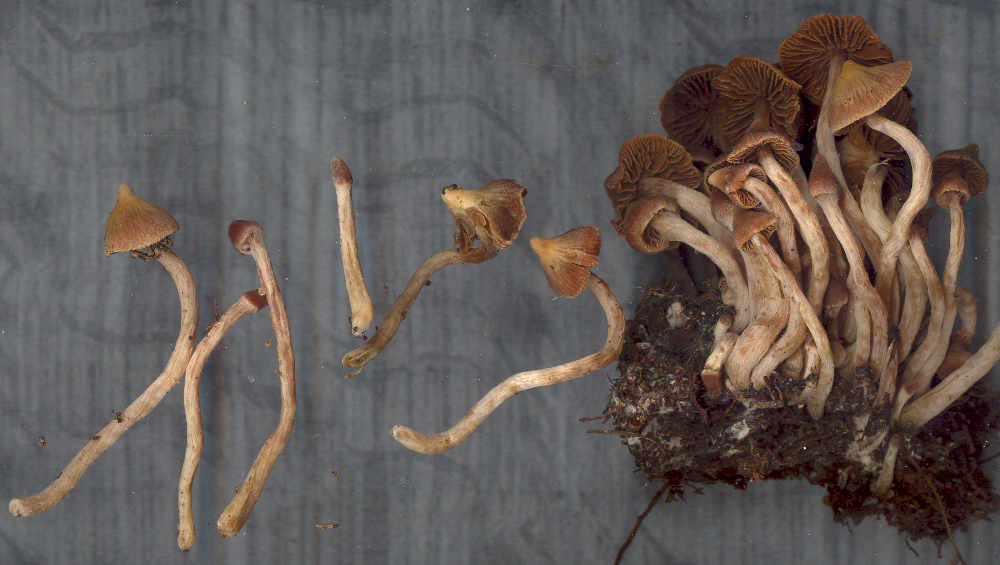
Cortinarius scoticus
Cortinarius scoticus is a little brown mushroom known from central and northern Europe, where it grows in pine forests. It was described in 2020, and named for Scotland, where it was first found. Along with five other British webcaps, C. scoticus was selected by Kew Gardens as a highlight of taxa described by the organisation's staff and affiliates in 2020.
From the article Cortinarius scoticus on Wikipedia (CC BY-SA), quoted section by section
Description
Cortinarius scoticus mushrooms have caps that are 0.7 to 1.5 centimetres (0.3 to 0.6 in) wide. They are hemispherical, maturing to a low convex or almost flat. The caps are red brown to dark red brown, and hygrophanous. The gills are brown and medium spaced. The stem is 4 to 6 centimetres (2 to 2 in) long and 0.2 to 0.3 centimetres (0.08 to 0.1 in) thick. The stems are cylindrical. When young, they are covered with silky, white fibrils, though they mature to yellowish brown. The flesh is brown. At the base of the stem, it has a weak, iodoform-like, smell that is best observed when the mushroom is slightly dried. In the gills, however, the scent is indistinct. The stem has a sparse, white, universal veil.
Microscopic characteristics. Cortinarius scoticus has basidiospores measuring 7.5 to 8.8 by 4.5 to 5.5 micrometres (μm). The spores are ellipsoid to somewhat almond-shaped, and moderately warty. They are fairly dextrinoid, meaning that they stain reddish to reddish-brown when Melzer's reagent or Lugol's solution is applied. The basidia are 25 to 34 by 7 to 10 μm. They are club-shaped, with four sterigmata. The hyphae in the flesh of the gills are yellowish brown, fairly strongly encrusted with zebra-striped encrustations. The surface of the pileipellis is pale, consisting of more or less parallel hyphae, 5 μm wide, without encrustations. …
What it does
Cortinarius scoticus is found in mesic and damp pine-dominated forests. It is known from central and northern Europe.
Wikipedia: “Ecology”
Where it lives
Recorded sightings
—
geo-referenced records in GBIF, from museums, herbaria and field observers.
Drag the globe to turn it. Dots are where records exist, not a range map; darker means more records.
In the stacks
Searching the stacks…
Every page naming Cortinarius scoticus in the Biodiversity Heritage Library →
This page is assembled live from iNaturalist, GBIF, Wikipedia, the Source Library and the Internet Archive. It is not yet part of the hand-edited codex. iNaturalist taxon 1361945.