 NL·0373
Herbarium of the Nature Library
- Name
- Conus geographus
- Family
- Conidae
- Native to
- Tropical Indo-Pacific, from East Africa and the Red Sea to Japan, Australia and Polynesia
- Habitat
- Coral reef, Sandy lagoon
Geography cone
Conus geographus
Also calledGeographer cone (English) · Anboina-gai (Japanese) · Cône géographe (French)
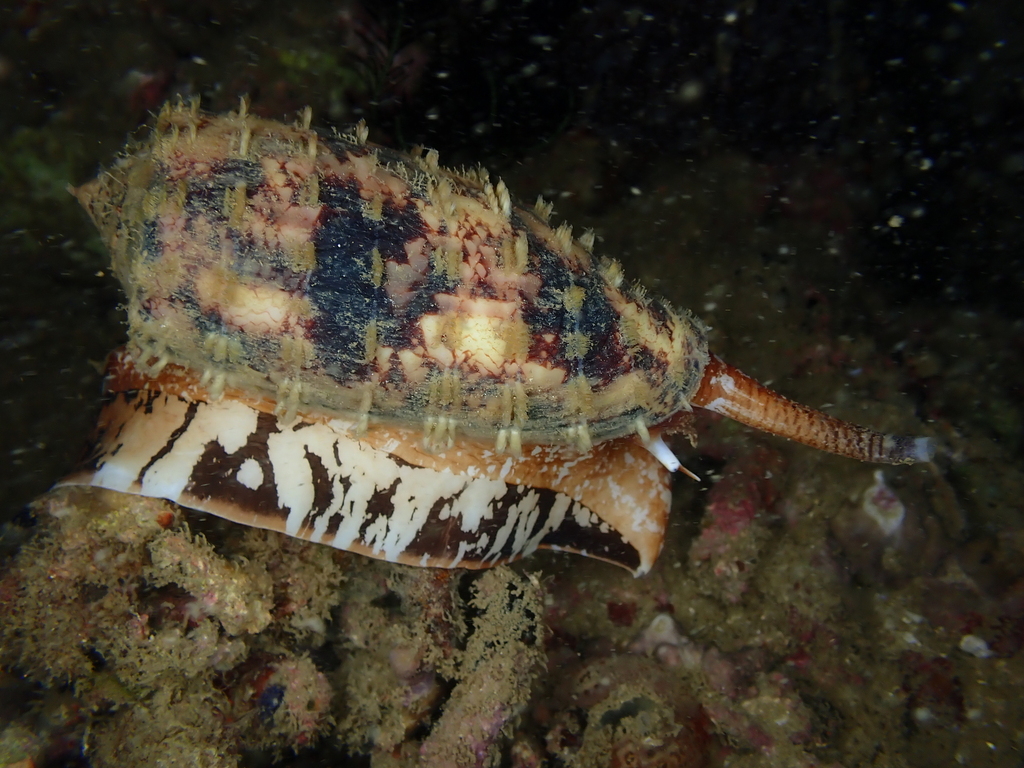
A beautifully patterned sea snail responsible for most of the recorded human deaths from cone snails. It hunts fish by engulfing them in a net-like mouth after releasing a cocktail of venoms that includes a fast-acting insulin.
Conus geographus, popularly called the geography cone, geographer cone, or geographic cone, is a species of predatory cone snail. It lives in reefs of the tropical Indo-Pacific and hunts small fish. While all cone snails hunt and kill prey using venom, the venom of Conus geographus is potent enough to kill humans. Wikipedia
What it can do
- iFires a harpoon-like hollow tooth loaded with venom
- iiReleases weaponised insulin into the water to send nearby fish into hypoglycaemic shock
- iiiVenom contains hundreds of different conotoxin peptides
- ivCan kill a human; dozens of deaths are documented
In the field
Field marks
- aThin, light, broad cone shell with a wide aperture
- bShoulder of the spire crowned with low knobs
- cWhitish to pinkish with brown net-like and blotchy bands, like an old map
- dBuried in sand by day
- Not to be confused with
- Tulip cone (Conus tulipa) is smaller with a violet-pink tinge; textile cone (C. textile) has a tent-shaped triangular pattern. All cone snails should be treated as dangerous.
- Where to see it
- Indo-Pacific reefs at night; often seen in shell collections. Never pick up a live cone.
- When
- Year-round
Life & habits
- Diet
- Small fish, engulfed in an expandable mouth (rostrum)
- Habitat
- Reef flats, lagoons and sandy patches between corals
- Size
- Shell up to about 15 cm
It hunts at night, spreading its false mouth over resting fish, which are sedated by venom and insulin before being stung and swallowed whole.
Where it lives
Recorded sightings
—
geo-referenced records in GBIF, from museums, herbaria and field observers.
Native range
Tropical Indo-Pacific, from East Africa and the Red Sea to Japan, Australia and Polynesia
Drag the globe to turn it. Dots are where records exist, not a range map; darker means more records.
In the old herbals & bestiaries
No plate in the Source Library names this exact species, so these show its closest relatives as the old naturalists drew them: same genus, or the same kind of animal. Click a plate to read the page it came from, with translation.

In the stacks
Searching the stacks…
Every page naming Conus geographus in the Biodiversity Heritage Library →
Marginalia
Georg Rumphius recorded in 1705 that a woman on Ambon died after holding a live cone shell; Japanese call it Anboina-gai, the 'Ambon shell'.
Curiosity
Fish-hunting cones like this one helped researchers discover very fast-acting insulin forms that are being studied for diabetes treatment.
Kinship





Photographs: iNaturalist contributors under the licences shown. Records: GBIF.org. Historical plates: Source Library (CC BY-SA 4.0; originals public domain). Summary text: Nature Library editors and Wikipedia (CC BY-SA). Medicinal and edibility notes are historical and educational, not advice. iNaturalist taxon 136427.