- Plants
- ›Vascular Plants
- ›flowering plants
- ›Dicots
- ›Gentians, Dogbanes, Madders, and Allies
- ›madder family
- ›Cinchonoideae
- ›Naucleeae
- ›Nauclea
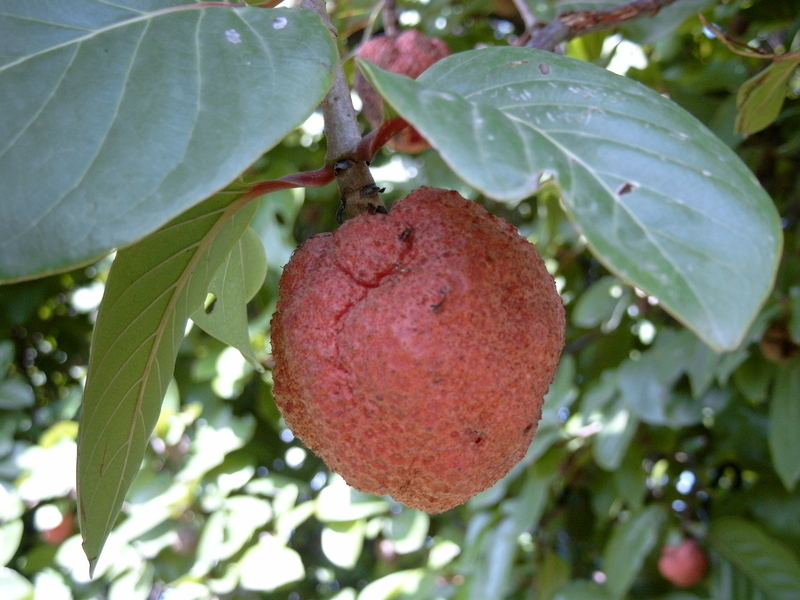
African peach
Nauclea latifolia
Nauclea latifolia, also known by its common name African peach, is a species of flowering plant in the family Rubiaceae, native to tropical regions of sub-Saharan Africa.
It grows as a spreading deciduous or evergreen shrub or small tree, typically 4–6 m tall, though it may reach greater heights under favorable forest conditions. The species is characterized by a multi-stemmed habit, rough dark grey-brown bark, opposite glossy green leaves, and terminal spherical heads of small, fragrant white to yellowish flowers. It produces fleshy syncarp fruits up to 8 cm in diameter containing numerous small seeds embedded in sweet, edible pink pulp.
From the article Nauclea latifolia on Wikipedia (CC BY-SA), quoted section by section
Description
It is an open-canopied shrub or tree with low branching and a straggling, multi-stemmed habit when young. The bark is rough, fibrous, and gray to dark gray in color. The leaves are opposite, simple, elliptic to obovate, measuring 10–22 cm long, with a leathery texture, glossy green upper surface, and paler underside with prominent pinnate venation. Inflorescences are solitary, terminal, spherical heads 4–5 cm in diameter, composed of numerous small, tubular, fragrant flowers. The fruits are compound syncarps that mature from green to deep red and contain sweet, watery pulp surrounding numerous tiny seeds.
Range & habitat
The species is native to tropical Africa, occurring from Senegal and Gambia in the west through West and Central Africa to Ethiopia, Uganda, and Angola. It is commonly found in savanna woodlands, dry forests, and gallery forests along rivers, from sea level up to approximately 1,200 m in elevation. It prefers tropical to subtropical climates with annual rainfall between 1,000 and 2,700 mm and grows best in well-drained loamy or sandy soils, though it tolerates poor and disturbed soils.
Wikipedia: “Distribution and habitat”
What it does
The species is pollinated primarily by insects, particularly bees and butterflies attracted to its fragrant flowers. Its fruits are dispersed mainly by animals such as baboons, monkeys, birds, and other frugivores, which consume the pulp and excrete the seeds at distances from the parent plant. It plays an important ecological role as a pioneer species in savanna and riparian ecosystems, contributing to soil stabilization and providing food resources for wildlife, including elephants and antelopes.
Wikipedia: “Ecology”
At the table
The wood of Nauclea latifolia is termite-resistant and is used for firewood, charcoal, and small-scale carpentry. The edible fruits are consumed as a famine food, while bark and roots are used as sources of natural dyes. Leaves are also used as livestock fodder during dry seasons.
Wikipedia: “Other uses”
In medicine
The plant is extensively used in traditional medicine throughout West and Central Africa. Bark decoctions are commonly used to treat malaria, fever, and dysentery; roots are employed for wounds, rheumatism, and pain; leaves are used for diarrhea and respiratory ailments; and fruits are used for gastrointestinal disorders. Though there have been reports of findings of the opioid tramadol in the bark of the tree, later studies have found that the tramadol is actually synthetic and most probably connected to the widespread opioid misuse in the native regions of the tree.
Wikipedia: “Traditional medicine”
Where it lives
Recorded sightings
—
geo-referenced records in GBIF, from museums, herbaria and field observers.
Drag the globe to turn it. Dots are where records exist, not a range map; darker means more records.
In the stacks
Searching the stacks…
Every page naming Nauclea latifolia in the Biodiversity Heritage Library →
This page is assembled live from iNaturalist, GBIF, Wikipedia, the Source Library and the Internet Archive. It is not yet part of the hand-edited codex. iNaturalist taxon 1371236.