- Plants
- ›Vascular Plants
- ›flowering plants
- ›Dicots
- ›magnolias, nutmegs, and allies
- ›custard-apples
- ›Annonoideae
- ›Annoneae
- ›Annona
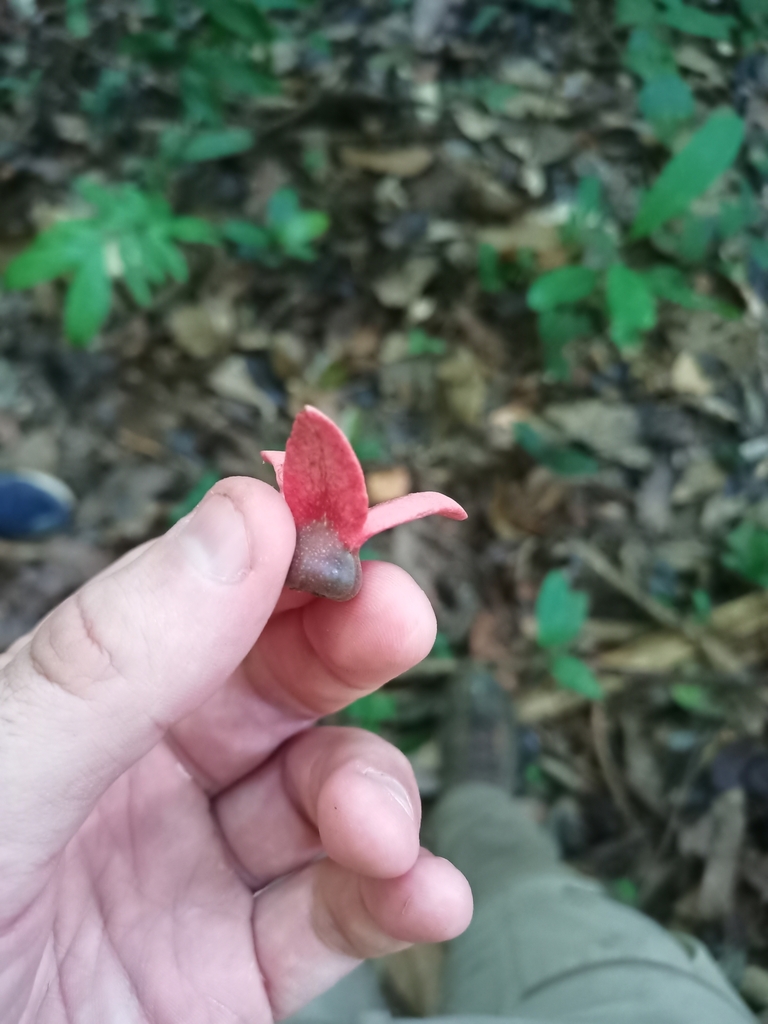
Annona haematantha
Annona haematantha is a species of flowering plant in the family Annonaceae. It is a tree or liana native to northern Brazil, the Guianas (French Guiana, Guyana and Suriname), southeastern Colombia, Ecuador, and Peru. Friedrich Anton Wilhelm Miquel, the Dutch botanist who first formally described the species, named it after its blood-red flowers (Latinized forms of Greek αἱμάτῐνος, haimátinos and ἄνθος, ánthos).
From the article Annona haematantha on Wikipedia (CC BY-SA), quoted section by section
Description
It is a woody vine reaching 5 centimeters in diameter. It has climbing habit that becomes horizontal as it reaches the forest canopy. Its membranous, elliptical leaves are 12–15 by 5-7 centimeters and come to a tapering point at their tip. Its leaves have 10-12 pairs of secondary veins emanating from their midribs. Its petioles are 5-6 millimeters and covered in rust-colored hairs. Its inflorescences have a solitary flower on a 10 millimeter long pedicel that is 1 millimeters in diameter. It has oval to triangular sepals that are 2-3 millimeters long and covered in dense brown hair. Its 6 petals are arranged in two rows of 3. The outer petals are fused to form a tube 5-10 millimeters long by 10 millimeters in diameter, with oval to triangular lobes that are 10–20 by 10-15 millimeters. The outer petals are yellow to red outside and deep red inside. The inner petals are fused to form a 7 millimeter long tube with 2 millimeter long triangular lobes.
Distribution and habitat. It grows in forests and swamp-forests in sandy soil. It flowers in January.
Uses. Bioactive compounds extracted from the roots have been reported to have antileishmanial properties.
Where it lives
Recorded sightings
—
geo-referenced records in GBIF, from museums, herbaria and field observers.
Drag the globe to turn it. Dots are where records exist, not a range map; darker means more records.
In the stacks
Searching the stacks…
Every page naming Annona haematantha in the Biodiversity Heritage Library →
This page is assembled live from iNaturalist, GBIF, Wikipedia, the Source Library and the Internet Archive. It is not yet part of the hand-edited codex. iNaturalist taxon 1377058.