- Plants
- ›Vascular Plants
- ›flowering plants
- ›Dicots
- ›Sunflowers, Bellflowers, Fanflowers, and Allies
- ›Sunflowers, Daisies, Asters, and Allies
- ›Asteroideae
- ›asters and allies
- ›Hinterhuberinae
- ›Mairia
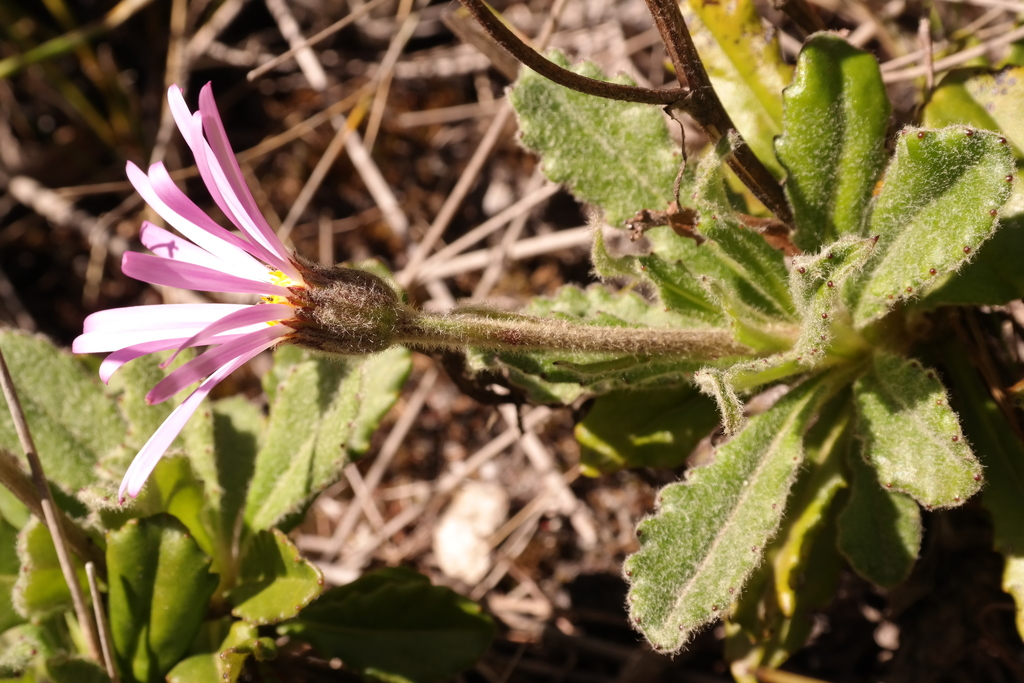
Hairy Fire-Aster
Mairia purpurata
Mairia hirsuta is a tufted perennial, herbaceous plant of up to .mw-parser-output .frac{white-space:nowrap}.mw-parser-output .frac .num,.mw-parser-output .frac .den{font-size:80%;line-height:0;vertical-align:super}.mw-parser-output .frac .den{vertical-align:sub}.mw-parser-output .sr-only{border:0;clip:rect(0,0,0,0);clip-path:polygon(0px 0px,0px 0px,0px 0px);height:1px;margin:-1px;overflow:hidden;padding:0;position:absolute;width:1px}40 cm (1+1⁄3 ft) high, that is assigned to the family Asteraceae. Most of its narrow to broad elliptic or inverted egg-shaped leaves are part of the basal rosette, have margin that is rolled under, with rounded or pointy teeth or with some peg-like extensions, lightly woolly on the upper surface and densely woolly on the...
From the article Mairia hirsuta on Wikipedia (CC BY-SA), quoted section by section
Description
Mairia hirsuta is a tufted, robust, perennial, herbaceous plant of mostly 25–38 cm (10–15 in) high (full range 14–40 cm), that has one to three leaf rosettes at its base. Its dark brown roots are thick and fleshy and emerge from a woody and robust rhizome of up to 7 cm (3 in) long. Most of its leaves are part of the basal rosette, but some are set alternately on the lower parts of the approximately nine to eighteen inflorescence stalks. The leaves are seated or are sometimes a little or substantially narrowed into a leaf stalk of 3–25 mm (1⁄10–1 in) long. The leaf axils are sometimes densely woolly. The leaf blade varies in outline between narrowly or broadly inverted egg-shaped and narrowly elliptic to elliptic, mostly 4+1⁄3–10 cm (1+2⁄3–4 in) long (full range 3–12+1⁄2 cm) and 1+1⁄2–3+1⁄2 cm (0.6–1.4 in) wide (full range 3⁄4–5 cm). The leaves have a blunt to pointy tip and a margin that is rolled under, with rounded or pointy teeth or is sometimes almost entire with some peg-like extensions. The upper surface shows a distinct main vein, is hairless or has some dispersed woolly hairs. The lower surface of the leaves is leathery and hard, and sometimes succulent and then the netted veins may be nearly invisible. …
Range & habitat
Mairia hirsuta is a local endemic of the Langeberg between Swellendam, Suurbraak and the neighbouring Warmwaterberg. It is considered a rare species, because although it occupies a range of only about 59 km2 (23 sq mi), it is well protected in the Boosmansbos Wilderness Area and the Marloth Nature Reserve. Here it grows in a fynbos vegetation on the steep, south-facing slopes.
Wikipedia: “Distribution, ecology and conservation”
Where it lives
Recorded sightings
—
geo-referenced records in GBIF, from museums, herbaria and field observers.
Drag the globe to turn it. Dots are where records exist, not a range map; darker means more records.
In the stacks
Searching the stacks…
Every page naming Mairia purpurata in the Biodiversity Heritage Library →
This page is assembled live from iNaturalist, GBIF, Wikipedia, the Source Library and the Internet Archive. It is not yet part of the hand-edited codex. iNaturalist taxon 1377070.