- Plants
- ›Vascular Plants
- ›flowering plants
- ›Dicots
- ›Legumes, Milkworts, and Allies
- ›Legumes
- ›Faboideae
- ›Millettieae
- ›Philenoptera
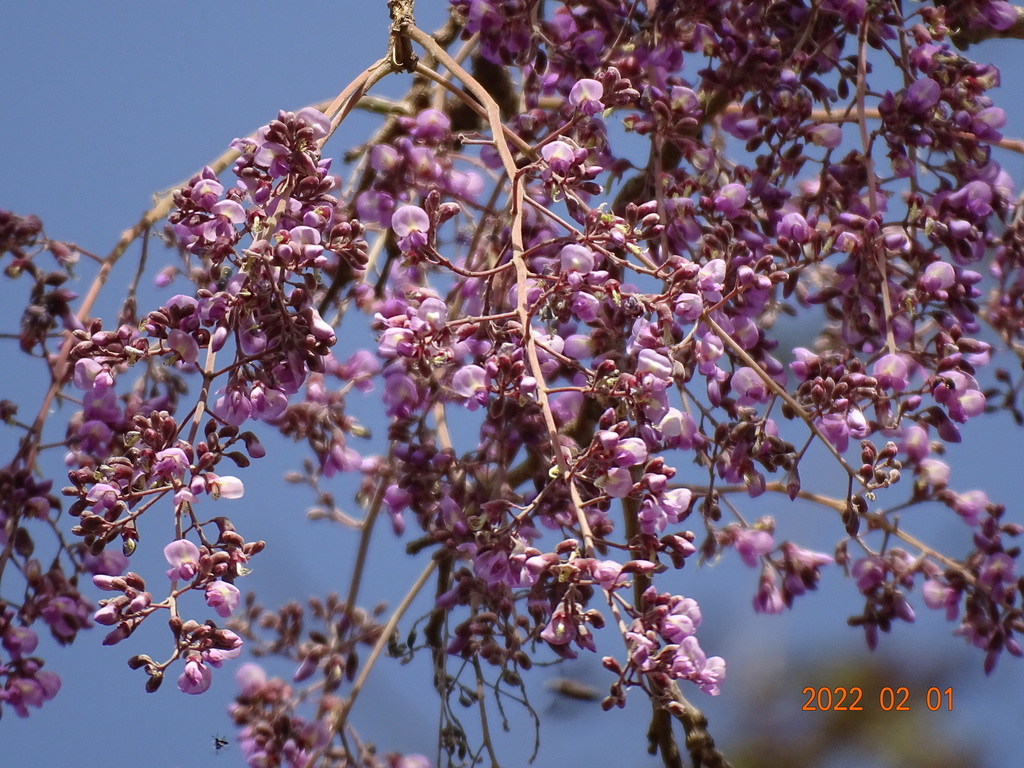
Philenoptera laxiflora
Philenoptera laxiflora, synonym Lonchocarpus laxiflorus, is a species of legume in the family Fabaceae. The tree grows to 4–8 meters in height, has grey or yellowish bark and compound leaves. New leaves are accompanied by purple flowers on multi-branched panicles. The fruit is a glabrous papery pod, usually containing one seed. Ph. laxiflorus is widely distributed in West Africa, Central Africa, the African Great Lakes, and Northeast Africa. It is found in savanna woodlands and dry forested areas, particularly fringing forest near water courses.
From the article Philenoptera laxiflora on Wikipedia (CC BY-SA), quoted section by section
Toxicity
Ph. laxiflorus has been little studied, though many species in the related genus Lonchocarpus contain rotenoids, tannins, flavonoids, and isoflavonoids. One study extracted several new compounds from the bark: two isoflavanes (lonchocarpane and laxiflorane) and two pterocarpanes (philonopterane and 9-O-methyl derivative). Nothing specific is known about the toxicology of Ph. laxiflorus.
Wikipedia: “Chemistry and toxicology”
Where it lives
Recorded sightings
—
geo-referenced records in GBIF, from museums, herbaria and field observers.
Drag the globe to turn it. Dots are where records exist, not a range map; darker means more records.
In the stacks
Searching the stacks…
Every page naming Philenoptera laxiflora in the Biodiversity Heritage Library →
This page is assembled live from iNaturalist, GBIF, Wikipedia, the Source Library and the Internet Archive. It is not yet part of the hand-edited codex. iNaturalist taxon 138397.