- Plants
- ›Vascular Plants
- ›flowering plants
- ›Dicots
- ›Legumes, Milkworts, and Allies
- ›Legumes
- ›Acacias, Mimosas, Mesquites, and Allies
- ›Parkia
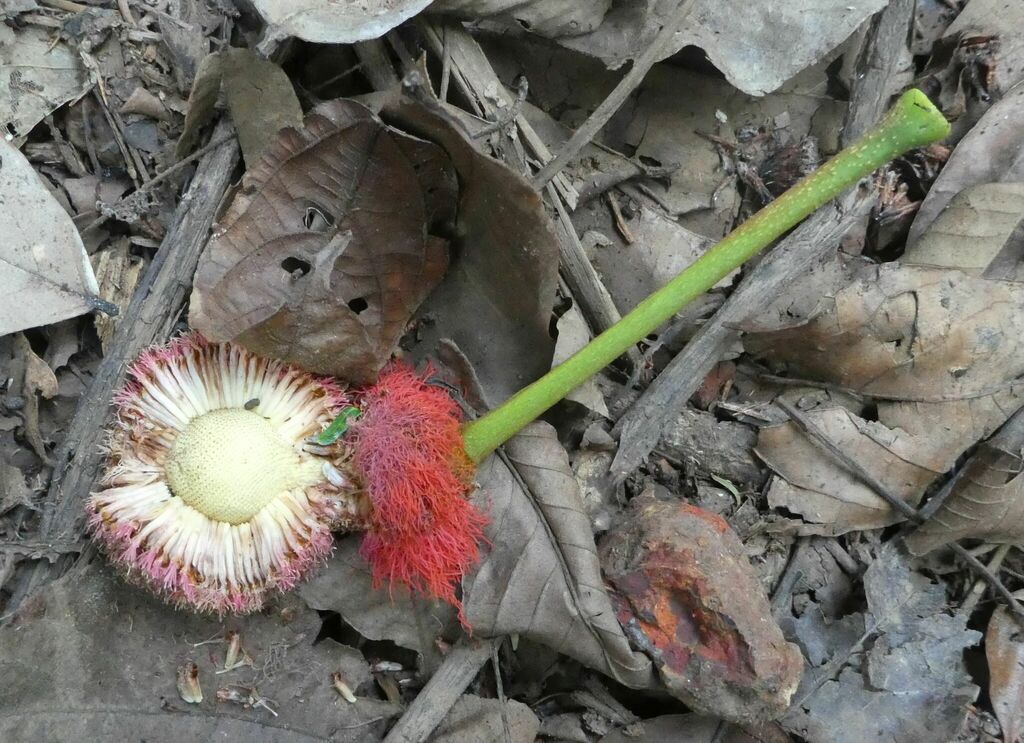
Parkia bicolor
Parkia bicolor, the African locust-bean, is a species of flowering plant, a tree in the family Fabaceae. It is native to tropical West and Central Africa. Its natural habitats are tropical moist lowland forests, swampland, woodland and savannah.
From the article Parkia bicolor on Wikipedia (CC BY-SA), quoted section by section
Description
Parkia bicolor is a medium to large tree growing to a height of about 40 m (130 ft) with a trunk a metre or more in diameter with narrow, spreading buttresses. The crown is umbrella-shaped and has widely spreading branches. The young twigs are felted with short reddish-brown hairs. The leaves are alternate with ten to twenty-five pairs of pinnae, each composed of numerous pairs of small, narrow leaflets. The inflorescence is a pendulous, two-part head of small flowers, which is followed by long, dangling pods each containing up to twenty-five seeds.
Range & habitat
Parkia bicolor is found in tropical western and central Africa, its range extending from Sierra Leone eastward to Yangambi in the Democratic Republic of the Congo, and southwards to Cabinda (Angola). It typically grows in rainforest and gallery forest, as well as woodland, swampy areas and savannah. When forest is being cleared, this species is often left as isolated trees because of its useful properties.
Wikipedia: “Distribution and habitat”
What it does
The flowers at the base of the flowerhead are sterile but produce plentiful nectar which attracts bats. The flowers are largely pollinated by the bats, but pottos and dormice have also been observed visiting them.
Wikipedia: “Ecology”
At the table
The timber of Parkia bicolor is not highly esteemed but is used to make planks, and canoes and for light construction work, joinery and turnery. Additionally, it is used to make plywood and pulpwood. The flesh of the fruit can be eaten, and the seeds can be fermented to make a condiment. The bark, leaves and roots are all used in traditional medicine and the spreading crown makes this a useful shade tree. Parkia bicolor exudes a water-soluble, proteinaceous gum. After hydrolysis, this yields 74% galactose, 9% arabinose, 9.5% glucuronic acid and 7.5% 4-0-methylglucuronic acid.
Wikipedia: “Uses”
Where it lives
Recorded sightings
—
geo-referenced records in GBIF, from museums, herbaria and field observers.
Drag the globe to turn it. Dots are where records exist, not a range map; darker means more records.
In the stacks
Searching the stacks…
Every page naming Parkia bicolor in the Biodiversity Heritage Library →
This page is assembled live from iNaturalist, GBIF, Wikipedia, the Source Library and the Internet Archive. It is not yet part of the hand-edited codex. iNaturalist taxon 138675.