- Plants
- ›Vascular Plants
- ›flowering plants
- ›Dicots
- ›Legumes, Milkworts, and Allies
- ›Legumes
- ›Faboideae
- ›Crotalarieae
- ›Crotalaria
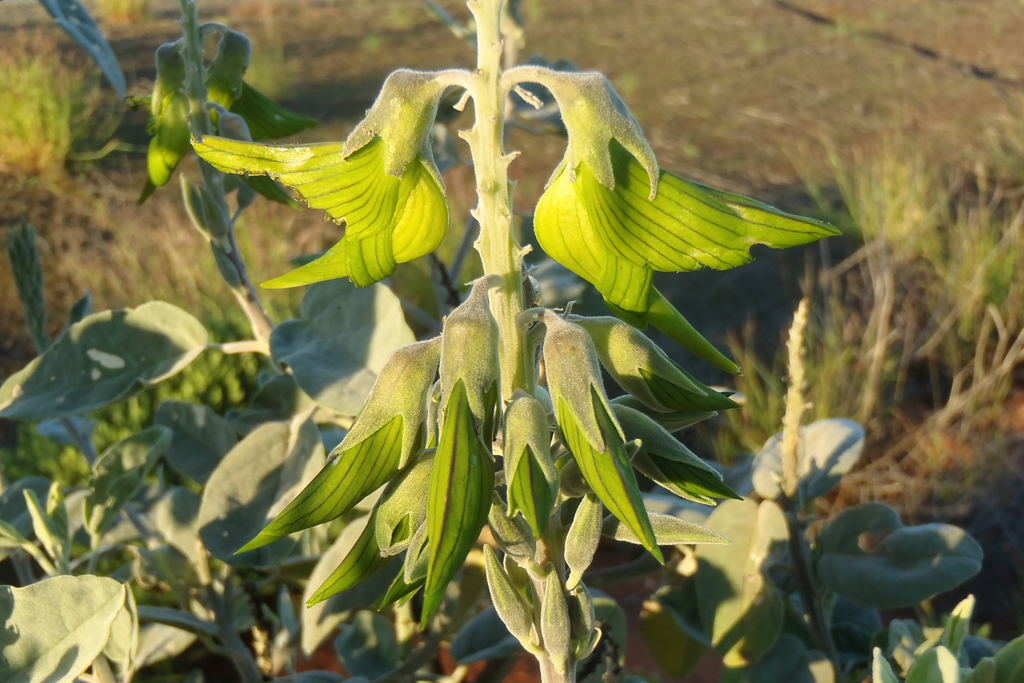
Birdflower
Crotalaria cunninghamii
Crotalaria cunninghamii, also known as green bird flower, bird flower ratulpo, parrot pea, or regal bird flower, is a plant of the legume family Fabaceae, named Crotalaria after the Greek word for rattle because their seeds rattle, and cunninghamii after early 19th-century botanist Allan Cunningham. Crotalaria cunninghamii is known as Mangarr to the Nyangumarta Warrarn Indigenous group.
Crotalaria cunninghamii is a short-lived perennial plant native to Australia, and its habitat is the deserts, coastlands, drainage lines, and sand dunes of the northern half of Western Australia and the Northern Territory. This habitat is semi-arid to temperate regions in well-drained soils. Crotalaria cunninghamii blooms from January to April. It is pollinated by large bees and by honeyeaters.
From the article Crotalaria cunninghamii on Wikipedia (CC BY-SA), quoted section by section
Description
The green birdflower is a perennial shrub that grows to about 1–3 m in height. It has hairy or woolly branches and dull green foliage. The oval leaves are about 30 mm long, the large and greenish pea flowers are streaked with fine black lines, and the club-shaped seed pods are up to 50 mm long. The plant's flowers grow on long spikes at the ends of its branches. The flower greatly resembles a bird attached by its beak to the central stalk of the flowerhead. Crotalaria cunninghamii is non-allergenic, and its pods are large and almost square and are covered in a soft, green, hairy shell.
Range & habitat
Crotalaria cunninghamii habitat is the arid to semi-arid zones of the tropics, including northern Western Australia, the Northern Territory, northern South Australia, and southwest Queensland . Crotalaria cunninghamii predominantly grows in well-drained soils in shrubland and grassland or savannah woodlands, usually on desert dunes, sandplains, and drainage lines. Crotalaria cunninghamii also grows in Mulga communities in arid regions. Mulga communities are 'hotspots' of resources, such as water holes in deserts . Mulga communities account for 20% of the total land mass of arid Australia.
Wikipedia: “Habitat”
What it does
Crotalaria cunninghamii is usually pollinated by birds. During a study orchestrated by the Desert Ecology Research Group from the University of Sydney in 2011, it was found that during that period of unusually high rainfall in the Simpson Desert, rodents were observed eating and pollinating Crotalaria cunninghamii flowers. The rodents observed were the house mouse (Mus musculus) and the sandy inland mouse (Pseudomys hermannsburgensis). There was a similar ample rainfall in 2007; this unusual phenomenon was compared to where no rodents were observed. It was found that Crotalaria cunninghamii in 2011 had five times more inflorescences per plant, 90% more flowers per inflorescence, and two to three times more nectar per flower. Still, the nectar was 30% less sugar-rich. Rodents accessed the nectar by chewing a hole through the calyx, as opposed to how birds poke their beaks through the opening. The increase in the number of pollinators positively affected the propagation of the species. The regular pollinators of Crotalaria cunninghamii are nectivorous birds, bugs and bees. These creatures derive their energy from the nectar of Crotalaria cunninghamii and in return they pollinate the plant. …
Wikipedia: “Abnormal pollinators”
In medicine
Crotalaria cunninghamii can also be used to provide medicinal support to humans; through a process of heating and boiling, the leaves can be used to treat eye infections, and the bark can be used to treat swelling of the limbs. Aboriginal Australians used Crotalaria cunninghamii to treat eye infections and pain. The use of Crotalaria cunninghamii as a medicine is not widespread today, but it has historically been proposed to potentially have use in homeopathy.
Wikipedia: “Medicinal”
Where it lives
Recorded sightings
—
geo-referenced records in GBIF, from museums, herbaria and field observers.
Drag the globe to turn it. Dots are where records exist, not a range map; darker means more records.
In the stacks
Searching the stacks…
Every page naming Crotalaria cunninghamii in the Biodiversity Heritage Library →
This page is assembled live from iNaturalist, GBIF, Wikipedia, the Source Library and the Internet Archive. It is not yet part of the hand-edited codex. iNaturalist taxon 139362.