 NL·0636
Herbarium of the Nature Library
- Name
- Philetairus socius
- Family
- Ploceidae
- Native to
- Southern Africa: Namibia, Botswana and South Africa (Kalahari and Karoo)
- Habitat
- Semi-desert scrub, Savanna
On eBird ↗
Sociable Weaver
Live sightings near you, the range map, bar charts of when it is seen, and Macaulay Library photos and recordings.
Sociable weaver
Philetairus socius
Also calledVersamelvoël (Afrikaans) · Républicain social (French)
A sparrow-sized bird that builds the largest nests of any bird: colossal communal haystacks in camelthorn trees, housing hundreds of birds in separate chambers. The nest buffers temperatures in the Kalahari's searing days and freezing nights.
The sociable weaver is a species of bird in the weaver family, endemic to Southern Africa. It is the only species in its genus Philetairus. It is found in South Africa, Namibia, and Botswana, but its range is centered within the Northern Cape Province of South Africa. The species builds large, compound, community nests, a rarity among birds. These nests are perhaps the most spectacular structure built by any bird. Wikipedia
What it can do
- iBuilds nests weighing up to around a tonne, with up to 100 or more separate chambers
- iiNest interiors stay much warmer at night and cooler by day than outside
- iiiColonies may be used for many decades, some for over a century
- ivProvides homes for pygmy falcons, lovebirds, finches and reptiles
In the field
Field marks
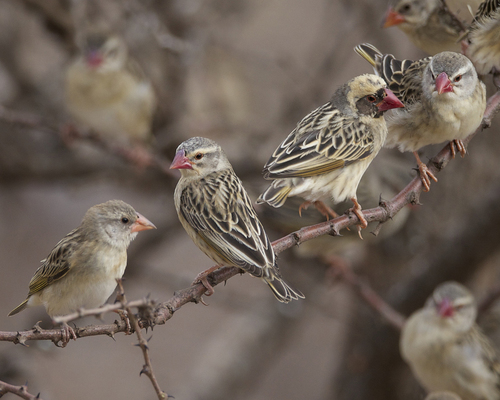
- aBlack chin and throat patch
- bScalloped back pattern with dark feathers edged pale
- cBlack-and-white scaly flanks
- dPale, heavy conical bill
- eBrownish crown
- Voice
- Chattering, twittering contact calls around the colony; a 'chip-chip' in flight.
- Not to be confused with
- Scaly-feathered weaver (scaly-feathered finch) is smaller with a white moustache and black stripes, and lacks the black throat. House sparrows lack the scaly flanks and black chin.
- Where to see it
- Kgalagadi Transfrontier Park, Augrabies Falls, Kalahari roads in Namibia (nests on telephone poles), Etosha
- When
- Resident year-round
Listen
Looking for field recordings…
Life & habits
- Diet
- Insects, especially termites, plus seeds
- Habitat
- Arid savanna with large trees such as camelthorn (Vachellia erioloba), also telephone poles
- Size
- About 14 cm; 25–30 g
Members of a colony continually add straw to the roof and maintain individual chambers; helpers feed young.
Where it lives
Recorded sightings
—
geo-referenced records in GBIF, from museums, herbaria and field observers.
Native range
Southern Africa: Namibia, Botswana and South Africa (Kalahari and Karoo)
Drag the globe to turn it. Dots are where records exist, not a range map; darker means more records.
In the old herbals & bestiaries
No plate in the Source Library names this exact species, so these show its closest relatives as the old naturalists drew them: same genus, or the same kind of animal. Click a plate to read the page it came from, with translation.

Commentaries on the Six Books of Dioscorides
Relative · Pietro Andrea Mattioli · 1560 · p.307

Commentaries on the Six Books of Dioscorides on Medical Matter
Relative · Pietro Andrea Mattioli · 1563 · p.292

Commentaries on the Six Books of Pedanius Dioscorides on Medical Matter
Relative · Pietro Andrea Mattioli · 1565 · p.491
In the stacks
Searching the stacks…
Every page naming Philetairus socius in the Biodiversity Heritage Library →
Marginalia
The French naturalist François Le Vaillant described the giant nests in the 1780s; the bird's French name, républicain, likens a colony to a republic.
Curiosity
Large nests can collapse the trees that hold them, especially after rain soaks the straw.
Kinship



Photographs: iNaturalist contributors under the licences shown. Records: GBIF.org. Historical plates: Source Library (CC BY-SA 4.0; originals public domain). Summary text: Nature Library editors and Wikipedia (CC BY-SA). Medicinal and edibility notes are historical and educational, not advice. iNaturalist taxon 13956.