- Plants
- ›Vascular Plants
- ›flowering plants
- ›Dicots
- ›Legumes, Milkworts, and Allies
- ›Legumes
- ›orchid trees and redbuds
- ›Bauhinieae
- ›Bauhinia
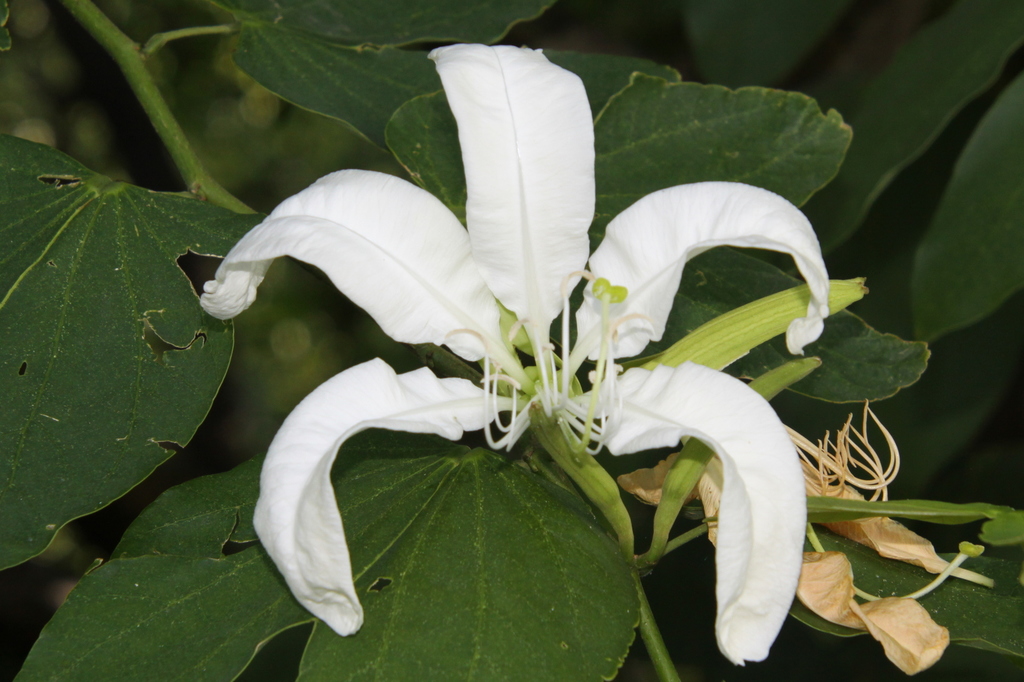
Brazilian orchid tree
Bauhinia forficata
Bauhinia forficata, commonly known as Brazilian orchid tree,Pata de Vaca,, Pezuña de Vaca is a species of flowering tree in the pea family, Fabaceae, that is native to Argentina, Brazil, Uruguay and Peru.
From the article Bauhinia forficata on Wikipedia (CC BY-SA), quoted section by section
Description
Bauhinia forficata is a medium-sized broadleaf evergreen tree that typically reaches a height of 25–30 feet (7.6–9.1 m) with a canopy spread ranging from 25–35 feet (7.6–10.7 m). The species displays a symmetrical crown that may take on a vase-shaped, rounded, or spreading form, and has a dense canopy with a medium texture. Growth is moderate under suitable conditions.
Range & habitat
Bauhinia forficata is native to South America. In Brazil, its natural range extends from the state of Rio de Janeiro to Rio Grande do Sul. Within the country, it occurs in diverse ecosystems, including the semi-arid Caatinga region, forest fragments in the state of Paraná, and along the Amazon coastal areas. It is also native to other parts of the continent, including central and northern Argentina, Bolivia, Paraguay and Uruguay. It typically inhabits well-drained soils and performs best in full sun or areas with high, intermittent shade, such as beneath open pine canopies. Although it is tolerant of drought, the plant benefits from occasional irrigation or afternoon shade during hot, dry periods to prevent flower desiccation. In alkaline soils, it may exhibit interveinal chlorosis due to nutrient imbalances. Bauhinia forficata is suited to the United States Department of Agriculture (USDA) hardiness zones 10A through 11.
Wikipedia: “Distribution and habitat”
Where it lives
Recorded sightings
—
geo-referenced records in GBIF, from museums, herbaria and field observers.
Drag the globe to turn it. Dots are where records exist, not a range map; darker means more records.
In the stacks
Searching the stacks…
Every page naming Bauhinia forficata in the Biodiversity Heritage Library →
This page is assembled live from iNaturalist, GBIF, Wikipedia, the Source Library and the Internet Archive. It is not yet part of the hand-edited codex. iNaturalist taxon 139568.