- Plants
- ›Vascular Plants
- ›flowering plants
- ›Dicots
- ›Legumes, Milkworts, and Allies
- ›Legumes
- ›Acacias, Mimosas, Mesquites, and Allies
- ›Acacia
- ›Alatae
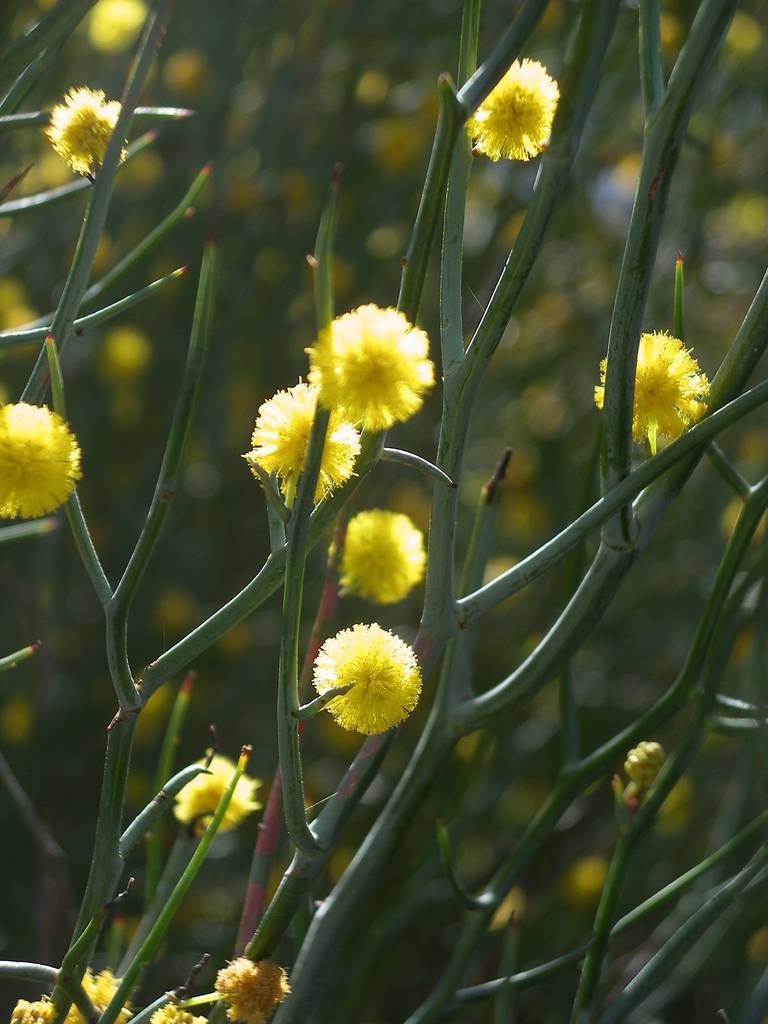
Leafless Rock Wattle
Acacia aphylla
Acacia aphylla, commonly known as leafless rock wattle, is a species of flowering plant in the family Fabaceae and is endemic to an area around Perth in Western Australia. It is a widely branched shrub with glaucous, sharply-pointed branchlets, flowers arranged in spherical light golden heads, and leathery, linear pods.
From the article Acacia aphylla on Wikipedia (CC BY-SA), quoted section by section
Description
Acacia aphylla is widely branched, spiny, glaucous, glabrous shrub that grows to a height of 0.9–3 m (2 ft 11 in – 9 ft 10 in) and has no leaves or phyllodes. The flowers are borne in spherical heads of 20 to 30 on a peduncle 7–10 mm (0.28–0.39 in) wide, and are bright, light golden. Flowering occurs from August to October, and the fruit is a leathery, linear pod 30–90 mm (1.2–3.5 in) long and 3–4 mm (0.12–0.16 in) wide containing seeds that are oblong, 4.0–4.5 mm (0.16–0.18 in) long.
Range & habitat
Leafless rock wattle has a restricted range and is only found in two areas in the Darling Range about 60 kilometres (37 mi) apart from each other. The areas are both to the east of Perth with one population being found in Hidden Valley area in the Helena River and the other south of Northam in the Clackline Nature Reserve. The species is commonly found in open forest communities that are dominated by Eucalyptus marginata and Eucalyptus calophylla, or in woodlands where Eucalyptus loxophleba dominates. Species commonly found in the understorey include Grevillea endlicheriana, Hakea petiolaris, and Xanthorrhoea preissii. It is generally associated with areas of laterite and granite outcrops on hillsides, and will grow in rock crevices. It is mostly found to grow in soils that are sandy, loam, clay, or gravel and brown or yellow in colour. Plants are mostly killed by fire but populations will regenerate from the soil seedbank.
Wikipedia: “Distribution and habitat”
Where it lives
Recorded sightings
—
geo-referenced records in GBIF, from museums, herbaria and field observers.
Drag the globe to turn it. Dots are where records exist, not a range map; darker means more records.
In the stacks
Searching the stacks…
Every page naming Acacia aphylla in the Biodiversity Heritage Library →
This page is assembled live from iNaturalist, GBIF, Wikipedia, the Source Library and the Internet Archive. It is not yet part of the hand-edited codex. iNaturalist taxon 139888.