- Animals
- ›Molluscs
- ›Gastropods
- ›Heterobranchs
- ›Euthyneura
- ›Tectipleura
- ›Eupulmonata
- ›Common Land Snails and Slugs
- ›Helicina
- ›Helicoidei
- ›Helicoidea
- ›Helix Snails
- ›Helicinae
- ›Thebini
- ›Eobania
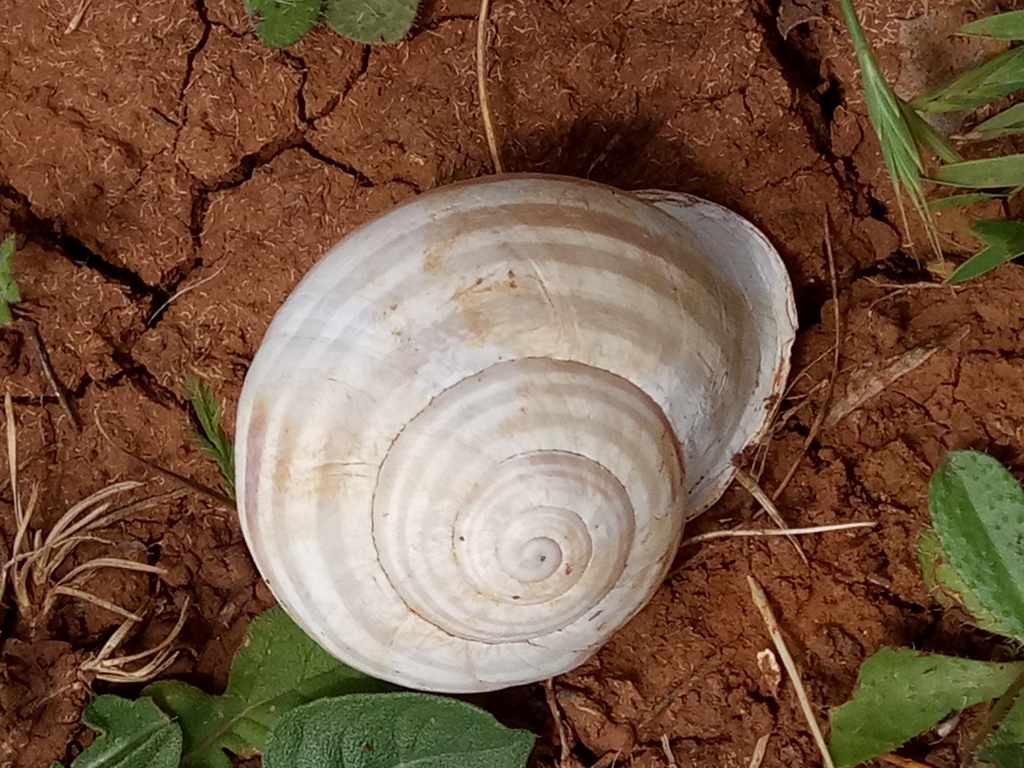
Eobania constantina
Eobania constantina is a species of terrestrial land snail in the family Helicidae, native to northern Algeria and other parts of North Africa. It occurs primarily in Mediterranean environments, ranging from humid coastal regions to more semi-arid inland areas, and inhabits a variety of habitats, from remote mountainous regions to urban areas. As a member of Helicidae, it possesses a coiled shell and hermaphroditic reproductive system, with both shell morphology and genital anatomy playing important roles in its classification.
From the article Eobania constantina on Wikipedia (CC BY-SA), quoted section by section
Range & habitat
Eobania constantina, and terrestrial helicid snails in general, are typically found close to the Mediterranean coast, ranging from the more humid areas near the coast to the semi-arid climate closer to the Sahara. The species is found in high abundance in Northeastern Algeria, particularly in the Kebir Rhumel basin, where it has been identified in provinces such as Mila, Constantine, Jijel, Sétif, and Oum El Bouaghi. It was also recorded further west within the Tizi Ouzou region in Kabylie as well as within the regions of Boumerdes and Algiers, and is particularly abundant in the Chettaba forest massif. It inhabits many elevations, with observations ranging from regions at sea level to more mountainous regions at ~1700 feet above sea level.
Wikipedia: “Distribution and habitat”
In human culture
One of the earliest formal records of land snails in Algeria comes from Edward Forbes' 19th‑century work, which described terrestrial mollusks collected around Algiers and Béjaïa. These early catalogs provided the first taxonomic baselines for Algerian helicids, often based solely on shell morphology. During this era, collection was driven by European naturalists working in French colonial territories. This period saw the naming and description of many nominal taxa, some of which were later revised. Helix constantina was first described by Forbes in 1838. Taxonomic history in Algerian helicids has been complex due to morphological variation and changing genera. In particular, misinterpretations of shell morphology led researchers to mix up Massylaea and Eobania species and caused disagreements over the true classification of helicids like E. constantina. However, molecular and anatomical work revealed that the genital morphology of Massylaea species matches that considered typical of Eobania, leading to the suggestion that Eobania should be referred to as Massylaea. Early mollusc records, like those by Forbes and Terver, were written and compiled during the period of French occupation in Algeria, where French scientists were the main drivers of fieldwork and species description. …
Wikipedia: “Taxonomic history”
Where it lives
Recorded sightings
—
geo-referenced records in GBIF, from museums, herbaria and field observers.
Drag the globe to turn it. Dots are where records exist, not a range map; darker means more records.
In the stacks
Searching the stacks…
Every page naming Eobania constantina in the Biodiversity Heritage Library →
This page is assembled live from iNaturalist, GBIF, Wikipedia, the Source Library and the Internet Archive. It is not yet part of the hand-edited codex. iNaturalist taxon 1403833.