- Plants
- ›Vascular Plants
- ›flowering plants
- ›monocots
- ›gingers, bananas, and allies
- ›Banana Family
- ›Musa
- ›Callimusa
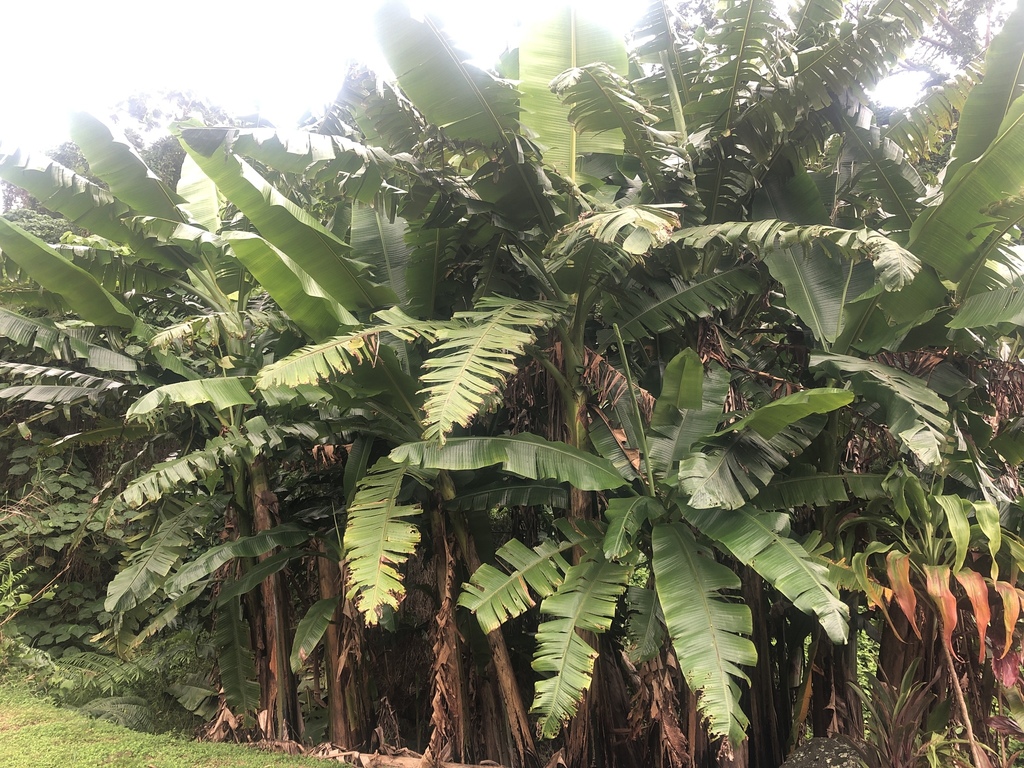
fe'i banana
Musa troglodytarum
Fe'i bananas (also spelt Fehi or Féi) are cultivated plants in the genus Musa, used mainly for their fruit. They are very distinct in appearance and origin from the majority of bananas and plantains currently grown. Found mainly in the islands of the Pacific, particularly French Polynesia, Fe'i bananas have skins which are brilliant orange to red in colour with yellow or orange flesh inside. They are usually eaten cooked and have been an important food for Pacific Islanders, moving with them as they migrated across the ocean. Most are high in β-carotene (a precursor of vitamin A).
The botanical name for Fe'i bananas is Musa troglodytarum L. Its origin is uncertain and it may be a hybrid.
From the article Fe'i banana on Wikipedia (CC BY-SA), quoted section by section
Description
Fe'i bananas are cultivated varieties (cultivars), rather than wild forms. They are distinctly different from the much more common bananas and plantains derived from Musa acuminata and Musa balbisiana. All members of the genus Musa are tall herbaceous plants, typically around 3–10 m (10–33 ft) tall or even more. Although they appear tree-like, the "trunk" is actually a pseudostem, formed from the tightly wrapped bases of the leaves. At maturity each pseudostem produces a single flowering stem that grows up inside it, eventually emerging from the top. As it elongates, female flowers appear which go on to form fruit – the bananas. Finally male flowers are produced. In cultivated bananas, the fruit is usually seedless and the male flowers sterile. Fe'i bananas can be distinguished from other kinds of cultivated bananas and plantains in a number of ways. They have highly coloured sap, pink through to bright magenta and dark purple. The bracts of the flowering spike (inflorescence) are bright shiny green rather than dull red or purple. The flowering and fruiting stem is more or less upright (rather than drooping), so that the bunches of bananas are also upright. Ripe fruit has brilliant orange, copper-coloured or red skin with orange or yellow flesh inside. It has prominent ridges, making it squarish in cross-section.
Range & habitat
Fe'i bananas are mainly found from the Maluku Islands (Moluccas) in the west to French Polynesia in the east, particularly the Society Islands and the Marquesas Islands. They have been important both as a staple and as a ceremonial food, although their cultivation and use has sharply declined in recent decades. As the Pacific Islanders spread by canoe throughout the Pacific, they took Fe'i bananas with them; cultivation has been traced back to around 250 BC in the Marquesas and to around 800 AD in Tahiti in the Society Islands. They are believed to have originated in the New Guinea area, where cultivars with seeds occur, as do the wild species from which they are thought to be descended.
Wikipedia: “Distribution”
At the table
Fe'i bananas are generally eaten as "plantains", i.e. they are usually cooked rather than eaten raw. They have been described as "delicious and nutritious when baked or boiled, especially if the slices are swathed in fresh coconut cream." They have also been described as "unpleasantly astringent" unless cooked, having higher proportions of starch and lower proportions of sugar than other kinds of banana. However, in the Federated States of Micronesia, some cultivars, particularly 'Karat Pwehu', 'Karat Pako' and to a lesser extent 'Utin Iap' (='Uht En Yap'), are commonly eaten raw when fully ripe. Karat bananas have a soft texture and a sweet taste and were a traditional weaning food in the Micronesian island of Pohnpei. In countries where Fe'i bananas were once a major food item, there has been a shift away from eating traditional foods towards eating imported foods. Bananas with whiter flesh are preferred over traditional varieties with deeply coloured flesh. One issue with Fe'i bananas is that eating them causes the production of yellow coloured urine, thought to be caused by the excretion of excess riboflavin present in the fruit. This effect led people to believe that Fe'i bananas might not be safe to eat, particularly for children. Along with the shift away from traditional foods, there has been a rise in vitamin A deficiency. …
Wikipedia: “Culinary use”
In human culture
Fe'i bananas are an important component of ceremonial feasts in the Marquesas and the Society Islands. Karat bananas are reported to be one of the few kinds of banana that can be used in ceremonial presentations in Pohnpei, Micronesia. A Samoan legend is that the mountain banana and the lowland banana fought. The mountain banana – the Fe'i banana – won. Filled with pride at its victory, the mountain banana raised its head high, whereas the defeated lowland banana never raised its head again. (Fe'i bananas have an upright fruiting stem, whereas the fruiting stem droops in other kinds of banana.) The bright orange-red colours of Fe'i bananas make them attractive to artists. The French Post-Impressionist painter Paul Gauguin visited the Society Islands, including Tahiti, towards the end of the 19th century. Three of his works include what are considered to be Fe'i bananas: Le Repas (The Meal, 1891), La Orana Maria (Hail Mary, 1891) and Paysage de Tahiti (Tahitian Landscape, 1891). Fe'i bananas were one of the main staples of Liv Coucheron-Torpand and Thor Heyerdahl during their one-and-a-half-year stay on the Marquesan island of Fatu-Hiva in 1937–38. Heyerdahl reported that Fe'i bananas grew all around their cabin on Fatu-Hiva, while on Tahiti they had only seen Fe'i bananas growing "in almost inaccessible cliffs."
Wikipedia: “In culture”
Where it lives
Recorded sightings
—
geo-referenced records in GBIF, from museums, herbaria and field observers.
Drag the globe to turn it. Dots are where records exist, not a range map; darker means more records.
In the stacks
Searching the stacks…
Every page naming Musa troglodytarum in the Biodiversity Heritage Library →
This page is assembled live from iNaturalist, GBIF, Wikipedia, the Source Library and the Internet Archive. It is not yet part of the hand-edited codex. iNaturalist taxon 140911.