- Plants
- ›Vascular Plants
- ›flowering plants
- ›monocots
- ›Aroids, Water Plantains, Seagrass, and allies
- ›Arum Family
- ›Aroideae
- ›Arisareae
- ›Ambrosina
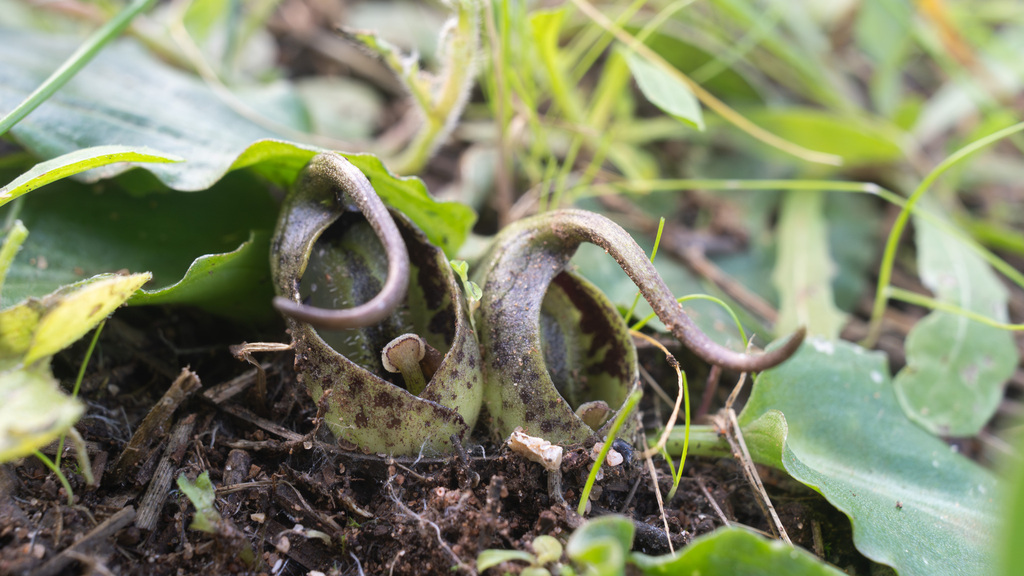
Ambrosina bassii
Ambrosina is a genus in the family Araceae that consists of only one species, Ambrosina bassii, and the only genus in the tribe Ambrosineae. This species is the smallest terrestrial aroid in the Mediterranean, growing only to 8 cm tall. It is usually found growing in woodlands on north faces of hillsides and in humus soil that is covering limestone. It is distributed in Sardinia, Corsica, Sicily, southern mainland Italy, Tunisia, and Algeria.
From the article Ambrosina on Wikipedia (CC BY-SA), quoted section by section
Description
Ambrosina bassii has oval leaves that are 3.5 to 6 cm long and resemble the leaves of many aroid seedlings. The inflorescence is 2.5 cm long bent over and has an unusual spathe. The spathe is shaped like an egg and is greenish brown with dots on it. Inside the egg shaped spathe is divided two chambers. In one chamber is contained a single female flower and in the other are 8 to 10 male flowers. The seeds have an elaiosome. However, seeds are rarely formed, as this species exhibits a low reproductive rate.
Pollen. The inaperturate pollen grains are 26–50 μm big. It disperses as a single grain (monad).
What it does
Ambrosina foliage may be affected by reddish-brown, 0–1 mm large leaf spots caused by the phytopatogenic fungus Entylomaster dietelianus (Bubák) Vánky & R.G. Shivas (syn. Entyloma dietelianum Bubák). Numerous 10–16 μm large spores are embedded within the leaf spots. This fungal disease is specific to the family Araceae.
Wikipedia: “Parasite ecology”
In human culture
The generic name Ambrosina honours the brothers Bartolomeo Ambrosini (1588–1657) and Giacinto Ambrosini (1605–1671).
Wikipedia: “Etymology”
Where it lives
Recorded sightings
—
geo-referenced records in GBIF, from museums, herbaria and field observers.
Drag the globe to turn it. Dots are where records exist, not a range map; darker means more records.
In the stacks
Searching the stacks…
Every page naming Ambrosina bassii in the Biodiversity Heritage Library →
This page is assembled live from iNaturalist, GBIF, Wikipedia, the Source Library and the Internet Archive. It is not yet part of the hand-edited codex. iNaturalist taxon 141510.