- Plants
- ›Vascular Plants
- ›conifers
- ›conifers
- ›pine family
- ›pines, spruces, larches, and allies
- ›Pinus
- ›Strobus
- ›Parrya
- ›Nelsoniae
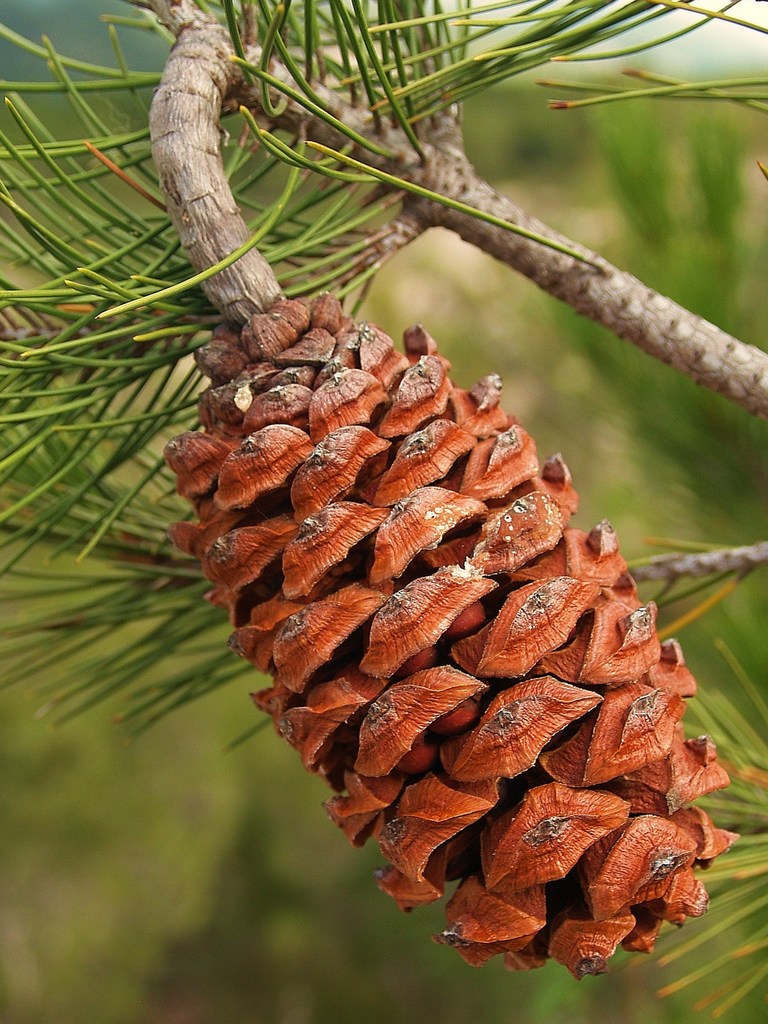
Nelson's pinyon
Pinus nelsonii
Pinus nelsonii, Nelson's pinyon, is a species of pine native to the mountains of northeastern Mexico, in Nuevo León, San Luis Potosí and Tamaulipas at 1,800–3,200 m altitude. It has very singular characteristics and is not closely related to any other pines in either morphology or genetics. It is placed in subgenus Strobus either in its own section Nelsonia or subsection Nelsoniae.
From the article Pinus nelsonii on Wikipedia (CC BY-SA), quoted section by section
Description
It is a small tree growing to 10 m tall with a trunk up to 20–30 cm diameter. The crown is rounded and dense, and resembles that of the unrelated Pinus pinea from the western Mediterranean. The needles are produced in fascicles of three (occasionally four), but 'zipped' together by their finely serrated margins so that they look like a single needle; they can only be separated by force. They are 4–8 (rarely 10) cm long and 0.7–1 mm thick, sub-shiny dark green in colour, with a persistent grey basal sheath 7–9 mm long. The cones are cylindrical, 6–12 cm long and 4–5 cm broad, orange-brown to red-brown colour, with 60–100 scales with large but indistinct umbos, and carried on a stout downcurved peduncle 3–6 cm long. Unlike all other pines, their growth while immature does not pause during the first winter. The seeds are large, 12–15 mm, red-brown. The cones mature in November after rain season. It grows in a semi-arid temperate climate with summer rainfall and is very drought-tolerant. The seeds are edible and delicious, and are very appreciated by people in the region. They are so valuable that they are transported to the markets of Mexico City. Because of its seeds, it has been very devastated by people. …
Where it lives
Recorded sightings
—
geo-referenced records in GBIF, from museums, herbaria and field observers.
Drag the globe to turn it. Dots are where records exist, not a range map; darker means more records.
In the stacks
Searching the stacks…
Every page naming Pinus nelsonii in the Biodiversity Heritage Library →
This page is assembled live from iNaturalist, GBIF, Wikipedia, the Source Library and the Internet Archive. It is not yet part of the hand-edited codex. iNaturalist taxon 141539.