- Plants
- ›Vascular Plants
- ›flowering plants
- ›Dicots
- ›pinks, cactuses, and allies
- ›four o'clock family
- ›Ceodes
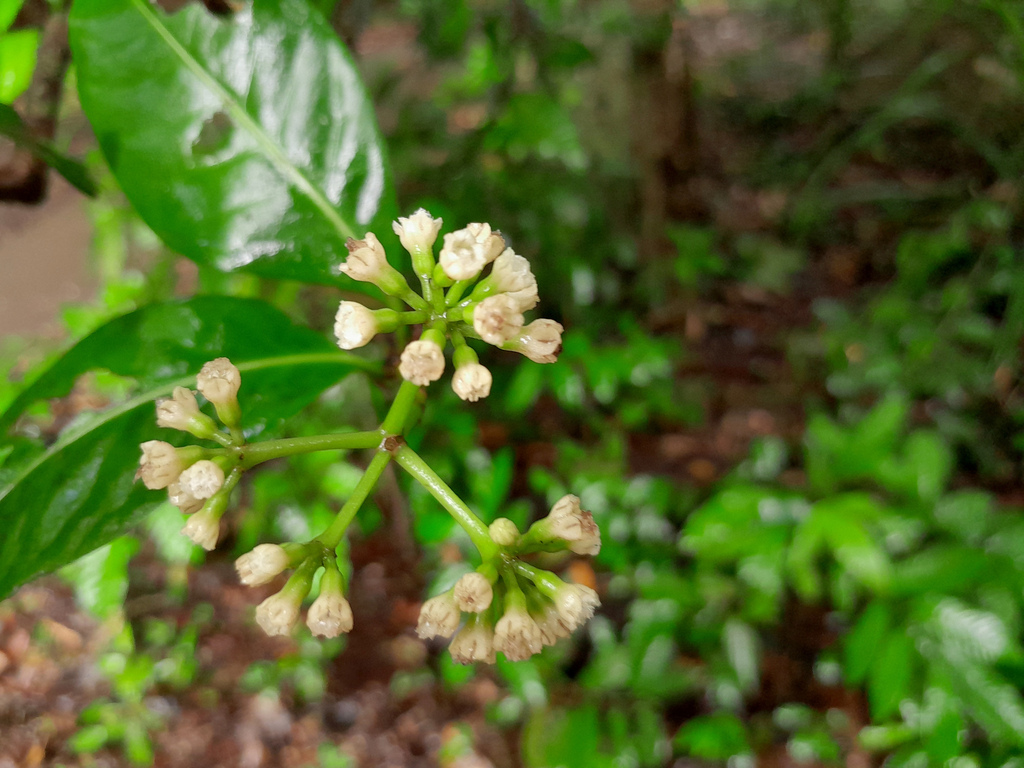
Birdlime Tree
Ceodes umbellifera
Ceodes umbellifera, synonym Pisonia umbellifera, commonly known as the birdlime tree or bird catcher tree, is a species of plant in the Nyctaginaceae family. The evergreen shrub has soft wood, small pink or yellow flowers, and produces cavate brown fruit throughout the period March to April. The species has been categorized under different genera in its documented lifetime, being reallocated between Pisonia and Ceodes. Its former genus, Pisonia, is named after a Dutch scientist, Willem Piso, and umbellifera is derived from Latin umbelliferum, denoting the species' big, 'shade-carrying' foliage.
The tree's fruit often trap insects, small mammals and birds. This is because the sticky sap of the fruit sticks to the skin, fur or feathers of the animal and renders it immovable. As such, ensnared creatures will often die from starvation or be unable to defend themselves from natural predators.
From the article Ceodes umbellifera on Wikipedia (CC BY-SA), quoted section by section
Description
Ceodes umbellifera is a shrub with large, medium green leaves. Other variegated varieties exist (Ceodes umbellifera 'Variegata') with marbling of white, light and dark green on the shrub's leaves. The tree's elliptic to ovate leaves may be between 6 and 20 cm long, and 4 to 10 cm wide. They are hairless and glossy with a papery texture. Each leaf has between 8 and 10 light lateral veins on each side, ‘without distinctly contrasting dark veins’. The petiole of each leaf is thick, between 0.5 and 5 cm long, and sometimes exstipulate. There are discrepancies between sources regarding the height of the shrub. Most state that Ceodes umbellifera will grow to between 4 and 12 metres. Some sources suggest the tallest known specimen is 20 metres tall, whilst another reports a height of 28 metres. Once mature, the tree has a spreading, rounded crown which may cover over 20 feet. In summer, the tree will start to bud and produce flowers. Before blooming, the buds of the flower stem form a complex, terminal inflorescence. Buds are around 6 cm in height, and have a pale brown, chickpea-like appearance. The inflorescence is either hairless, or has fine, silky hairs. Peduncles to the buds and flowers may be between 3.5 and 4 cm. These branch out at the apex, forming what botanist Debasmita Pramanick describes as ‘loose umbel[s] or contrated panicle[s]’ to spawn 3-8 flowers. …
Wikipedia: “Morphology”
Range & habitat
Ceodes umbellifera may be found in a diverse range of climates worldwide. The plant is native to Australia, Southern China, Thailand, Vietnam, Taiwan, Malaysia, Philippines, Indonesia, Hawaii and many Polynesian islands. It is also naturally occurring in some parts of Africa and Madagascar. In Australia, the species is found along the east coast in the states of New South Wales and Queensland, where it is 'widespread, but not common'. In NSW, it is found along the North Coast and Central Coast regions. It mostly grows in rainforests north of the Shoalhaven region. In Hawaii, Ceodes umbellifera is known as 'pāpala' or 'pāpala kēpau'. It is particularly endemic in the areas of Kauaʻi, Oʻahu, Lānaʻi and Maui, but has also been found on mainland Hawaii and Molokaʻi. In Hawaii, the species will be found in areas receiving "50-100 inches" of rainfall annually and in regions between "150-1999" feet above sea level.
Wikipedia: “Distribution”
What it does
The fruit of Ceodes umbellifera exude a sticky sap, which often sticks to wildlife passing by the tree. Small animals, such as birds, reptiles and insects are often trapped in the substance and starve to death. Largely it is seabirds, dwelling on off-shore islands, that die in the fruits of the shrub. However, there are some accounts of mainland birds becoming stuck. Scientists in the Goldsborough Valley, south of Cairns in Queensland, Australia, discovered a female Buff-breasted Paradise Kingfisher who was "completely immobilised, unable even to flap her wings". It is generally agreed that the tree's birdlime is an adaptation, enabling the tree to pollinate; pollen will adhere to a bird, and be deposited somewhere else, where a new plant may grow. However, some botanists suggest that the extreme stickiness may have evolutionary advantages outside of pollination. Since Ceodes umbellifera is widespread on tropical island rainforests, it is plausible that when the plant "traps and kills animals" it is "creating pockets of nutrients in the immediate soil environment for seedlings". …
Wikipedia: “Ecology”
In medicine
Studies state that there is not sufficient research on the chemical constitution of this genus. A 1996 study found that Ceodes umbellifera had six different saponins, with three of these being ‘new oleanolic acid saponins’. Secopisonic acid, pisodienone, pisoninol I and II have also been extracted from the plant. A 2018 study assessing anti-inflammatory and cytotoxic properties of Ceodes umbellifera discovered 12 new compounds in the plant's stem.
Wikipedia: “Phytochemistry”
In human culture
In Hawaii, the tree's leaves and bark are also used as a stable source of food for pigs. The adhesive sap from the fruit is also commonly used by indigenous Hawaiians. The sap may be made into a paste with soil and clay, and used to mend broken bowls. Red soil or other natural colours were used to adjust the colour of the birdlime to match the bowl or other implement. This mixture would then be used to join broken parts or fill holes, left to dry and then smoothed with a pumice stone. Additionally, it is used by indigenous men to catch birds, from which the feathers are plucked and used for traditional garments, called ‘ahu’ula. These garments consisted of netting to which feathers were attached. Certain coloured feathers denoted different social statuses. This is likely because of the rarity of certain coloured birds and their feathers, and the associated bird-hunting prowess required to catch them. The bird lime of papala kepau was used for these tasks when it was available during its fruiting months, but otherwise a small net was used to trap birds.
Wikipedia: “Culture”
Where it lives
Recorded sightings
—
geo-referenced records in GBIF, from museums, herbaria and field observers.
Drag the globe to turn it. Dots are where records exist, not a range map; darker means more records.
In the stacks
Searching the stacks…
Every page naming Ceodes umbellifera in the Biodiversity Heritage Library →
This page is assembled live from iNaturalist, GBIF, Wikipedia, the Source Library and the Internet Archive. It is not yet part of the hand-edited codex. iNaturalist taxon 1416645.