- Plants
- ›Vascular Plants
- ›flowering plants
- ›Dicots
- ›Heathers, Balsams, Primroses, and Allies
- ›symplocos family
- ›Symplocos
- ›Symplocos
- ›Barberina
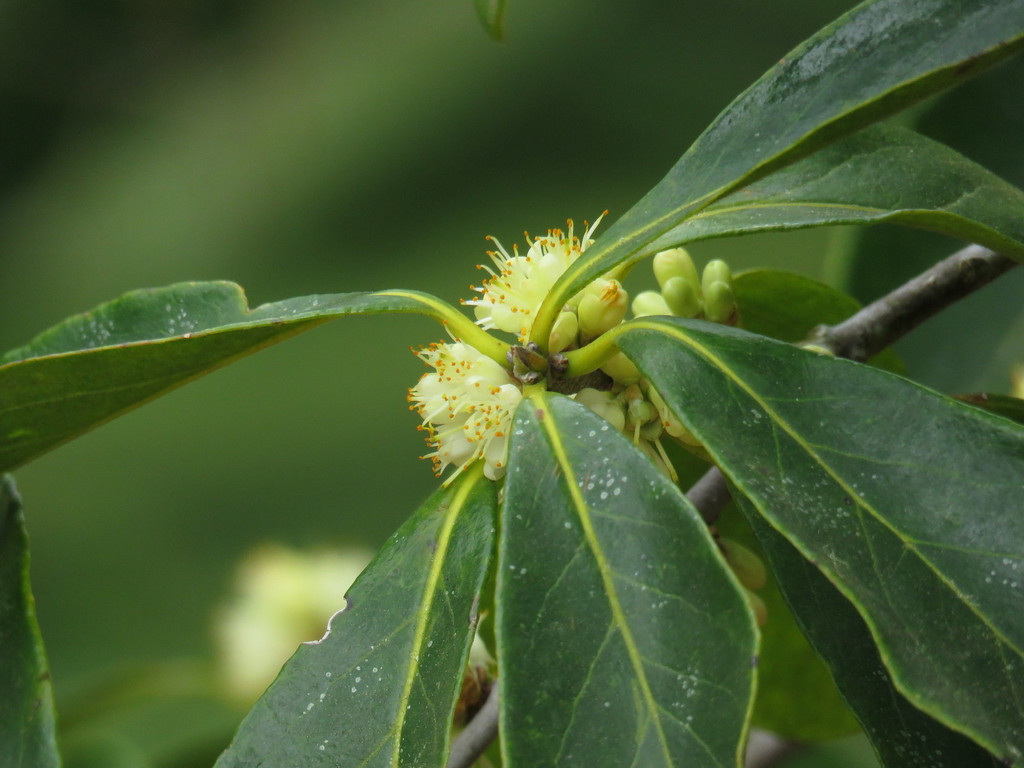
Sweetleaf
Symplocos tinctoria
Symplocos tinctoria (the common sweetleaf, horse-sugar, or yellowwood) is a deciduous or evergreen shrub or tree. It is recognized by pith of twigs chambered; by foliage not notably aromatic when bruised, leaves finely hairy beneath. Shrubs or trees to 17 m tall by 36 cm diameter at breast height. The largest first-year twigs are under 3 mm across, terminal buds with acute tip, scales ciliate. Leaves are 7–15 cm long, margin entire or occasionally some teeth on the apical half, with a sweet taste that may be faint in old leaves. It is conspicuous when in flower; flowers opening before new leaves develop, fragrant, in clusters from axils of previous year's leaves or from just above the leaf scars if the leaves have fallen; the petals are creamy yellow to yellow, with one pistil. Fruits nearly cylindrical to ellipsoid drupes 8–12 mm long, with thin pulp and a hard stone containing one seed; the tip usually retaining parts of the sepals. Foliage is relished by browsing wildlife. A yellow dye may be obtained from bark and leaves. It flowers March to May.
From the article Symplocos tinctoria on Wikipedia (CC BY-SA), quoted section by section
Range & habitat
Symplocos tinctoria is native to the southern and eastern United States, to an area from Oklahoma east to Florida and north to Maryland. Occasional, plants are often scattered; uncommonly grouped; thin to dense woods of slopes, bluffs, broad-leaf woods of sandy soils, stream borders and stable dunes. It is the only native representative of the genus in North America.
Wikipedia: “Distribution and habitat”
What it does
The foliage is relished by browsing wildlife. The branches are parasitised by galls of Exobasidium symploci that visually resemble fruits of the plant.
Wikipedia: “Ecology”
At the table
A yellow dye was once made from the bark and leaves. The bark was used as a tonic by early American settlers.
Wikipedia: “Uses”
Where it lives
Recorded sightings
—
geo-referenced records in GBIF, from museums, herbaria and field observers.
Drag the globe to turn it. Dots are where records exist, not a range map; darker means more records.
In the stacks
Searching the stacks…
Every page naming Symplocos tinctoria in the Biodiversity Heritage Library →
This page is assembled live from iNaturalist, GBIF, Wikipedia, the Source Library and the Internet Archive. It is not yet part of the hand-edited codex. iNaturalist taxon 141855.