- Plants
- ›Vascular Plants
- ›Ferns
- ›Leptosporangiate Ferns
- ›Polypod Ferns
- ›eupolypods II
- ›spleenwort family
- ›Asplenium
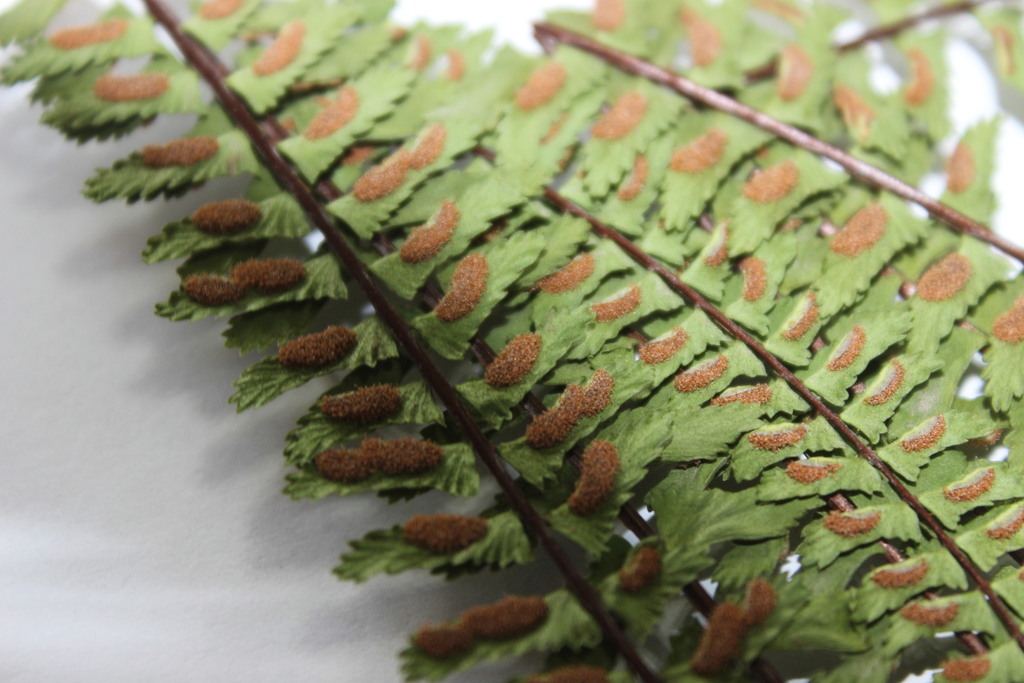
single-sorus spleenwort
Asplenium monanthes
Asplenium monanthes, the single-sorus spleenwort, is a fern native to parts of Africa, islands in the Atlantic, the Americas and Hawaii. It belongs to the family Aspleniaceae.
From the article Asplenium monanthes on Wikipedia (CC BY-SA), quoted section by section
Description
Here are key features of Asplenium monanthes:
The erect-standing leaves' rachises are reddish dark-brown/blackish throughout, shiny and hairless. The once pinnately-divided leaves usually are up to 60 cm (24 in) long, but mostly about half that, and up to around 3 cm (1 in) wide. The leaves' 10-45 pairs of subdivisions, or pinnae, are strongly asymmetric, somewhat trapezoidal, the leaf's middle ones up to 17 mm (5⁄8 in) long and 8 mm (5⁄16 in) wide, though typically smaller, with bases rounded to diminishing gradually to the attachment point. Pinna margins facing the leaf tip are toothed, while margins on the pinnae's lower side are toothless. A single sorus (rarely up to 3) occurs on each fertile pinna, always near the lower, toothless margin. Sori are slender to oval in outline, with a narrow, silvery scale or film of tissue, the "indusium," running along the pinna's lower margin. When the spore-producing sporangia are mature, they may hide the indusium. At some locations the above details still may not be enough to distinguish Asplenium monanthes from similar species in the area. An obscure feature possibly helping to confirm the identity is that sometimes along the length of the rachis, two very narrow, silvery, filmy "wings" can be observed, especially with magnification; these are barely visible in images on this page. …
Range & habitat
Asplenium monanthes displays a scattered distribution. In the United States, it occurs in the southern states of Arizona, North and South Carolina, Alabama and Florida, plus Hawaii. In the Caribbean, it inhabits the islands of Jamaica and Hispaniola. In Mexico it occurs nearly throughout, though not in the Yucatan Peninsula. In Central America, it is found in Guatemala, El Salvador, Honduras, Nicaragua, Costa Rica and Panama. In South America, it inhabits Colombia, Venezuela, Ecuador, Peru, Bolivia, Brazil, Uruguay and Argentina. In Africa, it is found in Cameroon, Rwanda, Sudan, Ethiopia, Somalia, Uganda, Kenya, Tanzania, Malawi, Zimbabwe, South Africa, Lesotho and Madagascar. The spleenwort also appears in the Azores, Madeira, Canary Islands, Bioko, Gough Island and Tristan da Cunha.
Wikipedia: “Distribution”
In medicine
In Mexico's Sonora state women of the Guarijio people take a "tea" of Asplenium monanthes to stop menstruation and as a contraceptive.
Wikipedia: “In traditional medicine”
In human culture
The genus name Asplenium is based on the Greek splen, meaning "spleen," because Dioscorides thought that a fern or ferns in the genus was useful for treating diseases of the spleen. In the common name "spleenwort," the -wort is from Old English wyrt, meaning "plant, root," thus "a plant for the spleen." The species name monanthes is based on the Greek monos, meaning "single, alone" and the Greek anthos, meaning "flower". In this case, an extended meaning of "flower" is conjured, that of "reproductive structure"—the fern's sorus. Thus, "a single sorus," aptly describing the single-sorus spleenwort.
== References ==
Wikipedia: “Etymology”
Where it lives
Recorded sightings
—
geo-referenced records in GBIF, from museums, herbaria and field observers.
Drag the globe to turn it. Dots are where records exist, not a range map; darker means more records.
In the stacks
Searching the stacks…
Every page naming Asplenium monanthes in the Biodiversity Heritage Library →
This page is assembled live from iNaturalist, GBIF, Wikipedia, the Source Library and the Internet Archive. It is not yet part of the hand-edited codex. iNaturalist taxon 142833.