- Animals
- ›Arthropods
- ›Crustaceans
- ›Typical Crustaceans
- ›Malacostracans
- ›Decapods, Isopods, and allies
- ›Decapods and Krill
- ›Decapods
- ›Crabs, Lobsters, Shrimps, and Allies
- ›True Crabs
- ›Eubrachyuran Crabs
- ›Thoracotrematan Crabs
- ›Shore and marsh crabs
- ›Sesarmid Marsh Crabs
- ›Episesarma
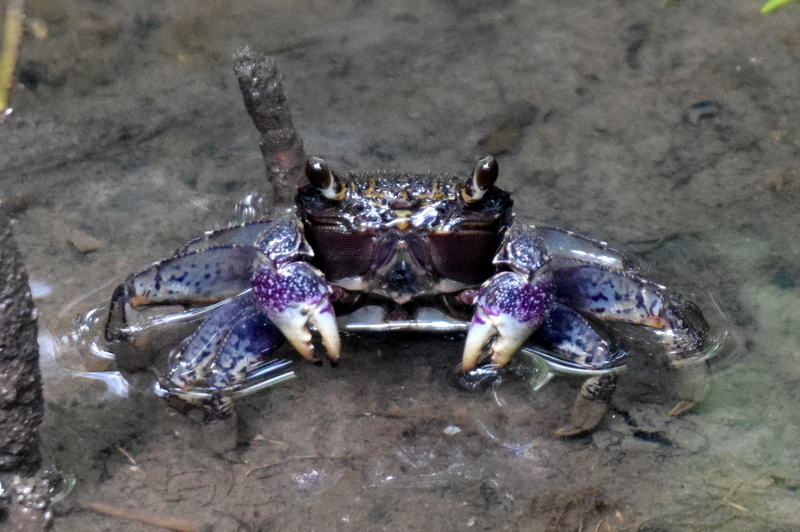
Violet Vinegar Crab
Episesarma versicolor
The violet vinegar crab (Episesarma versicolor) is a swimming crab species in the genus Episesarma. Distributed all over marine and brackish waters of Indo-West Pacific regions. It is harvested by many local fishermen for rich proteinaceous food.
From the article Episesarma versicolor on Wikipedia (CC BY-SA), quoted section by section
Description
The genus Episesarma comprises some of the largest sesarmid crabs. E. versicolor is distinguished by its white tipped violet chela (claw). Males grow up to a maximum length of 5 cm. The carapace is square-shaped and relatively flat, colored brown to brownish grey. The first gonopod of male E. versicolor has a narrower, shorter tip compared to other members of the genus. The dorsal portion of the dactylus possess 65-80 densely packed projections called tubercles These bony spine-like structures are more pronounced in males and, as seen in other crab species with tubercles, seem to be stridulatory organs for generating sound.
Range & habitat
A mangrove inhabitant, it is found all over Southeast Asian countries such as Southern China, Hong Kong, Indonesia, Malaysia, Philippines, Singapore, Thailand, northern Australia and South Asian countries like Bangladesh, India and Sri Lanka. They also seem to possess an estimate of around 40 bony spine-like structures called tubercles. These are more pronounced in males and these tubercles like in other crab species that have them seemingly represent stridulatory organs used to create sound.
Wikipedia: “Distribution”
What it does
Like most crabs they possess both male and female sexes. A ritual is generally performed utilizing both olfactory and tactile cues followed by an indirect sperm transfer.
Wikipedia: “Reproduction”
Where it lives
Recorded sightings
—
geo-referenced records in GBIF, from museums, herbaria and field observers.
Drag the globe to turn it. Dots are where records exist, not a range map; darker means more records.
In the stacks
Searching the stacks…
Every page naming Episesarma versicolor in the Biodiversity Heritage Library →
This page is assembled live from iNaturalist, GBIF, Wikipedia, the Source Library and the Internet Archive. It is not yet part of the hand-edited codex. iNaturalist taxon 143091.